c. 130 – 202 (chief work written c. 180) · 2nd century
Irenaeus of Lyons and his work Against Heresies
Irenaeus was a native of Asia Minor and in his early youth saw Polycarp of Smyrna (Against Heresies 3.3.4). He became a presbyter in Lyons, and after the martyrdom of Bishop Pothinus in 177 he took over his see.
Provoked by an encounter with the Gnostic Marcosians, he wrote Against Heresies – his main work against Gnosticism – and the Demonstration of the Apostolic Preaching. Against the secret traditions of the Gnostics he put forward open apostolic tradition, the "rule of truth," the canon of four Gospels and the succession of bishops from the apostles, citing the list of the bishops of Rome as an example (Against Heresies 1.9.4; 3.3.3; 3.11.8). Central to his theology was the teaching of the recapitulation of Christ as the "second Adam."
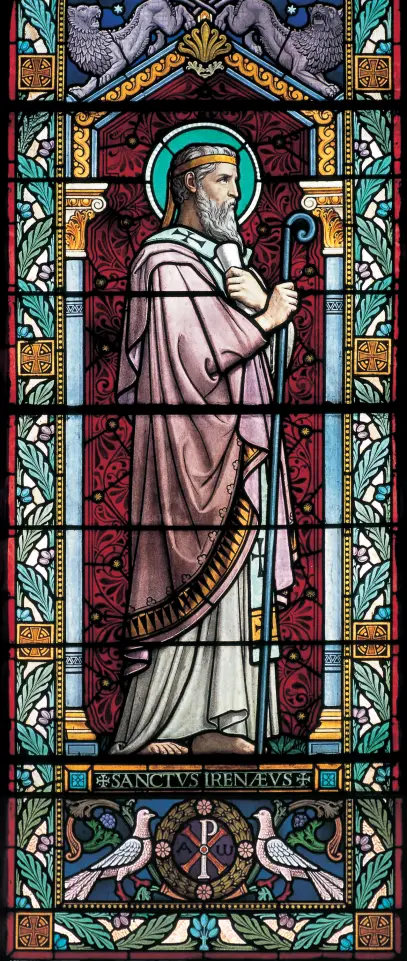
Key points
- Against Heresies: his main work against Gnosticism, prompted by a dispute with the Marcosians
- The "rule of truth" and the canon of "four and only four" Gospels (Against Heresies 1.9.4; 3.11.8)
- Apostolic succession of bishops; the list of the bishops of Rome (Against Heresies 3.3.3)
- Took the see of Lyons after the death of Bishop Pothinus in 177
- Shelley: against the Gnostics’ secret tradition the catholics offered the rule of faith and episcopal succession (Hegesippus, Irenaeus, Tertullian).
- Roetzel: against Marcion Irenaeus invoked 1 Cor. 8:6 (one God) and Rom. 10:4 (Christ as the 'fulfilment', not the 'end' of the law); thus he transformed Paul, the apostle to the Gentiles, into the 'ecclesiastical Paul' who defended the church from doctrinal error.
- Morgan: Irenaeus made Paul central to orthodoxy: the Adam–Christ typology affirms the unity of creation and redemption, 'recapitulation' comes from Eph. 1:10.
- Gunton: Irenaeus, a “theologian of crisis”, affirmed the common createdness of spirit and matter against Gnostics, an early proponent of creation from nothing.
People
- Irenaeus of Lyons
- Polycarp of Smyrna
- Pothinus of Lyon
- Victor of Rome
Place
Smyrna; Lyon (Gaul)
Sources disagree
Irenaeus' death date (202) rests on only one tradition; Against Heresies is dated by the books anywhere from 177–180 to "the late 2nd century."
Sources
Primary sources
- Irenaeus of Lyons – Against Heresies, bk. I, ch. 9; bk. III, ch. 3, 11
Textbooks
- Justo L. González – The Story of Christianity, vol. I (Russian edition), sec. «Ириней Лионский»
- Justo L. González – A History of Christian Thought in One Volume (Abingdon, 2014), p. 66–72
- Louis Berkhof – History of Christian Doctrines (Russian edition), p. 40–45, 119–121
- Alister McGrath – Reformation Thought (Russian edition: «Theological Thought of the Reformation»), p. 199–200
- Stuart G. Hall – Doctrine and Practice in the Early Church (Russian edition), p. 19, 27, 30, 40–46
- Jaroslav Pelikan – The Christian Tradition: A History of the Development of Doctrine, vol. 1 (Russian edition), p. 126–139, 141
- Tony Lane – Christian Thinkers (Russian edition), p. 18–20
- J. North – A History of the Church (Russian edition), p. 39–41
- Bruce L. Shelley – Church History in Plain Language (Russian edition), Ch. 7, sec. «Предводители для церквей»
- The Cambridge Companion to St Paul, ed. James D. G. Dunn (2003), p. 247, 251, 259
- The Cambridge Companion to Christian Doctrine, ed. Colin E. Gunton (1997), p. 35
More on the doctrine
- Irenaeus against the Gnostics: Open Apostolic Tradition, the Rule of Faith and the Four Gospels (c. 180)
- Irenaeus: recapitulation – Christ as the new Adam (c. 180)
- Irenaeus: the apostolic succession of bishops against the Gnostics (c. 180)
Data compiled: 2026-11-09