16th–17th centuries · 16th century
Original Sin in the Confessional Age: Trent, Flacius, Baius, the Socinians and the Eastern Confessions
The fifth session of the Council of Trent affirmed the reality and transmission of original sin but condemned the view that in baptism sin is merely "covered or not imputed": the baptized become "innocent, immaculate, pure", and only an "inclination to sin" remains in them. In Lutheranism Flacius asserted that original sin is not an accident but the very substance of fallen humanity and that "our substance is sin"; the Formula of Concord condemned this as a Manichaean error (Epitome I.19). In Louvain Baius taught that through the fall something of nature itself was lost, and was condemned by Rome (1567, 1579). The Socinians, according to Berkhof, revived Pelagianism, while the Eastern confessions of the 17th century, opposing the Augustinian West, spoke of "ancestral sin" but insisted on free will and rejected double predestination.
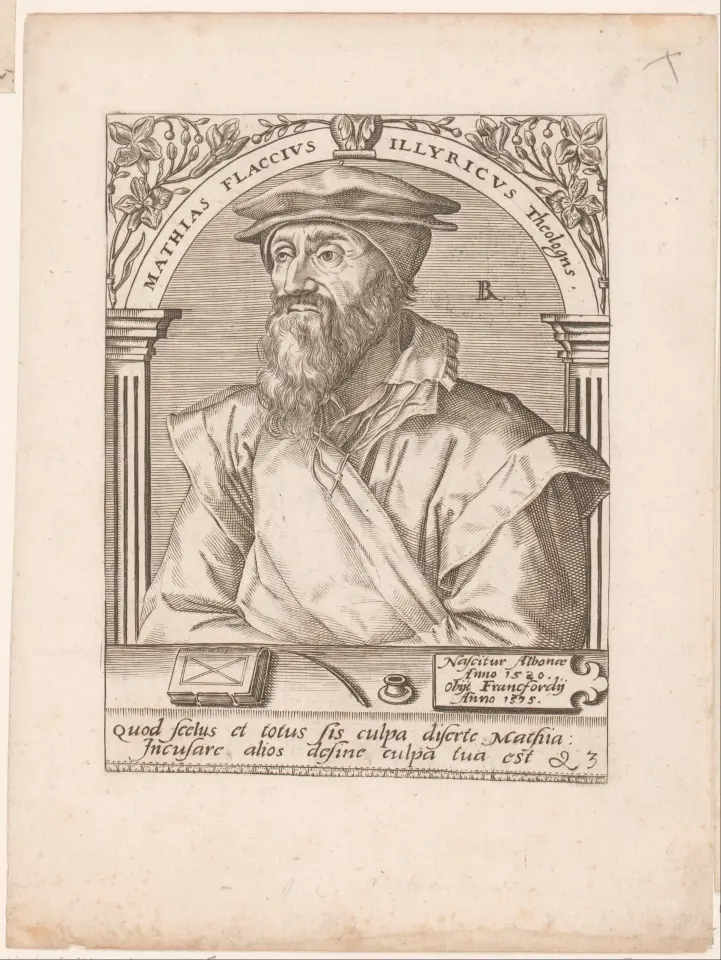
Positions
- The Council of Trent
- The baptized become guiltless; only an inclination to sin remains; those who deny infant baptism are condemned
- Flacius
- Original sin is the substance of fallen humanity; original righteousness, free will and the image of God are lost, and the image of Satan is now in us
- The Formula of Concord
- Human nature and original sin are distinct; "no one but God alone can separate the corruption of our nature from the nature itself"; the opposite extreme – a slight corruption of nature – is also condemned
- Baius (the Louvain faculty) and Lessius
- Baius: the distorted will cannot will the good; God determines the act of the will in conversion; Lessius: the will determines itself, help is given to all
- The Socinians (according to Berkhof)
- The image of God is only dominion over creatures; people die because they were created mortal; there is no inclination to sin, only bad examples
- The Eastern confessions of the 17th century
- "Ancestral sin" is passed on to descendants and forgiven in baptism; a person is free to choose between good and evil even before grace; God is the cause only of good
Key points
- The decree on original sin is the preface to the Tridentine decree on justification
- Flacius was accused of denying Luther’s simul iustus et peccator and of closeness to Manichaeism
- Flacius refused to recant and died in exile; even the strict Lutherans stopped supporting him
- The Louvain faculty accused Lessius of Pelagianism, and he accused it of Calvinism
- A commission of cardinals under Sixtus V found no errors in Lessius, but the disputants were ordered to refrain from attacks
- The Socinians: God is a kind Father ready to forgive the penitent; a Savior is not needed, Christ's teaching and example are merely useful
- The Eastern confessions: a theology that denies freedom amounts to asserting that nature is evil; double predestination is incompatible with God's goodness
- Kolb: for Luther original sin is the failure to fear, love and trust God above all things. Flacius answered Viktorin Strigel's definition of original sin as an “accident” by calling it the formal “substance” of the fallen sinner: the sinner's material “substance” remains human, but to be human means above all to love and trust God, and when knowledge of God is displaced by faith in a false source of life, sinners exist “in the image of Satan” and are in essence sin. The Formula of Concord rejected the equation of the fallen human's essence with sin itself: in Aristotelian terms sin is an “accident” that corrupted nature and destroyed the relationship with God but is forgiven through Christ
Outcome
Catholic teaching on original sin was fixed against Protestant "non-imputation"; the Formula of Concord rejected Flacius's thesis as Manichaean; Baius was condemned; the Eastern confessions affirmed both the inheritance of sin and free will.
People
- Matthias Flacius
- Victorinus Strigel
- Michael Baius
- Lessius
- Pius V
- Gregory XIII
- Sixtus V
Terms
- original sin as substance
- Flacius's claim that sin is the very essence of fallen humanity, the "chief and best part" of its being.
- ancestral sin – to propatorikon hamartema
- Adam's sin, passed on to his descendants.
Place
Trent, Jena, Louvain
Sources disagree
González does not give the year of the fifth session (the council – 1545–1563); Flacius's disputation with Strigel – 1560, the Formula of Concord – 1577; the condemnations of Baius – 1567 and 1579; the Socinians – 16th–17th centuries (Berkhof, undated); the Eastern confessions – 17th century (Pelikan).
Sources
Primary sources
- Formula of Concord, pt. 1, art. 1
Textbooks
- Jaroslav Pelikan – The Christian Tradition, vol. 2: The Spirit of Eastern Christendom (600–1700) (Russian edition), p. 446–448
- Louis Berkhof – History of Christian Doctrines (Russian edition), p. 107–108
- Justo L. González – A History of Christian Thought, vol. III: From the Protestant Reformation to the Twentieth Century (Abingdon, rev. ed. 1987), p. 126–128, 229, 243–244
- The Cambridge Companion to Reformation Theology, ed. David Bagchi, David C. Steinmetz (2004), p. 86
Related entries
- Response to: The Reformers on Original Sin and Total Depravity: Luther and Calvin (1517–1559)
- Developed in: The Tridentine Decree on Justification and the Anathemas against Protestant Teaching (1547)
Data compiled: 2026-11-17