1517–1559 · 16th century
The Reformers on Original Sin and Total Depravity: Luther and Calvin
Already in the Disputation against Scholastic Theology (1517) Luther wrote that a human being, like a bad tree, can only will evil, and that virtue without grace is sin. To be a sinner, for Luther, means to have one's whole nature permeated by sin; "flesh" in Paul is the whole person craving self-justification; the will retains only an absolutely passive capacity to be turned toward God by His Word. Calvin in the Institutes (2.1.8) defined original sin as "a hereditary depravity and corruption of our nature, diffused into all parts of the soul"; nature in itself is good, but the supernatural gifts were lost and reason and will corrupted. According to Berkhof, the Reformers, against the Catholic understanding of original sin as the absence of original justice, taught hereditary corruption and guilt, but allowed for civil righteousness.
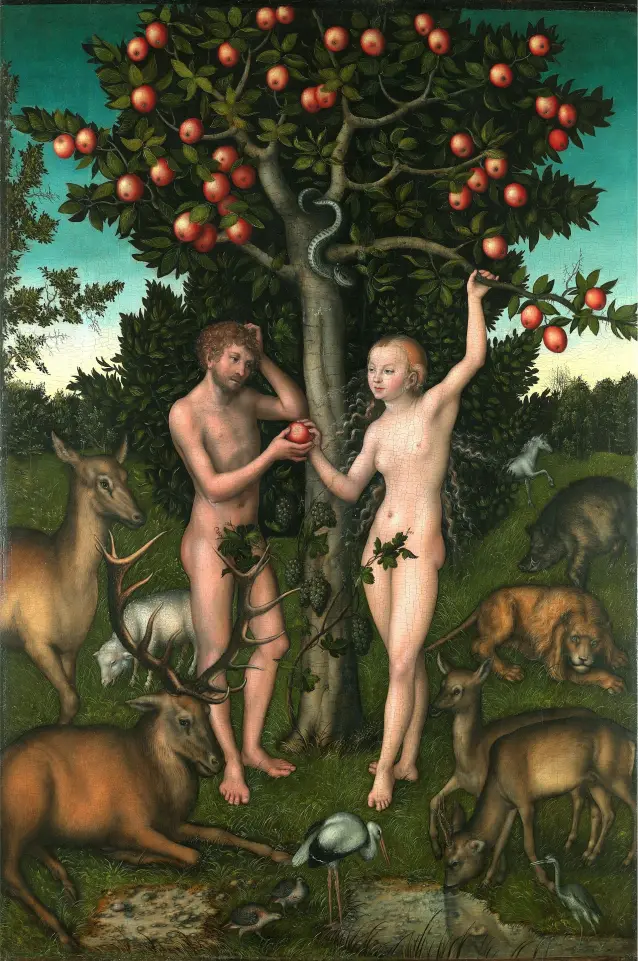
Positions
- Roman Catholics, the "papist theologians" (according to Berkhof and Luther)
- Original sin is the absence of original justice; sin is anything said, done or thought against the law of God
- Luther
- Sin is all that is born of father and mother before any action; the will is not coerced but so steeped in sin that it freely chooses evil, like a beast between two riders – God and the devil
- Calvin
- Adam's sin is above all unbelief (Institutes 2.1.4); not only guilt but sin itself is transmitted; the virtues of the pagans are "splendid vices"; the first motions of desire are actual sins
- Zwingli, the later Melanchthon (according to Berkhof)
- Zwingli regarded original sin rather as a disease; Melanchthon, at first in agreement with Luther, later changed his view
Key points
- Luther: “we do not become righteous by doing righteous deeds, but having been made righteous we do righteous deeds”
- Luther: sin is inexhaustible, no one can know all their sins
- Calvin: reason retained a striving for truth and a knowledge of social order, but in “heavenly things” the keenest minds are “blinder than moles” (Institutes 2.2.13, 18)
- Calvin, after Augustine: the will is like a horse, with God and the devil as riders; if the devil has seized the saddle, he drives it into ditches and over precipices (Institutes 2.4.1)
- Calvin: the soul is the “nobler part”, immortal but created out of nothing (against Servetus, who held it a particle of the divine substance) (Institutes 1.15.2, 5)
- Calvin: demons are evil not by nature but by their corruption (Institutes 1.14.16)
- Berkhof: Beza stressed that Adam is the natural head and federal representative; the Reformers taught total but not “absolute” depravity, and Calvin pointed to common grace
- Hendrix: answering Latomus, Luther distinguished grace (mercy that forgives sin) from God’s righteousness (the gift of faith that gradually heals the believer): ‘Everything is forgiven through grace, but as yet not everything is healed’; believers are simul iusti et peccatores, yet healing is under way. ‘This life is not godliness but the process of becoming godly, not health but getting well, not being but becoming.’
- Packull: early Swiss Anabaptists held children innocent until they sin knowingly; Hubmaier taught a damaged will (“semi-Augustinianism”).
Outcome
The teaching of a hereditary corruption embracing reason and will, while the goodness of nature as creation is retained, became a distinctive mark of Protestant anthropology.
People
- Martin Luther
- John Calvin
- Huldrych Zwingli
- Philip Melanchthon
- Theodore Beza
- Michael Servetus
- Jakob Latomus
Terms
- flesh
- For Luther, the whole person craving self-justification, not the bodily: "our trouble is not that the flesh tempts us, but that we are flesh".
- natural depravity
- For Calvin, not the order of originally created nature but a corruption introduced by sin.
- image of God – imago Dei
- For Calvin, belongs above all to the soul; the distinction of "image" and "likeness" is rejected as Hebrew parallelism; after the fall what remains is a "frightful deformity".
Place
Wittenberg, Geneva
Sources disagree
The 97 Theses – 1517 (González, from context); Luther's teaching – 1517–1546 (González, HCT); the Institutes – 1536–1559, final edition – 1559; Berkhof: "the Reformation period".
Sources
Primary sources
- Calvin – Institutes of the Christian Religion, bk. I, ch. 14, sec. 16; ch. 15, sec. 2, 5; bk. II, ch. 1, sec. 4, 8; ch. 2, sec. 13, 18; ch. 4, sec. 1
Textbooks
- Louis Berkhof – History of Christian Doctrines (Russian edition), p. 106–107
- Justo L. González – A History of Christian Thought in One Volume (Abingdon, 2014), p. 290–291, 313
- Justo L. González – A History of Christian Thought, vol. III: From the Protestant Reformation to the Twentieth Century (Abingdon, rev. ed. 1987), p. 35–37, 54–56, 143–144, 146–148
- The Cambridge Companion to Reformation Theology, ed. David Bagchi, David C. Steinmetz (2004), p. 61, 213–216
Related entries
- Developed in: Adam's Federal Headship and New England Theology: from Cocceius to Edwards and Finney (16th – mid-19th century)
- Develops: Original Sin and Free Will: Augustine against Pelagius, Celestius and Julian of Eclanum (409–430)
- Rejects: Medieval Anthropology: Boethius, Gregory the Great, Eriugena, Anselm and Original Righteousness as a Supernatural Gift (6th–13th centuries)
- Developed in: The Controversy over Free Will: Erasmus against Luther and Zwingli (On Free Will, The Bondage of the Will) (1524–1525)
- Answered by: Original Sin in the Confessional Age: Trent, Flacius, Baius, the Socinians and the Eastern Confessions (16th–17th centuries)
Data compiled: 2026-11-17