16th–20th centuries · 16th century
Creation, Science and Evolution: from the Scientific Revolution to Tennant, Teilhard de Chardin and Ramm
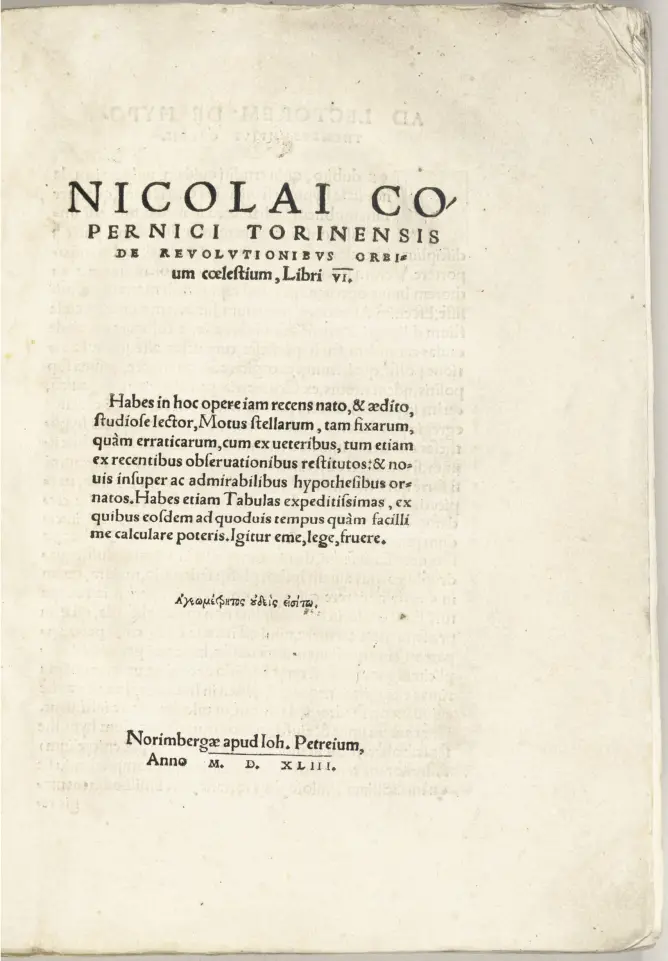
Copernicus's discoveries destroyed the three-tiered medieval picture of the world, and the culmination of the scientific revolution was Newton's universe as an orderly mechanism subject to laws; humanity ceased to be the center of creation. Lane distinguishes three responses of theologians to Darwin's theory: to reject it, to adapt it to traditional theology, or to reinterpret theology in the light of evolution. Tennant understood the impulses inherited from animals as merely the "material" of sin, and sin itself as an act of the will against conscience. Pierre Teilhard de Chardin saw all reality evolving according to the "law of complexity-consciousness" toward the "Omega point" – Christ; for him sin and evil are an inevitable imperfection and by-product of evolution. Bernard Ramm (1954) denied any contradiction between true science and the Bible and preferred to speak of "progressive creation".
Positions
- Tennant
- Humanity gradually became an ethical being; the sole cause of sin is the irresolute will; as the race develops the horror of sin increases; the universality of sin is acknowledged
- Teilhard de Chardin
- Evolution is a universal law directed by purposiveness, not chance; cosmogenesis is "Christogenesis"; evolution and perfection are incompatible, like a "square circle"
- Ramm
- There is no contradiction between true science and the Bible; an ancient history of the earth and "theistic evolution" are admissible; Genesis 1–3 is theological teaching in narrative form
- Critics
- Berkhof: Tennant does not explain how such a will is possible in a being subject to the law of evolution; Lane: Teilhard gives too much room to evolutionary thought; fundamentalists found Ramm's approach accommodationist, liberals found it inconsistent
Key points
- The Aristotelian emphasis on purpose (telos) gave way to Galileo's quantitative, mathematical view; Newton himself saw science as a way to grasp the greatness of God
- Tennant defines sin as the activity of the will against conscience, knowledge of the law and the will of God (the Hulsean Lectures, The Origin and Propagation of Sin)
- Teilhard was ordered not to publish his writings; The Phenomenon of Man was finished in 1938 and, like his other works, published after his death in 1955
- Lane: Teilhard is comparable to Origen – a pioneer whose ideas proved unacceptable
- Huxley wrote that a theologian would find Teilhard’s treatment of sin and suffering inadequate
- Ramm: Adam is both an abstract person and the progenitor of the race; in Offense to Reason (1985) the first chapters of Genesis are called an inspired attempt to reconstruct events
Outcome
The evolutionary picture of the world raised the question of the origin of sin and the meaning of the creation narrative; Teilhard's posthumously published works were received with enthusiasm and influenced theologies that reject dualism and stress eschatology.
People
- Copernicus
- Galileo Galilei
- Isaac Newton
- Tennant
- Pierre Teilhard de Chardin
- Julian Huxley
- Bernard Ramm
Terms
- law of complexity-consciousness
- For Teilhard, the increasing complexity, centralization and consciousness of matter; the geosphere develops into the biosphere, then into the noosphere.
- Omega point – omega point
- The final goal and constant reference point of evolution, in which humanity is united – Jesus Christ, homo futurus.
- progressive creation
- The expression Ramm preferred to "theistic evolution".
Place
China, Paris, New York
Sources disagree
The scientific revolution – 16th–18th centuries (Grenz and Olson: Galileo – 1564–1642, Newton – 1642–1727; the year of Copernicus's discovery is not given); Berkhof does not date Tennant's lectures (20th century); Teilhard's articles – from 1916 (González), his works published 1955–1959 (Lane); Ramm's book – 1954.
Sources
- Louis Berkhof – History of Christian Doctrines (Russian edition), p. 117
- Justo L. González – A History of Christian Thought, vol. III: From the Protestant Reformation to the Twentieth Century (Abingdon, rev. ed. 1987), p. 470, 472–473
- Tony Lane – Christian Thinkers (Russian edition), p. 301–303
- Stanley Grenz, Roger Olson – 20th-Century Theology: God and the World in a Transitional Age (Russian edition), p. 14–20, 194–196, 462–465
Related entries
- Developed in: Teilhard de Chardin: evolution, the "Omega Point" and the eschatology of process theology (1938–1955)
In church history
- The Galileo Affair and the Condemnation of Heliocentrism (1616–1630s)
- Darwin's Origin of Species and theologians' response (1859 and 1871)
Data compiled: 2026-11-17