1547 · 16th century
The Tridentine Decree on Justification and the Anathemas against Protestant Teaching
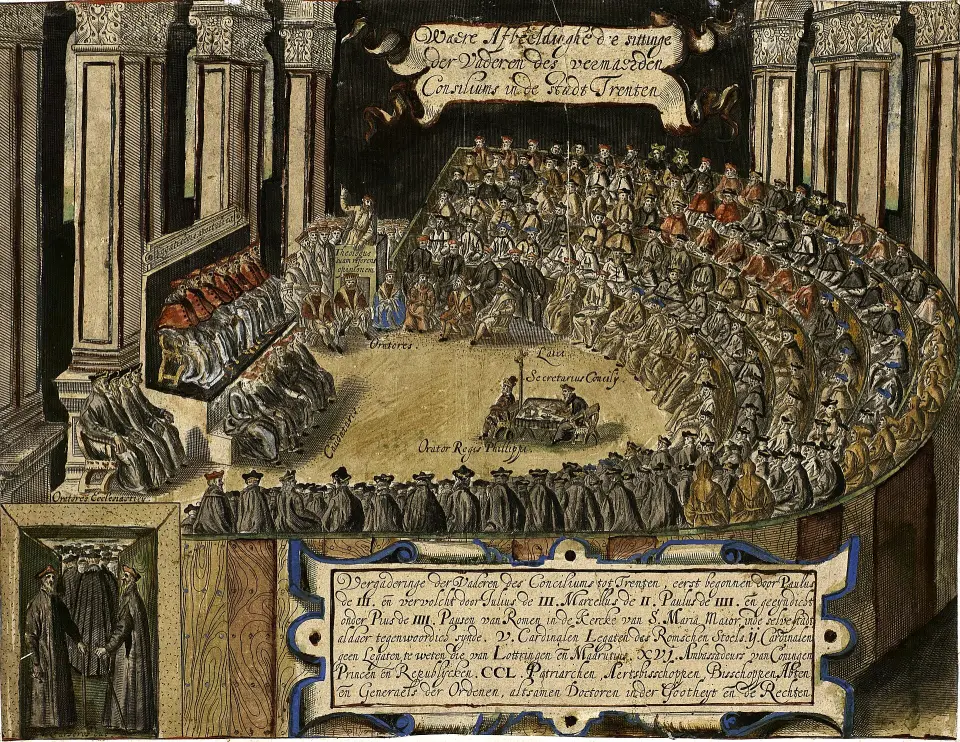
The sixth session of the Council of Trent ended on 13 January 1547 with a decree on justification of sixteen chapters and thirty-three canons; González calls it the heart of the council's theological work. Justification begins with prevenient grace, independently of merits, but free will must then accept or reject the salvation offered. Justification itself is "not only the remission of sins, but also the sanctification and renewal of the inner man": God does not merely impute the righteousness of Christ but, with the cooperation of free will, actually makes the believer righteous. The council named as the single formal cause of justification the righteousness of God by which God makes us righteous, and thereby rejected the Regensburg compromise of two causes (1541). The council also rejected the reformers' teaching on assurance of salvation.
Positions
- Luther (later), Melanchthon, Calvin
- Justification is a declaration of righteousness; the justifying righteousness of Christ is external, "alien" and imputed; renewal is called sanctification; assurance of salvation is possible, grounded in God's faithfulness to His promises
- The Regensburg proposal (1541)
- Two causes of justification – external and internal righteousness; Melanchthon and Calvin supported the agreement
- The Council of Trent
- Justification includes the remission of sins, sanctification and the renewal of the inner man; the single formal cause is the inner gift of righteousness; no one can know with the infallible certainty of faith whether they have received grace
Key points
- Trent: the order of justification of adults – grace, faith from hearing, fear, hope, love, hatred of sin, repentance, baptism
- Trent: faith is “the beginning of human salvation, the foundation and root of all justification” (ch. 8)
- Trent: justification is an objective reality and grows through good works (ch. 10); simul iustus et peccator is rejected (ch. 11)
- Trent: one cannot know one’s own predestination without a special revelation (ch. 12)
- Trent: baptism is the first justification; one who falls after baptism is restored by the sacrament of penance (ch. 14)
- Trent: mortal sin takes away grace but not faith (ch. 15); eternal life is both grace and a reward for merits (ch. 16)
- Canons 9, 11, 12, 17, 18, 25, 30 and 31 condemn justification by faith alone or by imputation alone, and faith as confidence in God’s mercy
- The same canons condemn predestination to evil and the idea that the righteous sin in every good work
- Bellarmine later argued that the Fathers and Bernard, when saying "faith alone justifies", meant a living faith joined with love
- Bagchi: pre-Trent Catholic polemicists, Erasmus and Eck included, saw themselves on a middle path between Manichaeism and Pelagius: all agreed that grace does not remove human moral responsibility, neither at the start of salvation nor in perseverance to the end. They charged Protestants with licence (Cochlaeus: the Peasants’ War; Witzel: morals in Protestant lands); safer to see the soul as a viator, a wayfarer.
- Steinmetz: in Catholic theology justification is a slow transformation of the sinner by grace; Luther brought it forward and set it apart from sanctification. The “double righteousness” formula (Regensburg, 1541) came from Gropper and Bucer; Luther and Rome rejected it, and Trent Seripando’s proposal. In Trent’s teaching the justified life begins with baptism, which removes the guilt and punishment of sin and brings one into a state of grace; concupiscence remains in the soul not as sin itself but as the ‘tinder of sin’, an inclination to be resisted with the help of grace. Sinners are righteous as far as grace has transformed them, a long process, and there is no room for imputed righteousness: Trent’s doctrine of justification is a doctrine of real transformation by divine grace.
- Shelley: Trent rejected compromise and defined justification by two causes: external righteousness and an inner one infused in the believer. Protestant external righteousness is an event, Catholic internal a process: for Trent one becomes righteous gradually, and “declaring” is a “chimera”. Luther, Calvin and Grebel insisted on salvation by grace alone; Trent on grace and human cooperation.
Outcome
Catholic teaching on justification as inner renewal was defined in opposition to Luther's imputation; according to González, the canons were decisive for the final parting of the ways, although some anathemas are aimed at the opinions of individual reformers or at caricatures. McGrath regards the dispute as partly a misunderstanding arising from different meanings of the word "justification"; Lane cites Hans Küng's view that there is no irreconcilable enmity here.
People
- Paul III
- Martin Luther
- Philip Melanchthon
- John Calvin
- Martin Bucer
- Robert Bellarmine
- Bernard of Clairvaux
- Hans Küng
Terms
- prevenient grace
- Grace that precedes turning to God and is given independently of any merits. For Arminius and Wesley, grace given to all that makes people able to receive the grace of faith, but not irresistible.
- formal cause
- The direct, most immediate cause of justification; distinct from the efficient cause (God) and the meritorious cause (Christ).
- temporal punishment
- The punishment for sin that remains after the eternal punishment is remitted; discharged by fasting, good works, penance, indulgences and purgatory.
Place
Trent, Regensburg
Sources disagree
The decree – 13 January 1547 (McGrath; González: January 1547); the council as a whole – 1545–1563 (González, HCT); the Regensburg colloquy – 1541; Bellarmine's Disputations – 1586–1593.
Sources
- Justo L. González – A History of Christian Thought in One Volume (Abingdon, 2014), p. 345, 347–350
- Justo L. González – A History of Christian Thought, vol. III: From the Protestant Reformation to the Twentieth Century (Abingdon, rev. ed. 1987), p. 244–247
- Alister McGrath – Reformation Thought (Russian edition: «Theological Thought of the Reformation»), p. 167–174
- Tony Lane – Christian Thinkers (Russian edition), p. 173, 218–219, 222–223
- The Cambridge Companion to Reformation Theology, ed. David Bagchi, David C. Steinmetz (2004), p. 240, 250–251, 251–252, 252
- Bruce L. Shelley – Church History in Plain Language (Russian edition), Ch. 28, sec. «Облик современного католичества»
Related entries
- Response to: Luther: The Discovery of the "Righteousness of God" and Justification by Faith Alone (c. 1515 (1513–1521))
- Rejects: Justification in Protestantism after Luther: Zwingli, Melanchthon's Forensic Justification, Bucer's Double Justification (1520–1571)
- Develops: Original Sin in the Confessional Age: Trent, Flacius, Baius, the Socinians and the Eastern Confessions (16th–17th centuries)
- Developed in: Catholic Controversies on Grace after Trent: Baius, Báñez, Molina and the De Auxiliis Controversy (1567–1606)
In church history
- The Council of Trent (1545–1563)
Data compiled: 2026-11-17