1536–1563 · 16th century
Calvin and the Reformed doctrine of the sacraments: sign and seal, spiritual presence
Calvin defined a sacrament as an outward sign by which the Lord seals on the conscience the promises of His good will to sustain weak faith (Institutes 4.14.1); against Zwingli and the Anabaptists he affirmed the efficacy of the sacraments by the power of the Spirit, against Rome the distinction between the "figure" and the "truth." Sign and thing signified are distinct but inseparable ("distinctio sed non separatio"): receiving the sign of the body, the believer receives the body itself. The body of Christ is not locally present – it is in heaven, but by the power ("virtue") of the Spirit the believer is united with it; this is called "virtualism." According to González, Calvin's teaching took shape as a mediating position marked by Bucer's influence; in 1549 Calvin and Bullinger reached the Zurich Consensus, which the Lutherans did not accept, and the Heidelberg Catechism (1563) expressed this teaching in catechetical form.
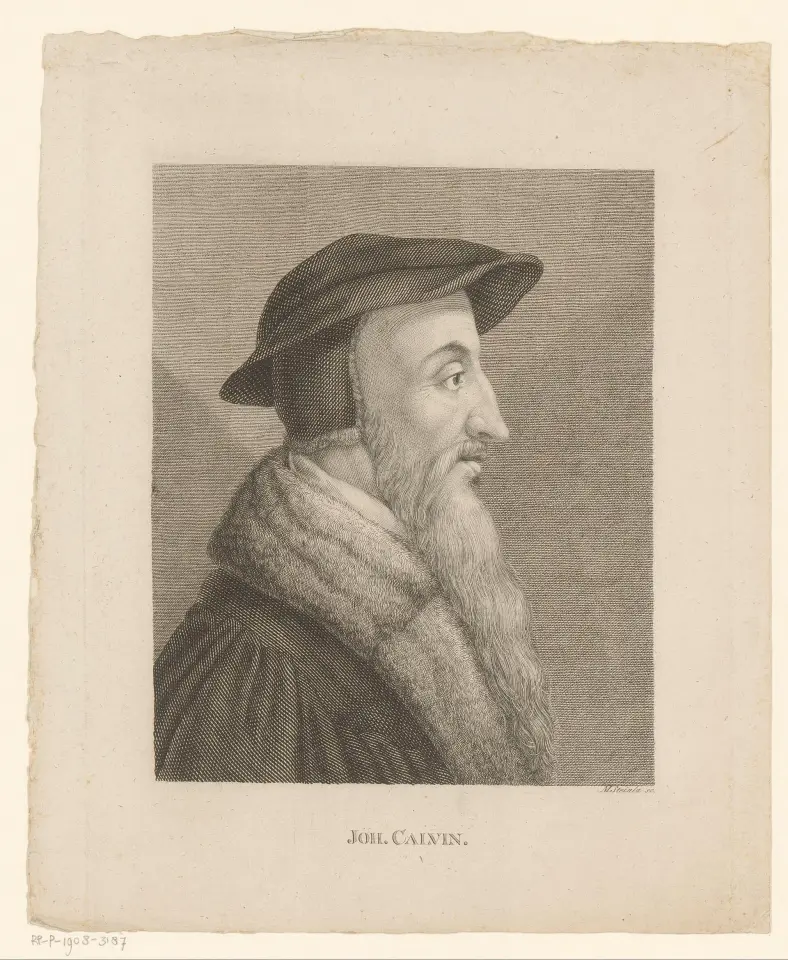
Positions
- Calvin
- A sacrament is a sign and seal made effective by the Spirit; the substance of the sacrament is Christ; Christ's body is in heaven and the Spirit lifts us up to it; how this is possible is a mystery
- Zwingli and the Anabaptists (per Calvin)
- The sacraments are only symbols and testimonies
- Catholics and Lutherans (per Calvin)
- Substantial and local presence of the body; this requires the ubiquity of the glorified body and violates Christ's humanity
- Bucer
- A real eating of the body and blood without their real presence in the bread and wine; Luther rejected this: "we do not have the same spirit"
- Bullinger
- Symbolic parallelism: the Spirit joins the believer to Christ by faith, but alongside the sacrament and not through it; he feared Calvin’s language ascribes more efficacy to the signs than to the Spirit (Allen after Gerrish)
Key points
- González: for Calvin baptism is a sign of forgiveness of sins and of death and resurrection with Christ; forgiveness extends to future sins, so the question of post-baptismal sin does not arise
- McGrath: Calvin considered infant baptism a genuine tradition of the early Church and, influenced by the Anabaptists in Strasbourg, expanded Zwingli’s argument from circumcision. Calvin's position on the Supper is not a political compromise but an expression of his Christology
- In the Eucharist Calvin distinguished the signification (the promises), the substance (Christ) and the effect or benefit (redemption, justification, sanctification, eternal life) (Institutes 4.17.11)
- Heidelberg Catechism (76–79): bread and wine do not become body and blood, just as the water of baptism does not become blood
- Heidelberg Catechism: by the Holy Spirit we are more and more united with the body of Christ, who is in heaven
- Hazlett: Bucer’s mature view – communion as mystical convergence of two realities, inseparable but unfused; Christ “exhibits” himself, nourishing soul and body. Bucer held it legitimate to call the Eucharist a “sacrifice” – in patristic usage or, with Aquinas, as “an image representing Christ’s passion”
- Steinmetz: Calvin affirmed real presence but rejected the ubiquity of the risen nature, agreeing with Zwingli that it is finite and at the Father’s right hand; he explained “spiritual real presence” by the cross’s power, faith’s ascent, the Spirit’s action and the extra Calvinisticum
- Muller: the Consensus Tigurinus (1549) joined Genevan and Zurich views of the sacraments and allows a range of Eucharistic views; already the first Reformed generation rejected bodily presence while differing on the nature of presence
- Wright: Robert Bruce taught that the sacrament is given not to receive something new but to receive the same better than in the Word, holding Christ more firmly; John Craig, who taught reception of Christ’s “natural” body, distorted Calvin
- Zachman: the foundation of Calvin’s Supper teaching is a dialectic of absence and presence: as human Christ is in heaven, but by the Spirit nearer than on earth. Believers rise to Christ’s ascended humanity, not seeking food in the bread; his flesh is an inexhaustible spring of Godhead’s life (Inst. IV.xvii.9)
- Allen: after Gerrish, the Reformed differed on the Supper: Zwingli – memorialism, Bullinger – parallelism, Calvin – instrumentalism. They rejected transubstantiation because Christ remains in heaven; for Calvin the Spirit lifts the believer to Christ through the sacrament. The Reformed reduced the sacraments to two by a criterion: instituted by Jesus and commanded for all (Scots Confession, 1560). Reformed confessions see baptism as adoption and engrafting into Christ; outer and inner differ as human and divine action. Calvin distinguished sacrifices of propitiation and of praise: “Christ’s cross is overthrown as soon as the altar is erected” (Institutes 4.18.3).
Outcome
Calvin's doctrine of spiritual presence became the basis of the Reformed confession; Switzerland and a large part of Germany followed it, and the dispute with the Lutherans marked the final break between the Reformed and Lutheran traditions.
People
- John Calvin
- Martin Bucer
- Heinrich Bullinger
- Peter Martyr Vermigli
Terms
- distinguish but not separate – distinctio sed non separatio
- A formula of Christological origin applied by Calvin to sign and thing signified (McGrath).
- virtualism
- Calvin's teaching on the presence of Christ's body through the power ("virtue") of the Spirit.
- Zurich Consensus – Consensus Tigurinus
- The formula of agreement on the sacraments between Calvin and Bullinger (May 1549).
Place
Geneva, Strasbourg, Zurich
Sources disagree
González ties Calvin's teaching to the editions of the Institutes (1536; final edition 1559); McGrath dates the Treatise on the Lord's Supper to 1540 and the Zurich Consensus to May 1549; Lane places the Short Treatise in the Genevan period (1541–1564), the Wittenberg Concord in 1536, and the Heidelberg Catechism in 1563.
Sources
Primary sources
- Calvin – Institutes of the Christian Religion, bk. IV, ch. 14, sec. 1; ch. 17, sec. 9, 11; ch. 18, sec. 3
Textbooks
- Justo L. González – A History of Christian Thought in One Volume (Abingdon, 2014), p. 311, 320–324
- Justo L. González – A History of Christian Thought, vol. III: From the Protestant Reformation to the Twentieth Century (Abingdon, rev. ed. 1987), p. 165–172
- Alister McGrath – Reformation Thought (Russian edition: «Theological Thought of the Reformation»), p. 257–263
- Tony Lane – Christian Thinkers (Russian edition), p. 173–174, 180–182
- The Cambridge Companion to Reformation Theology, ed. David Bagchi, David C. Steinmetz (2004), p. 123, 137–138, 142, 146, 198–199
- The Oxford Handbook of Christology, ed. Francesca Aran Murphy (2015), p. 361–362
- The Oxford Handbook of Sacramental Theology, ed. Hans Boersma, Matthew Levering (2015), p. 354–355, 355, 353–355, 354, 347–348, 349–351, 353
Related entries
- Response to: Zwingli, the Supper controversy and the Marburg Colloquy (1529) (1523–1529)
- Develops: Calvin: the distinction of natures, the "extra calvinisticum" and the threefold office (1536–1566)
- Response to: The Anabaptists and believers' baptism: the dispute over infant baptism (1525)
- Rejected in: The Lutheran controversy over the Supper, "crypto-Calvinism" and the Formula of Concord (1577)
Data compiled: 2026-11-17