1536–1566 · 16th century
Calvin: the distinction of natures, the "extra calvinisticum" and the threefold office
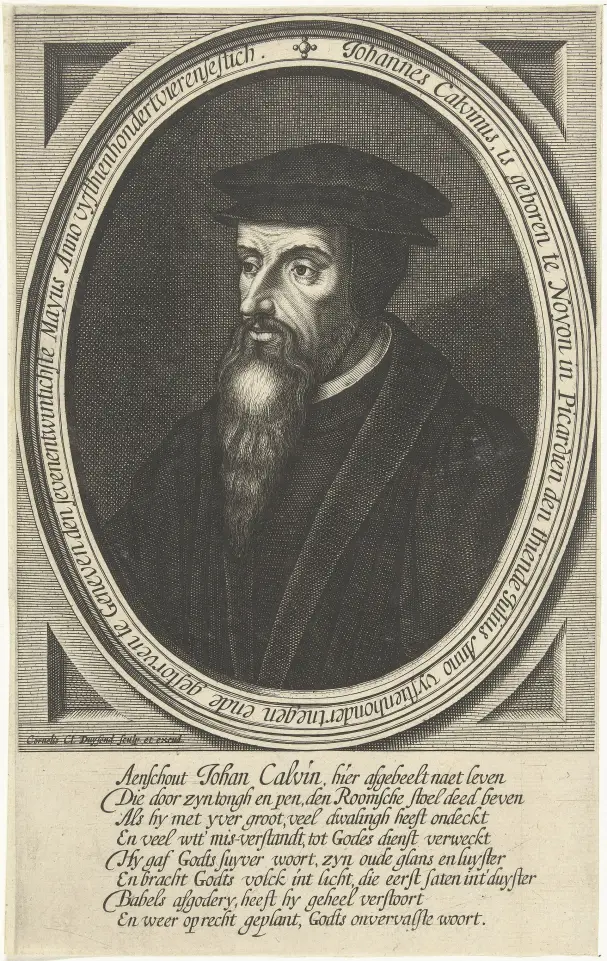
Calvin follows orthodoxy – two natures in one person, "not by a mixture of substances but by unity of person" (Institutes 2.14.1) – but controversy sharpened his christology. Against Osiander he rejected as idle speculation the idea that the incarnation would have taken place even without the fall: Scripture knows only an incarnation for the sake of redemption (2.12.4–7); against Menno and other Anabaptists, who taught the heavenly flesh of Christ, he insisted on his physical descent from Adam (2.13.1–4); against Servetus he stressed the distinction of the natures (2.14.5–8). Together with Zwingli and against Luther he did not accept the argument from the communicatio idiomatum to the ubiquity of the risen body: the divinity of the Second Person was fully present in Jesus but was not confined by his humanity (2.13.4: the Son of God descended from heaven "without abandoning heaven" and "always filled the world") – later this was called the "extra calvinisticum". Calvin described the work of Christ through the threefold office – prophet, king and priest (2.15) – and this scheme became common in Reformed theology.
Positions
- Osiander
- Christ would have become incarnate even without the fall: the purpose is the completion of creation; Christ is mediator only according to his divinity
- Stancaro
- Christ is mediator only according to his humanity
- Menno Simons
- Christ became flesh "in Mary", not "from Mary"; Mary is a "foster mother"
- Luther
- The unity of the person ranks above the distinction of the natures; the communicatio idiomatum is an argument for the ubiquity of Christ's body
- Calvin
- The incarnation is for the sake of redemption; the whole work of redemption belongs to the unity of the person; the ubiquity of the divinity was not communicated to the body
Key points
- González: Calvin's christology is grounded in soteriology and "leans rather towards the ancient Antiochenes than towards the Alexandrians". Osiander's idea was not an innovation – many Franciscan theologians had taught it
- Lane: Menno's teaching of the flesh "in Mary" had already been rejected as heresy in the 2nd century, and the Mennonite churches did not follow him on this
- Berkhof: the Second Helvetic Confession of 1566 is the fullest official statement of Reformed Christology: it teaches two natures “not absorbed, mixed or confused” and rejects the ubiquity of Christ’s humanity
- Steinmetz: the “extra Calvinisticum” (from “etiam extra carnem”): the Logos’s divine nature is not exhausted by the incarnation and acts “outside the flesh”. Calvin answered Lutherans with hypostatic union: Christ is present at the Supper also by his human nature, though it is at the Father’s right hand
- Muller: Reformed Christology from Zwingli and Calvin taught communicatio idiomatum in concreto: properties of both natures belong to the Word’s person; the ascended Christ remains fully human and not bodily present at the Supper – against transubstantiation and ubiquity. Calvin did not invent Christ’s threefold office of prophet, priest and king but gave it prominence; it described distinct functions of Christ’s work, and later Reformed theology developed it historically: prophetic in revelation, priestly in Christ’s sacrifice, kingly in God’s final reign
- Zachman: for Calvin the Mediator must be true God and true man: fallen humans cannot reconcile themselves to God, and only God could descend; Christ’s human nature restores what was lost in Adam, and the Son imparts to us by grace the Sonship he has by nature (Institutes II.xii, II.xiv). Calvin tied the threefold office to the promises to Israel; Christ’s kingdom is spiritual, earthly rulers are “nursing fathers” of the Church; the priestly office excludes any other priesthood and the sacrifice of the mass, the prophetic office completed prophecy. After Irenaeus, Calvin held Christ’s divinity grew more hidden in earthly life (kenosis conceals, not lessens, glory) till in death only a man showed. Calvin applies Irenaeus’s “he suffered while his Godhead rested” also to Christ’s anguish (“My God, why hast thou forsaken me?”): real humanity
- Elliott: 17th-century Reformed Christology followed Calvin: unity of person is the Logos’s indwelling in humanity; genus apotelesmaticum, not maiestaticum. Exaltation begins only with the resurrection; Owen stressed the Spirit’s action on the assumed nature; Heidegger described exaltation in stages
Outcome
The distinction of natures and the "extra calvinisticum" became a characteristic emphasis of Reformed christology, and the threefold office a common scheme of Christ's work in Reformed theology.
People
- John Calvin
- Huldrych Zwingli
- Martin Luther
- Andreas Osiander
- Michael Servetus
- Francesco Stancaro
- Menno Simons
- Caspar Schwenckfeld
Terms
- extra calvinisticum
- The later name for the teaching that the divinity of the Word is not confined by the humanity of Jesus and fills the universe.
- threefold office – triplex munus
- Christ is prophet, king and priest; the name "Christ" ("anointed") points to these three offices.
Place
Geneva
Sources disagree
Calvin's teaching is dated by the Institutes (first edition 1536, final 1559; González); the dispute with Osiander – 1550s; the Second Helvetic Confession – 1566 (Berkhof); Menno – 1536–1561 (Lane).
Sources
Primary sources
- Calvin – Institutes of the Christian Religion, bk. II, ch. 12, sec. 4–7; ch. 13, sec. 1–4; ch. 14, sec. 1, 5–8; ch. 15
Textbooks
- Louis Berkhof – History of Christian Doctrines (Russian edition), p. 80–81
- Justo L. González – A History of Christian Thought in One Volume (Abingdon, 2014), p. 314–315
- Justo L. González – A History of Christian Thought, vol. III: From the Protestant Reformation to the Twentieth Century (Abingdon, rev. ed. 1987), p. 151–154
- Tony Lane – Christian Thinkers (Russian edition), p. 190–191
- The Cambridge Companion to Reformation Theology, ed. David Bagchi, David C. Steinmetz (2004), p. 138–139, 157, 157–158
- The Oxford Handbook of Christology, ed. Francesca Aran Murphy (2015), p. 355, 356–358, 358–359, 368–375
Related entries
- Developed in: Calvin and the Reformed doctrine of the sacraments: sign and seal, spiritual presence (1536–1563)
- Rejects: Lutheran christology: the communication of properties and the ubiquity of Christ's humanity (1571–1577)
Data compiled: 2026-11-17