1525 · 16th century
The Anabaptists and believers' baptism: the dispute over infant baptism
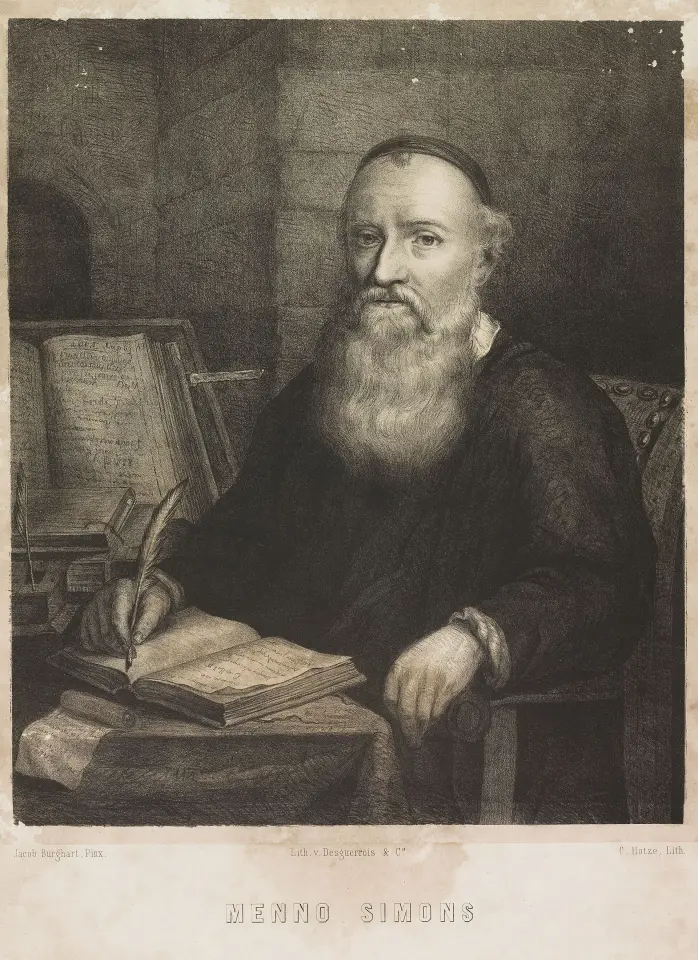
The Anabaptist movement arose in Zurich among those who considered Zwingli too moderate: Christianity is a matter of personal decision, so infants must not be baptized. On 21 January 1525 George Blaurock asked Conrad Grebel to baptize him and then began baptizing others; opponents called them "Anabaptists," though they themselves regarded their baptism as the only valid one. In his treatise Baptism, Rebaptism and Infant Baptism Zwingli defended infant baptism as a sign of the covenant, analogous to circumcision, but rejected the teaching of regeneration in baptism; the Zurich council moved against the radicals. The ancient laws imposing death for rebaptism, issued against the Donatists, were applied to them, and hundreds were killed. Menno Simons (Foundation of Christian Doctrine, on baptism) taught that regeneration "comes through faith from God and his word" and that baptism follows faith; to call the baptism of infants a washing of regeneration is to "do violence to the word of God".
Positions
- The Anabaptists
- Baptize only those who have personally decided; the Church is a community gathered out of the world, not relying on the state and the sword
- Zwingli
- Infant baptism is a sign of the covenant embracing the whole family, like circumcision; but it does not give new birth; refusal to baptize is "rebellion, schism and heresy"
- Menno Simons
- There is neither command nor apostolic example of infant baptism; infants show no fruits of regeneration (Foundation of Christian Doctrine: "we have not a single command in the Scriptures that infants are to be baptized, or that the apostles did practice it")
- The Reformed (per Berkhof)
- Baptism is instituted for believers and strengthens faith; the children of believers are children of the covenant and must be baptized
Key points
- González: at first the "brethren" merely questioned infant baptism and did not rebaptize
- McGrath: Zwingli, following Erasmus, doubted original sin, and the argument that baptism washes away its guilt did not convince him; by 1524 he had developed the theory of baptism as the analogue of circumcision. For Zwingli the Christian city and the Church were one, so baptism became a sign of loyalty to Zurich’s civic community; the Anabaptists saw in this the union of Church and state dating from Constantine
- Berkhof: the Reformed had to prove that children could be regarded as believers: some held covenant children regenerate until the contrary appeared, others left the question open
- Hendrix: Luther answered the Anabaptists: infants may have faith as the Spirit’s gift, and infant baptism is valid since many became Christians that way; “faith exists not for baptism but baptism for faith”, otherwise no one could be sure of his baptism
- Stephens: before the first rebaptisms (1525) Zwingli wrote little on baptism, emphasized faith rather than baptism and insisted that baptism is not necessary for the salvation of infants. He wanted confirmation only when those baptized as infants could confess faith, and later rejected his view that baptism strengthens faith. From December 1524 he argued for infant baptism: it initiates both those who believe and those who will, and replaced circumcision; forbidding infant baptism meant forbidding children to come to Christ (Matthew 19:13–14), and the households baptized in 1 Corinthians 1 and Acts 16 more likely than not included children. In 1525 Zwingli moved from baptism as our pledge to God to God’s pledge to us, the sign of the covenant of grace; he argued the Bible has only one covenant and rejected damnation of unbaptized infants: salvation depends ultimately on election
- Hazlett: Bucer was slow to condemn Anabaptists but became chief apologist of infant baptism; after Münster he taught baptism is a sign and seal of the covenant. The outcome of the Strasbourg dispute was compulsory universal infant baptism with confirmation
- Steinmetz: Calvin held the two testaments bound by one covenant under different administrations: Abraham’s faith sealed by circumcision, Paul’s by baptism. Against Marpeck, for whom the OT was “yesterday”, he saw continuity: as infants were circumcised, so children should be baptized. Calvin kept infant baptism but discarded its traditional justification (washing away the guilt and punishment of original sin): baptism is the covenant sign like circumcision; faith is more effect than cause, God’s gift – so infant baptism is the perfect sign of grace theology
- Packull: Grebel, Manz and Blaurock chose adult baptism, resting on the order of the Great Commission: teach, believe, be baptized. Anabaptists rejected ex opere operato, distinguished inner and outer baptism and held only the inner saving. Hubmaier refuted Zwingli’s equating of circumcision with baptism, defined baptism as a covenant of a good conscience with God and wrote the only Anabaptist baptismal liturgy: baptism is entry into the community under the “rule of Christ”
- Mattox: in the Large Catechism (1529) Luther defended infant baptism by the faith of saints baptized as infants and by “the faith of infants.”
- Allen: the Reformed defended infant baptism as the fulfilment of circumcision and condemned Anabaptists (Tetrapolitan, Helvetic Confessions).
- Rempel: Balthasar Hubmaier ranked believers’ baptism above the Supper; his Form of Water Baptism includes testing the candidate and the congregation’s prayer. Pilgram Marpeck saw the church as the continuation of Christ’s humanity and the “ceremonies” as his “fingers”; they are acts, not objects. For Dirk Philips water baptism witnesses to spiritual baptism; infants are saved without the sign; as with Calvin, no physical presence in the Supper.
Outcome
The baptism of conscious believers only became the distinguishing mark of Anabaptism; the magisterial Reformers grounded infant baptism in the doctrine of the covenant, and in some circles, under the influence of the Socinians, Arminians and Anabaptists, baptism came to be regarded as a mere act of profession (Berkhof).
People
- Conrad Grebel
- Georg Blaurock
- Huldrych Zwingli
- Menno Simons
- Hans Denck
Terms
- Anabaptists
- "rebaptizers" – a name given by their opponents.
- sign of the covenant
- Baptism as the outward sign of belonging to the covenant community, applying to the whole family.
Place
Zurich
Sources disagree
González dates the first baptism to 21 January 1525; Lane places Zwingli's treatise and the council's action in 1525; McGrath places Zwingli's theory in 1524; Lane gives Menno's activity as 1536–1561; Berkhof speaks only of the Reformation period.
Sources
Primary sources
- Menno Simons – Foundation of Christian Doctrine, sec. «Concerning Baptism»
Textbooks
- Louis Berkhof – History of Christian Doctrines (Russian edition), p. 184–185
- Justo L. González – A History of Christian Thought in One Volume (Abingdon, 2014), p. 302–303
- Justo L. González – A History of Christian Thought, vol. III: From the Protestant Reformation to the Twentieth Century (Abingdon, rev. ed. 1987), p. 90–91
- Alister McGrath – Reformation Thought (Russian edition: «Theological Thought of the Reformation»), p. 253–254
- Tony Lane – Christian Thinkers (Russian edition), p. 170–171, 190–192
- The Cambridge Companion to Reformation Theology, ed. David Bagchi, David C. Steinmetz (2004), p. 63, 99–100, 116, 122, 128, 135, 221–222, 222–223
- The Oxford Handbook of Sacramental Theology, ed. Hans Boersma, Matthew Levering (2015), p. 334, 349, 351–352, 366–368, 368–371, 373–374
Related entries
- Developed in: The Anabaptists: a believers' Church separated from the world and the state (1525–1527)
- Answered by: Calvin and the Reformed doctrine of the sacraments: sign and seal, spiritual presence (1536–1563)
In church history
Data compiled: 2026-11-17