150–200 · 2nd century
The formation of the New Testament canon, the rule of faith, and baptismal creeds
In response to Marcion's canon and the gnostics' secret traditions, the Church worked out its own answer in the second half of the 2nd century. It did so without any special council. The answer was open apostolic tradition attested by lists of bishops, and a gradually forming list of recognized writings.
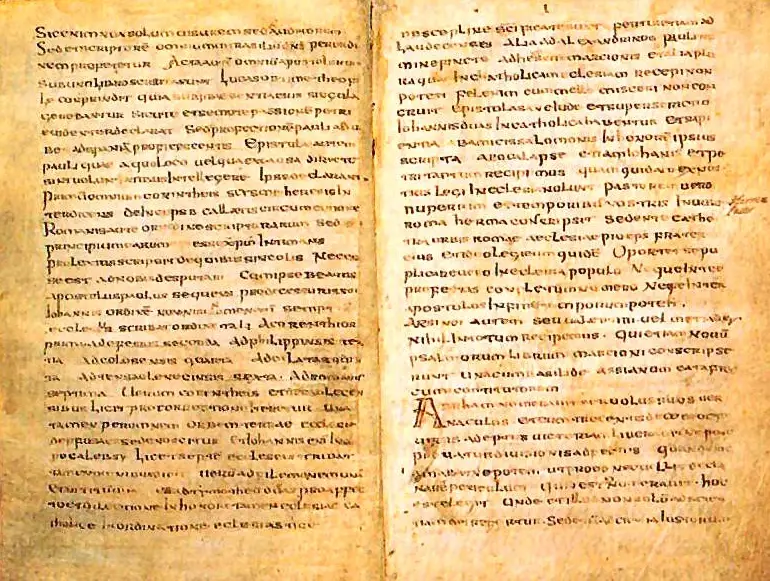
By the end of the century the core of the New Testament canon had taken shape: the four Gospels, Acts, and the Pauline epistles. An early example of such a list is the Muratorian Fragment (c. 170). It excluded Hebrews, James and both epistles of Peter, but included the apocryphal Apocalypse of Peter.
In parallel, Rome developed a baptismal creed, the "Old Roman Symbol" (c. 150). It took the form of three questions about faith in the Father, Son and Spirit. By 200 it had been expanded with statements on the virgin birth, crucifixion under Pontius Pilate, and the resurrection of the flesh. These statements were aimed directly against docetism, Marcion and the gnostics.
This "Old Roman Creed" underlies the later Apostles' Creed.
Key points
- Response to Marcion's canon: open apostolic tradition and lists of bishops
- The Muratorian Fragment (c. 170) – an early list of New Testament books
- The Old Roman baptismal creed (c. 150) – three questions on faith in the Trinity
- By 200 the creed was expanded against docetism and Marcion (virgin birth, crucifixion, resurrection of the flesh)
- Shelley: against the Gnostics the Church relied on three things: the clergy, the creed and the canon. The creed tells the story: the Father sent the Son to redeem the world by death, resurrection and the Spirit; so Tertullian, Irenaeus, Origen read it. The Old Roman Creed arose as a 2nd-century baptismal confession; apostles did not write it; it is Trinitarian without explaining the Trinity. The ‘utilitarian’ early orthodoxy of the rule of faith differs from the later orthodoxy of the councils, and accusing second-century people of rejecting doctrines interpreted only in the fourth century is anachronism. But heresies did not appear only in the 4th–5th centuries: the Church rejected Marcion and modalism before the Councils, expelling such teachers; orthodoxy was usually declared when heresy threatened the faith’s substance, and doctrines were forged by the Church’s ‘work crew’. A book entered the canon by three marks – self-evidence, use in worship, apostolic link; the Muratorian canon (c. 190) is wider than the final list.
- Roetzel: Schneemelcher suggests Rome may have preferred to exclude Paul's letters from the canon, but by the late second century it was too late. The Acts of Paul and Thecla (late 2nd c., Asia Minor) glorified Paul as celibate and martyr; Syrian and Armenian churches made them canonical.
- Morgan: 'the canonical Paul' differs from Paul as he was: seven authentic epistles, six 'Pauline' letters, and Hebrews wrongly attributed to him.
- Gunton: the rule of faith summarised belief in God the creator, Christ saviour and coming judge, the Spirit, the church, Christian life – a creed’s precursor; by the end of the second century the rule was claimed to be universal in the church, though it was not yet theology in the strict sense.
People
- Marcion
- Hippolytus of Rome
- Irenaeus of Lyons
- Tertullian
Place
Rome
Sources disagree
Full agreement on the New Testament's contents was reached, according to one book, only in the second half of the 4th century; the formation of the Apostles' Creed is placed by the books anywhere from the late 2nd to the 6th–7th centuries. Bruce (Shelley) dates the Muratorian canon to about AD 190 (first published by L. A. Muratori in 1740) and lists in it, besides the New Testament books, the Apocalypse of Peter and the Wisdom of Solomon, which did not enter the final canon; the site text dates the fragment to about 170.
Sources
- Jaroslav Pelikan – The Christian Tradition: A History of the Development of Doctrine, vol. 1 (Russian edition), p. 70–74, 131–140
- Justo L. González – The Story of Christianity, vol. I (Russian edition), sec. «Раннекафолическая церковь»
- J. North – A History of the Church (Russian edition), p. 43–45
- Justo L. González – A History of Christian Thought in One Volume (Abingdon, 2014), p. 61–65
- Tony Lane – Christian Thinkers (Russian edition), p. 67–68
- Bruce L. Shelley – Church History in Plain Language (Russian edition), Ch. 5, sec. «Те, кто знал», «Ответы гностицизму»; Ch. 5, sec. «Ортодоксия и ересь»; Ch. 6, sec. «Основы Библии», «Новые голоса от Бога»; Ch. 6, sec. «Новые голоса от Бога»
- The Cambridge Companion to St Paul, ed. James D. G. Dunn (2003), p. 252, 256
- The Cambridge Companion to Christian Doctrine, ed. Colin E. Gunton (1997), p. 27–28, 28
More on the doctrine
- Marcion's Canon: "Gospel" and "Apostle" against the Old Testament (c. 140–160)
- Irenaeus against the Gnostics: Open Apostolic Tradition, the Rule of Faith and the Four Gospels (c. 180)
Data compiled: 2026-11-09