c. 140–160 · 2nd century
Marcion's Canon: "Gospel" and "Apostle" against the Old Testament
Regarding Paul as the only apostle who had truly understood the Gospel, Marcion rejected the Old Testament as the Scripture of the Creator and reduced Christian Scripture to the Gospel of Luke, purged of "Judaizing interpolations," and ten epistles of Paul. From the Gospel he removed, among other things, the account of the Nativity (Irenaeus, Against Heresies 1.27.2; Tertullian, Against Marcion 4.7). According to González, the first New Testament canon was apparently that of Marcion: the church took from him not the idea of canonical literature but the impetus to determine which books should be considered Scripture. The response was to extend apostolic authority to the whole apostolic community and to the New Testament canon.
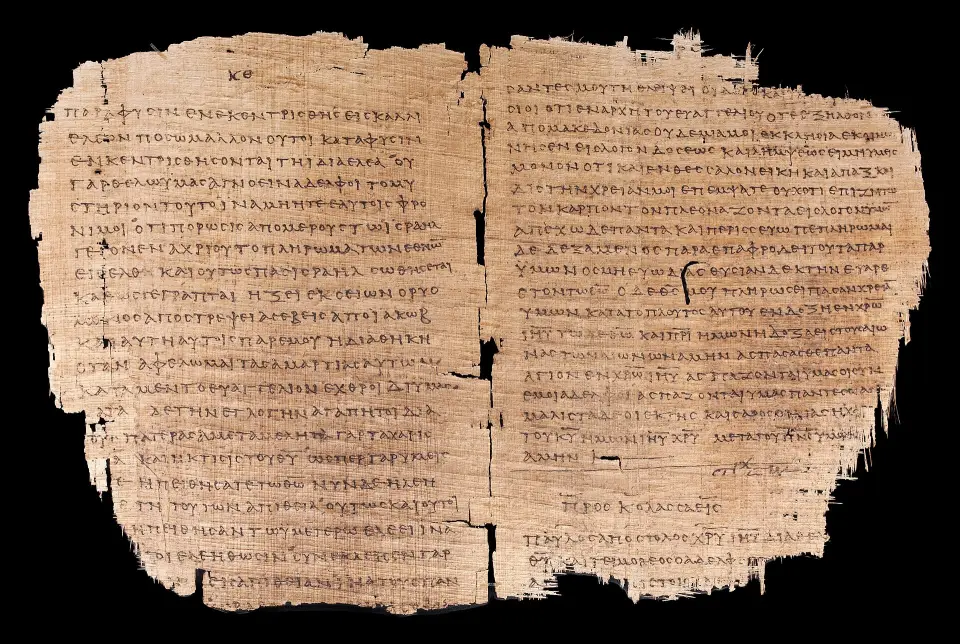
Positions
- Marcion
- Only Paul knew the truth, the other apostles distorted the gospel; the Old Testament has been abolished, not fulfilled, and its prophecies must be read literally, so they do not refer to the true Christ
- Irenaeus, Tertullian
- Paul is part of the apostolic community and shares its teaching: "Peter was an apostle of the same God as Paul"
- The church at large (according to González)
- The open tradition of all the apostles and a diversity of witnesses – Gospels agreeing on essentials
- Pelikan
- Whether the New Testament canon was a response to Marcion is an oversimplification, but Marcion's canon was his response to the Old Testament
- Roetzel
- Marcion was a radical Paulinist who both understood and misunderstood Paul: he rightly saw his emphasis on grace and newness, his egalitarian tendencies and the link between salvation and freedom, and elevated his letters to scriptural status, but oversimplified and falsified Paul's message
Key points
- Pelikan: Marcion set the double Scripture of the "Lord" (Gospel) and the "Apostle" (ten epistles, Galatians first; cf. Tertullian, Against Marcion 5.2) against the double "law and prophets"
- Hall: Marcion's Gospel began with Luke 3:1 and the arrival of the adult Jesus in Capernaum (Tertullian, Against Marcion 4.7)
- González: each group – Ebionites, Marcion, Gnostics, Valentinians – recognized only one Gospel; perhaps the church included several to show its faith did not rest on the witness of a single apostle
- Lane: in the five books Against Marcion, Tertullian disputes his right to the Christian heritage; cf. "Marcion, by what right do you hew my wood?" (Prescription against Heretics 37)
- Shelley: Marcion rejected the Old Testament and part of the New, keeping a trimmed Luke and ten Pauline letters; the Church gained by keeping the Old Testament.
- Roetzel: Marcion held Paul to be ‘the true apostle’, tested the ‘pillar apostles’ against Paul and blamed Judaizing redactors for corrupting his gospel. He rejected Matthew for endorsing the law (Matt. 5:17), probably did not know John, preferred Luke to Mark and ‘pruned’ even Luke.
Outcome
The church did not accept the rejection of the Old Testament; the question of the canon arose, and the apostolic community and the New Testament canon were recognized as bearers of a single authority.
People
- Marcion
- Paul
- Irenaeus of Lyons
- Tertullian
Terms
- canonical
- According to Knox (as cited by Pelikan), canonicity and apostolicity became almost synonymous.
Sources disagree
Berkhof: c. 139; Hall: c. 140–150; González: c. 144 and later; Pelikan connects the canon with Marcion's church of 144. None of the books dates the compilation of the canon precisely.
Sources
Primary sources
- Tertullian – Against Marcion, bk. IV, ch. 7; bk. V, ch. 2
- Irenaeus of Lyons – Against Heresies, bk. I, ch. 27
- Tertullian – The Prescription against Heretics, ch. 37
Textbooks
- Stuart G. Hall – Doctrine and Practice in the Early Church (Russian edition), p. 29–30
- Jaroslav Pelikan – The Christian Tradition: A History of the Development of Doctrine, vol. 1 (Russian edition), p. 90–93, 131–133
- Louis Berkhof – History of Christian Doctrines (Russian edition), p. 32
- Justo L. González – A History of Christian Thought in One Volume (Abingdon, 2014), p. 58, 62–63
- Tony Lane – Christian Thinkers (Russian edition), p. 22–23
- Bruce L. Shelley – Church History in Plain Language (Russian edition), Ch. 6, sec. «Перечень христианских книг»
- The Cambridge Companion to St Paul, ed. James D. G. Dunn (2003), p. 243, 246
Related entries
- Develops: Marcion: Two Gods – the Creator of the Law and the Good God of the Gospel (c. 140–144)
- Answered by: Irenaeus against the Gnostics: Open Apostolic Tradition, the Rule of Faith and the Four Gospels (c. 180)
In church history
- Marcion and the founding of the Marcionite church (139–144)
- The formation of the New Testament canon, the rule of faith, and baptismal creeds (150–200)
Data compiled: 2026-11-17