155 or 156 · 2nd century
The martyrdom of Polycarp of Smyrna
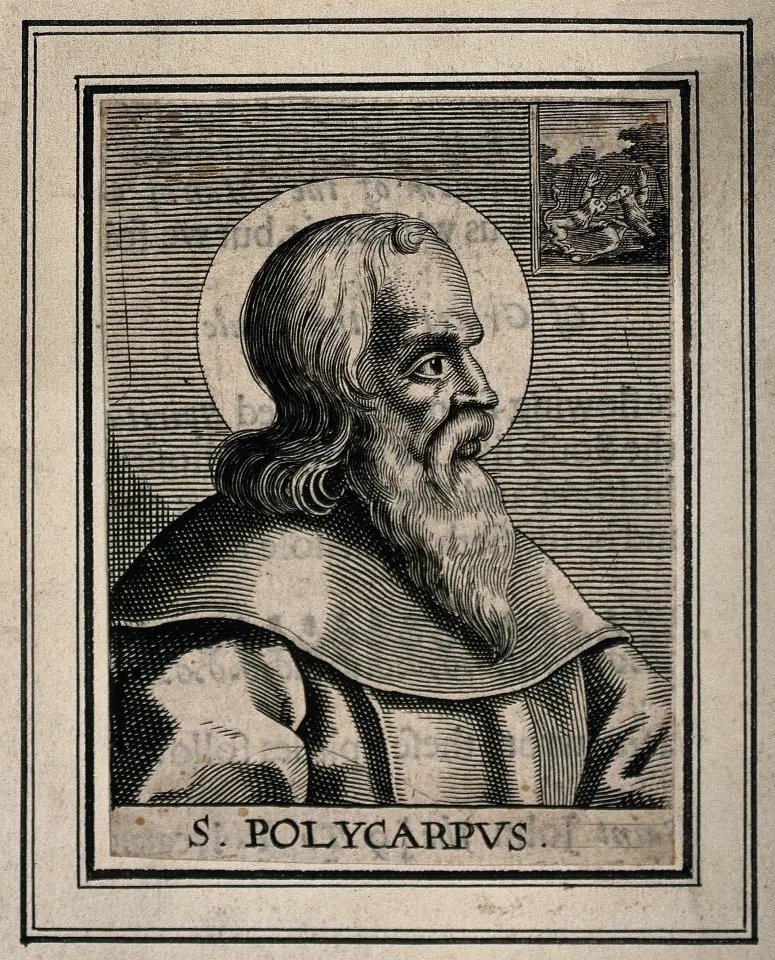
Polycarp was in his youth a disciple of the Apostle John and for many years bishop of Smyrna. He was the keeper of the letters of Ignatius of Antioch. After the execution of a group of Christians, an enraged crowd demanded him (Martyrdom of Polycarp 3).
The elderly bishop first went into hiding, then accepted his arrest as God's will (7). To the demand to curse Christ he replied: "Eighty and six years have I served Him, and He never did me any injury: how then can I blaspheme my King and my Saviour?" (9) He was burned at the stake.
The eyewitness account, the Martyrdom of Polycarp, is the oldest surviving document of its kind. It deliberately condemns the deliberate courting of martyrdom. As a contrast it cites a certain Quintus, who volunteered and then recanted (4).
Polycarp was an important link between the apostolic generation and Irenaeus of Lyons. Irenaeus had seen him "in his early youth" (Against Heresies 3.3.4).
Key points
- "Eighty and six years have I served Him, and He never did me any injury: how then can I blaspheme my King and my Saviour?" (Martyrdom of Polycarp 9)
- The Martyrdom of Polycarp – the oldest surviving eyewitness account of a martyrdom
- Condemnation of deliberately courting martyrdom (the example of Quintus, Martyrdom of Polycarp 4)
- Keeper of the letters of Ignatius of Antioch
- A link between the apostles (a disciple of John) and Irenaeus of Lyons
- Shelley: Polycarp answered the proconsul: “I am a Christian. If you wish to learn what that means, appoint a day and listen” (Martyrdom of Polycarp 10). The scene shows the authorities would gladly drop charges, and before 200 Rome merely, without interest, tried to silence Christians
People
- Polycarp of Smyrna
- John the Apostle
- Ignatius of Antioch
- Irenaeus of Lyons
- Germanicus
- Quintus
Place
Smyrna
Sources disagree
The year of martyrdom differs between books: 155 (González, North) and 156 (Hall, Lane); one book even allows for 166 or 177.
Sources
Primary sources
- The Martyrdom of Polycarp, ch. 3–4, 7, 9–10
- Irenaeus of Lyons – Against Heresies, bk. III, ch. 3
Textbooks
- Justo L. González – The Story of Christianity, vol. I (Russian edition), sec. «Мученичество Поликарпа»
- J. North – A History of the Church (Russian edition), p. 34
- Stuart G. Hall – Doctrine and Practice in the Early Church (Russian edition), p. 27
- Tony Lane – Christian Thinkers (Russian edition), p. 15
- Bruce L. Shelley – Church History in Plain Language (Russian edition), Ch. 4, introduction
Data compiled: 2026-11-09