64–68 AD · 1st century
The fire of Rome and Nero's persecution; the martyrdom of Peter and Paul
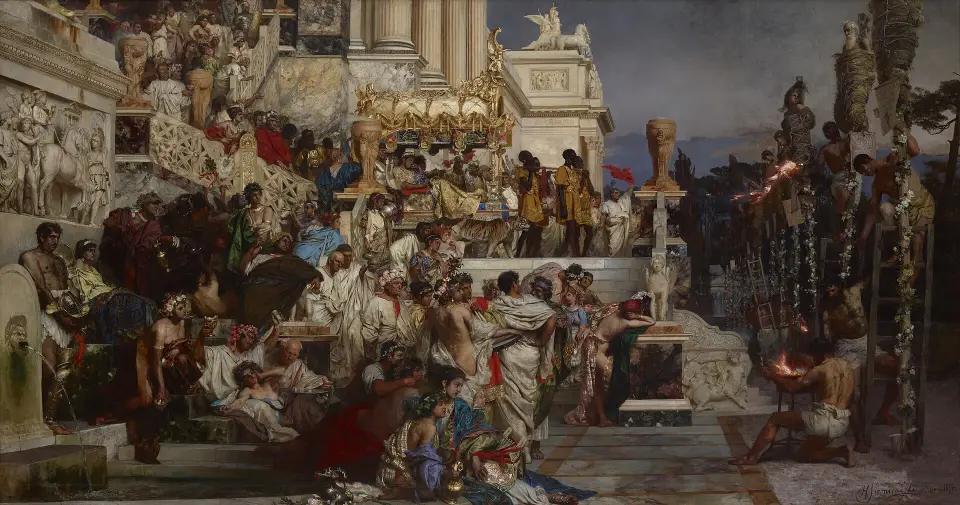
The descendants of Augustus held the throne until Nero (54–68 AD). On 19 July 64 AD, Tacitus says (Annals 15.38–41), a fire broke out in Rome. Of the city's 14 districts three were levelled to the ground, and in seven only a few half-burnt ruins were left.
Nero himself was suspected of arson. According to Tacitus (Annals 15.44), he blamed the Christians. They were then "torn by dogs, crucified, and burned as torches by night". They were condemned "for their hatred of the human race".
There appears to have been no special anti-Christian law. Christians were tried for a specific criminal offense. The persecution was confined to Rome and its surroundings and did not extend beyond them.
Christian sources (1 Clem. 5–6; Eusebius, Church History 2.25) associate this time with the deaths of the apostles Peter and Paul in Rome. Paul, being a Roman citizen, was beheaded in 67 AD. Peter was crucified c. 68 AD. Eusebius (Church History 3.1), citing Origen, writes that Peter was crucified head downwards at his own request.
The persecution ended with Nero's death in 68 AD, though his edicts against the Christians were not repealed. Discontented generals declared Nero an enemy of the state. After a brief struggle (the "year of the four emperors") the throne passed to Vespasian (68–79 AD). Under him, and under his son Titus, the Christians were not persecuted.
Key points
- The fire of Rome (from 19 July 64 AD): only four of the city's 14 districts escaped intact (Tacitus, Annals 15.40–41)
- Nero blamed the Christians for the fire; the empire's first official persecution
- Christians were executed by elaborate means, condemned "for hatred of the human race" (Tacitus, Annals 15.44)
- The persecution was confined to Rome; it lasted until Nero's death (68 AD)
- By tradition, Paul (beheaded, 67 AD) and Peter (crucified upside down, c. 68 AD) were put to death in Rome at this time
- Shelley: the fire of 64 lasted six days; Nero blamed the Christians and killed them cruelly; persecution hung over them, says Bruce, “like a sword of Damocles.”
- Haacker: in 1 Clem. 5:6–7 (late 1st c.) Paul preached "both in the east and west" and came "to the extreme limit of the west" – Spain, for Haacker; of Paul's end it says only that he "suffered martyrdom under the prefects", Rome is not named.
People
- Nero
- Tacitus
- the apostle Peter
- the apostle Paul
- Origen
- Vespasian
Place
Rome
Sources disagree
Paul's death is dated to 67 AD "by a credible tradition", Peter's crucifixion to "around 68 AD"; the exact date of the apostles' deaths is not certified by tradition, the books call it only probable. Haacker: Paul's death is not related in the New Testament; 1 Clem. 5:7 implies that Paul visited Spain, so he may have died only in the persecution of AD 64 after the fire of Rome.
Sources
Primary sources
- Tacitus – Annals, bk. XV, ch. 38–44
- Clement of Rome – First Epistle to the Corinthians, ch. 5
- Eusebius of Caesarea – Church History, bk. II, ch. 25; bk. III, ch. 1
Textbooks
- Stuart G. Hall – Doctrine and Practice in the Early Church (Russian edition), p. 11–13
- J. North – A History of the Church (Russian edition), p. 28–29
- Justo L. González – The Story of Christianity, vol. I (Russian edition), Ch. «Первые конфликты с государством», sec. 1.9, 1.11
- Bruce L. Shelley – Church History in Plain Language (Russian edition), Ch. 4, sec. «Причины гонений»
- The Cambridge Companion to St Paul, ed. James D. G. Dunn (2003), p. 39, 50–51
Data compiled: 2026-11-09