66–73 AD · 1st century
The Jewish War and the destruction of the Jerusalem Temple
King Agrippa II tried and failed to persuade the people to submit to the procurator Florus. Then Eleazar, the captain of the Temple guard and son of the high priest Ananias, secured an end to the acceptance of sacrifices and gifts from non-Jews. This amounted to a refusal of the sacrifice for the emperor and for Rome. Josephus explicitly calls this step the actual beginning of the revolt (66 AD).
Already under Nero, Vespasian had been sent to suppress the rebellion, and he progressively subdued Galilee. Nero's death (68 AD) drew Vespasian away from the campaign against Jerusalem. After a series of upheavals in Rome, the soldiers proclaimed him emperor (69 AD), against his own resistance. He departed for Egypt and left the continuation of the war to his son Titus.
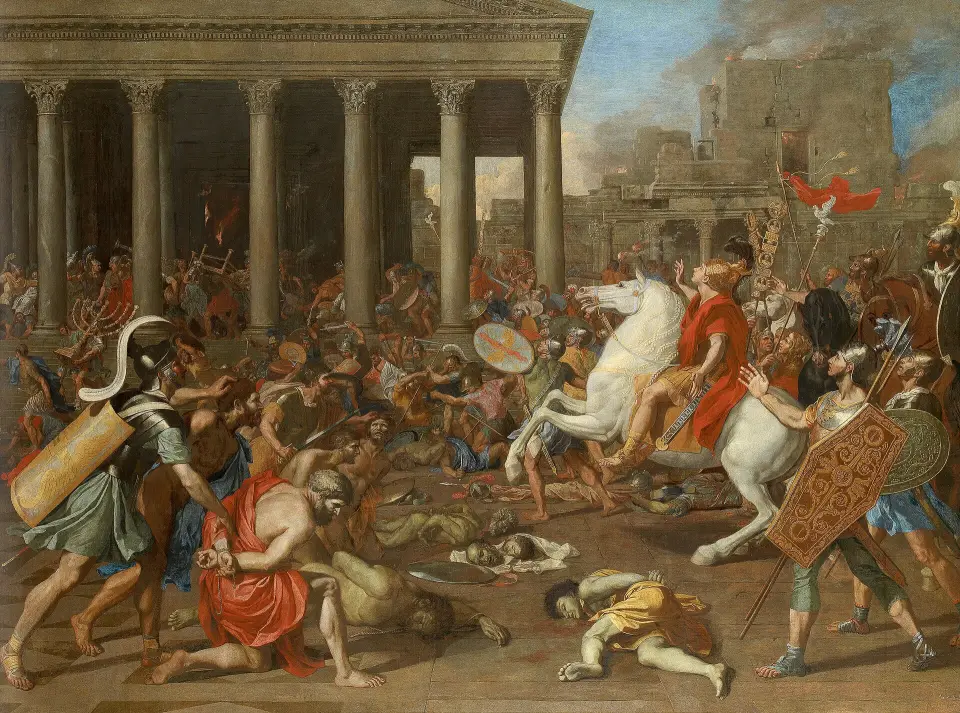
After a long siege, Roman soldiers set fire to the gates of the Temple court. Titus tried to stop the blaze, but the Temple burned on the 10th of the month of Loos (Av) in 70 AD – the same day and month on which the first Temple had burned under the Babylonians. While the Temple burned, soldiers killed Jews indiscriminately: those who surrendered met the same fate as those who resisted. About 6,000 women and children who had taken refuge in the gallery of the outer court perished there.
Three years later, on the 15th of Xanthicus, 73 AD, the last rebel stronghold fell: Masada. When it became clear the defense was doomed, the Sicarii leader Eleazar persuaded the defenders to kill their wives and children and then one another by lot. 960 people died; only an old woman and five children survived.
The destruction of the Temple dealt a mortal blow to the Sadducees. The Pharisees, who emphasized personal religion and the oral law, were scarcely affected and shaped Judaism's subsequent development. Soon after the fall of Jerusalem the rabbis adopted a limited canon of sacred books, excluding Sirach, the books of Maccabees, and the Greek additions to Daniel and Esther. They also removed the Greek translations from the synagogues.
By this time the Jewish Christians had already broken with official Judaism. Most of them had left Jerusalem and escaped the destruction. After 70 AD Jewish-Christian sects arose on the margins – Ebionites, Nazarenes and Elkesaites. They continued to observe the Law of Moses; the Ebionites used only the Gospel of Matthew and rejected Paul.
The destruction of Jerusalem was the early church's first turning point. Before 70 AD most Christians were Jews, and the mother church was in Jerusalem. After the Temple's fall the Gentile church became dominant, and a leading church emerged at Rome.
Key points
- The cessation of sacrifices for the emperor (66 AD) was the actual start of the revolt
- Vespasian subdues Galilee; after Nero's death (68 AD) he is proclaimed emperor (69 AD)
- The destruction of the Jerusalem Temple by Titus on the 10th of Loos, 70 AD; massacre and plunder of the city
- The fall of Masada (73 AD): the mass suicide of the defenders (960 people)
- The end of Temple-centered (Sadducean) Judaism and the shift of leadership to Pharisaic, rabbinic Judaism; the adoption of the rabbinic canon
- Jewish Christians had left Jerusalem before its fall; after 70 AD Jewish-Christian sects arose (Ebionites, Nazarenes, Elkesaites)
- The destruction of Jerusalem was the early church's first turning point: leadership passed to the Gentile church
- Shelley: pious Jews regarded the flight of the Jerusalem Christians at the start of the revolt as treason, which settled the Church’s fate in the Jewish world; years later Judaizing Christians were barred from synagogue services and the break became final – a faithful Jew could no longer be a Christian. He treats AD 70 as the end of the apostolic age: almost all the apostles were dead and the churches they founded had passed into new hands.
People
- Eleazar son of Ananias
- Agrippa II
- Gessius Florus
- Nero
- Vespasian
- Titus
- Eleazar (leader of the Sicarii at Masada)
- James, the Lord's brother
- Paul
- Peter
- Irenaeus of Lyons
- Origen
Place
Jerusalem; Galilee; Masada
Sources disagree
The dates of the Jewish War (66–70 AD) and the fall of Masada (73 AD) generally agree across all the books; exact calendar dates (10 Loos/Av 70 AD and 15 Xanthicus 73 AD) are given only by Josephus. The dating of the Jewish-Christian sects (Pelikan) extends into the 2nd century without exact dates – only their connection to the fall of Jerusalem is used here.
Sources
Primary sources
- Flavius Josephus – Jewish Antiquities; The Jewish War (Russian edition), War, bk. II, ch. 17; bk. I, ch. 1; bk. III; bk. VI, ch. 4–5; bk. VII, ch. 9
Textbooks
- J. North – A History of the Church (Russian edition), p. 24
- Justo L. González – The Story of Christianity, vol. I (Russian edition), Part one; ch. «Полнота времени», sec. 1.1; ch. «Иерусалимская церковь», sec. 1.6
- Jaroslav Pelikan – The Christian Tradition: A History of the Development of Doctrine, vol. 1 (Russian edition), p. 18–19, 27, 31–34
- Stuart G. Hall – Doctrine and Practice in the Early Church (Russian edition), p. 11, 22
- Tony Lane – Christian Thinkers (Russian edition), p. 10–11
- Justo L. González – A History of Christian Thought in One Volume (Abingdon, 2014), p. 17–18
- Bruce L. Shelley – Church History in Plain Language (Russian edition), Ch. 2, sec. «Падение Иерусалима»
Data compiled: 2026-11-09