440–461 · 5th century
Leo the Great: pontificate, the doctrine of Roman primacy, and the meeting with Attila
Leo I, bishop of Rome from 440 to 461, became famous for elevating the papacy. He taught that the apostle Peter had passed his supreme authority to the bishops of Rome, so that in the person of the pope Peter himself addresses the Church. Papal authority thus rests on this succession rather than on the political status of the capital.
When Hilary of Arles arbitrarily deposed and appointed bishops in Gaul, Emperor Valentinian III, at Leo's urging, issued a decree. It forbade bishops from making major decisions without Rome's consent.
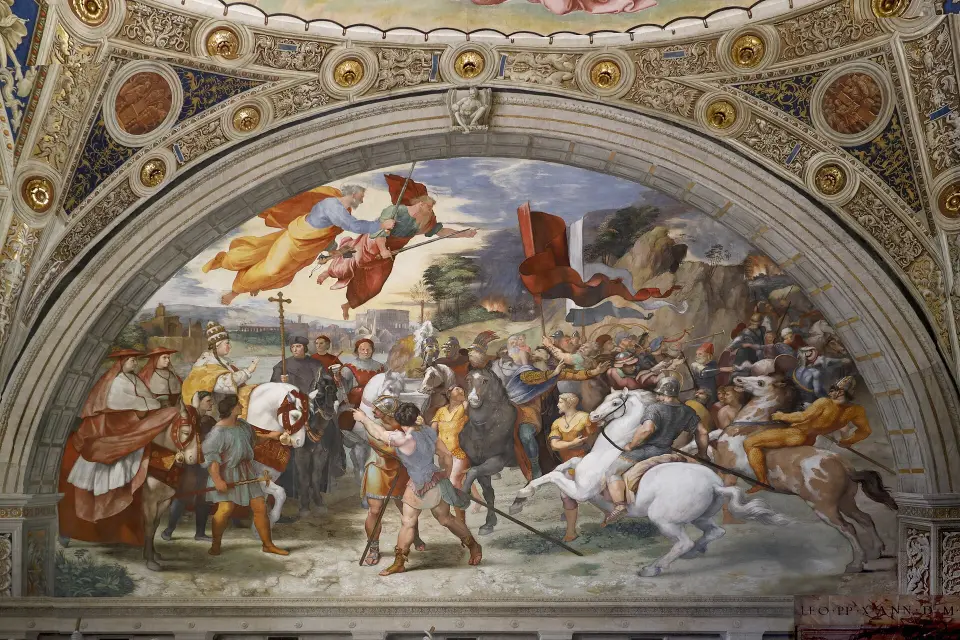
In 452 Leo personally went out to meet the Huns of Attila and persuaded them not to march on Rome. In 455 he negotiated with the Vandal Genseric. Though unable to prevent the sack of the city, he saved it from burning and many killings.
Leo was the first to be called pope in the modern sense. His theological legacy also includes the "Tome," a Christological letter that played a key role in the disputes over the natures of Christ.
Key points
- Doctrine: papal authority rests on succession from Peter, not on Rome's status as capital
- Valentinian III's decree (at Leo's urging) on Rome's authority over Gallic bishops
- Meeting with Attila (452) halted the Huns' march on Rome
- Negotiations with Genseric (455) mitigated the Vandal sack of Rome
- Leo I – the first pope in the modern sense of the word
- Shelley: in June 452 Attila, the “scourge of God,” crossed the Alps and invaded northern Italy, meeting almost no resistance. At a ford on the Po he was met by a Roman embassy; the emperor's envoy was Bishop Leo. Attila had probably decided long before the embassy: epidemics and famine forced him to halt; he readily heard the plea to spare Rome and kept his promise to leave Italy, “and the bishop of Rome took on a new role and new claims”. Leo showed that the papacy can adapt to the empire, the Germanic kingdoms and the nation-states. Before Constantine there is no convincing evidence of the Roman bishop’s authority outside Rome: honour yes, but not power. Rome was respected for capital status, size and wealth (mid-third century: about 30,000 members, 150 ministers, 1,500 widows and poor), for its charity, its teaching accepted in the West, and writers’ appeals from Irenaeus on to Peter and Paul as founders; yet Irenaeus and Cyprian differed from Rome when they thought it wrong. The title “pope” originally expressed fatherly care for every bishop; only in the sixth century was it applied exclusively to the bishop of Rome. Leo I was first to give a biblical and theological basis for papal claims; “it is wrong to speak of the papacy before Leo’s time”. Per Vatican I (1870), Christ founded the papacy, Peter was first pope, and the bishop of Rome as his successor holds primacy over the Church
People
- Leo the Great
- Attila
- Genseric
- Hilary of Arles
- Valentinian III
Place
Rome, Northern Italy
Sources
- Stuart G. Hall – Doctrine and Practice in the Early Church (Russian edition), p. 146
- Tony Lane – Christian Thinkers (Russian edition), p. 62–65
- Justo L. González – The Story of Christianity, vol. I (Russian edition), Ch. 20, sec. 20.3
- Bruce L. Shelley – Church History in Plain Language (Russian edition), Ch. 14, introduction; Ch. 14, sec. «Притязания римских католиков»
More on the doctrine
Data compiled: 2026-11-09