1198–1216 · 12th century
The Pontificate of Innocent III: the Peak of Papal Power
Innocent III was elected at 37. He taught that secular power derives its authority from the papal, "as the moon its light from the sun". He called himself the "Vicar of Christ", set "over nations and kingdoms".
He raised, then deposed, Emperor Otto IV, installing Frederick II in his place. He laid an interdict on France, forcing Philip Augustus to take back his lawful wife.
Innocent rejected both candidates for the see of Canterbury and appointed his own nominee, Stephen Langton. For this he excommunicated King John and placed England under interdict. After five years of struggle John capitulated in 1213, acknowledging England as a papal fief.
Under Innocent the Fourth Crusade began and the crusade against the Albigensians was proclaimed. The mendicant order of Francis was approved, and the practice of indulgences for crusade donors expanded. In 1215 the Fourth Lateran Council was convened.
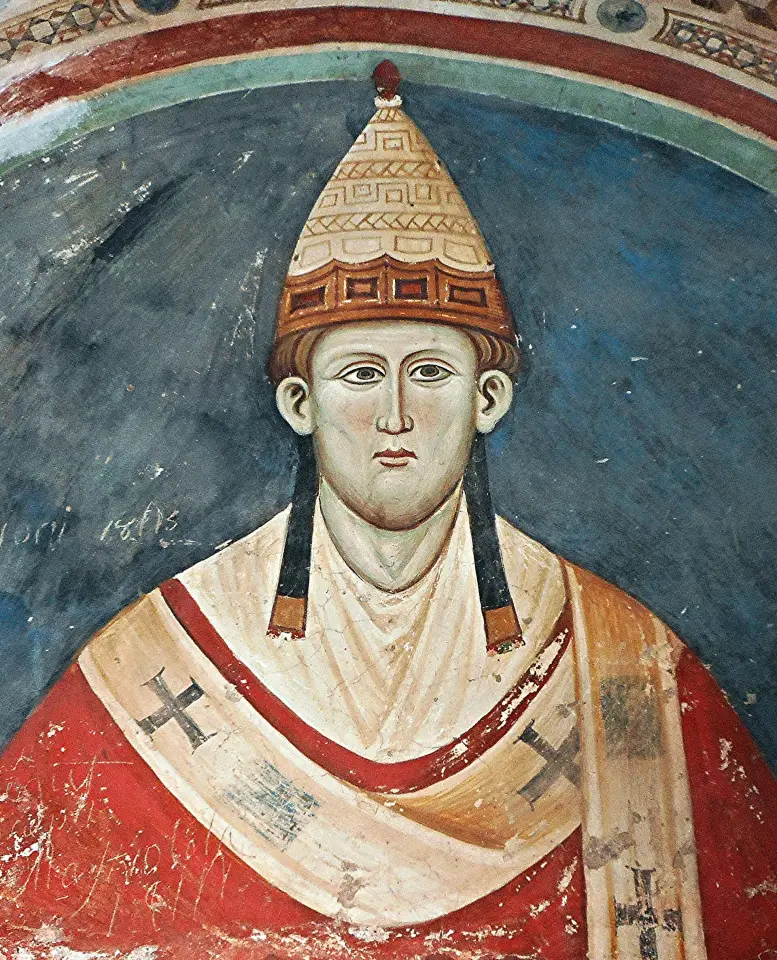
Key points
- The title 'Vicar of Christ' and the doctrine of papal power as the source of secular authority
- The interdict on England and King John's capitulation (1213)
- Approval of the Franciscans and the crusade against the Albigensians
- The expansion of the indulgence system through crusades (from 1198)
- Shelley: in the 12th–13th centuries the papacy centralized into Europe’s strongest force; Innocent III called it the sun and kings the moon. The pope’s chief weapon was spiritual punishment: excommunication came with a funeral-like bell, a closed book and an extinguished candle; an excommunicate could not be judge, witness or attorney or make contracts, and was refused Christian burial. An interdict struck whole peoples – all public worship and sacraments stopped except baptism and last anointing; Innocent III threatened it 85 times. Many states recognised the pope as feudal lord: King John of England, yielding after an interdict, became Innocent’s vassal, received England back as a fief and paid a heavy annual tribute; in France the pope made Philip Augustus take back the wife he had cast off, and in Germany he intervened in the civil war of rival claimants and chose Frederick II, who promised to respect papal rights and launch a crusade. A sign of papal arrogance is Innocent III’s claim that the pope, judge of the world, is ‘lower than God but higher than man’; the boast did not go unnoticed: more and more unlettered laity recalled the apostle’s ‘one God, one mediator’. Scholasticism, like the crusades, was an overreach of the Church: it gave the papal monarchy an impressive supernatural picture of this world and the next.
People
- Innocent III
- Otto IV
- Frederick II
- Philip II Augustus
- King John
- Stephen Langton
Place
Rome; Germany; France; England
Sources
- Tony Lane – Christian Thinkers (Russian edition), p. 119–120, 122
- Justo L. González – The Story of Christianity, vol. I (Russian edition), Ch. 25, sec. 25.2
- Justo L. González – A History of Christian Thought in One Volume (Abingdon, 2014), p. 243–244, 246
- J. North – A History of the Church (Russian edition), p. 153–155, 181
- Louis Berkhof – History of Christian Doctrines (Russian edition), p. 170
- Bruce L. Shelley – Church History in Plain Language (Russian edition), Ch. 19, sec. «Да придет Царствие Твое»; Ch. 20, sec. «Вершина познания»
More on the doctrine
Data compiled: 2026-11-09