1835–1906 · 19th century
Historical criticism and the "quest for the historical Jesus": from Strauss to Schweitzer
In 1835 David Friedrich Strauss's Life of Jesus appeared, presenting the Gospel miracles as "myths." Ferdinand Christian Baur of the Tübingen School applied Hegelian dialectic to early Christianity and dated a number of New Testament books to the second century. Ludwig Feuerbach's The Essence of Christianity (1841) influenced Marx and later Freud.
Ernest Renan's Life of Jesus remained a bestseller for many years. In 1892 Johannes Weiss, and in 1896 Martin Kähler, challenged the earlier "lives of Jesus." In 1906 Albert Schweitzer drew the conclusions in The Quest of the Historical Jesus: in his view, the portraits of Jesus by 19th-century authors were projections of their own values.
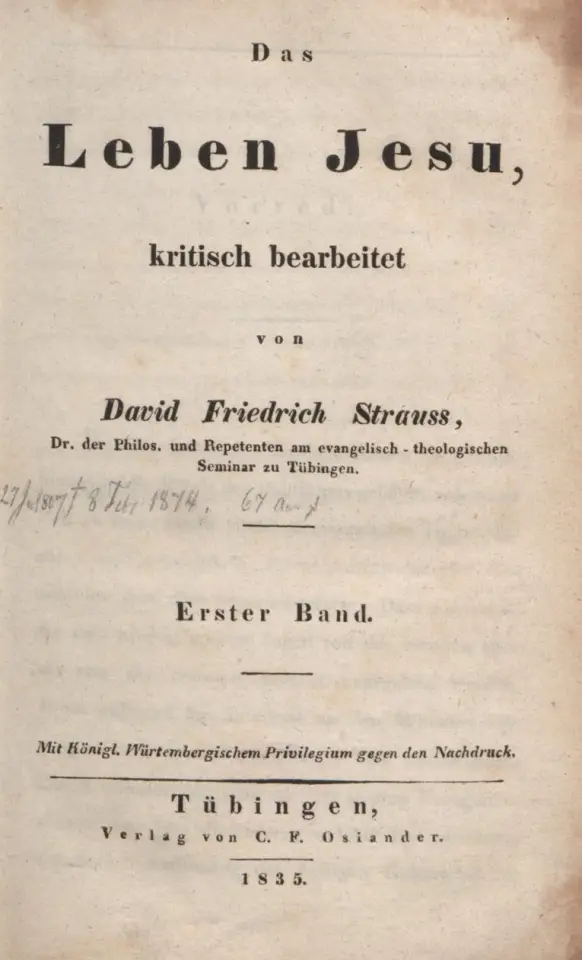
Key points
- Strauss's Life of Jesus (1835)
- Baur's Tübingen School: late dating of New Testament books
- Feuerbach's The Essence of Christianity (1841) – influence on Marx and Freud
- Critiques by Johannes Weiss (1892) and Martin Kähler (1896)
- Schweitzer's summing-up (1906) in The Quest of the Historical Jesus
- Ziegler: after Strauss paths split: Harnack and Troeltsch held historical research necessary for Christology, while Kähler, Herrmann and Bultmann disputed the link between the historical Jesus and the Christ of faith. Liberal Lives of Jesus, owing more to Schleiermacher than Strauss, drew Jesus as a person with supreme God-consciousness; Renan in his Life of Jesus (1864) called him a ‘great soul’ and his delusions ‘beautiful mistakes’. Martin Kähler (1896) held the Gospels to be believers’ confessions, not biographies; the ‘real Christ’ is the Christ preached, and faith arises when the biblical image of Christ ‘conquers’ a person; the Gospels are already ‘a form of dogmatics’. Wilhelm Herrmann (1906) denied that historians can remove uncertainty; faith gains certainty in a personal meeting with the living Jesus. Käsemann, Bultmann’s student, began the “new quest” after the war against radical skepticism: the Gospels tie salvation to the “earthly Jesus”, and historicising the kerygma’s mythic subject checks docetism and enthusiasm; Kingdom preaching and obedience to the Cross are key. Already in 1935 Dibelius noted that the Gospels aim both to report historical facts and to assert christology.
- Shelley: “lower” criticism restored manuscript texts, “higher” criticism studied authorship and setting; many assumed in advance that God works no miracles. Biblical criticism sought the “historical Jesus”: David Strauss (1809–1874) saw in the Gospel portrait the mythological views of the ancients.
People
- David Friedrich Strauss
- Ferdinand Christian Baur
- Ludwig Feuerbach
- Ernest Renan
- Johannes Weiss
- Martin Kähler
- Albert Schweitzer
- Philip Schaff
- Karl Marx
- Ernst Käsemann
- Wilhelm Herrmann
- Martin Dibelius
Place
Germany; France
Sources
- J. North – A History of the Church (Russian edition), p. 315–318
- Justo L. González – A History of Christian Thought in One Volume (Abingdon, 2014), p. 395–396
- Justo L. González – A History of Christian Thought, vol. III: From the Protestant Reformation to the Twentieth Century (Abingdon, rev. ed. 1987), p. 371, 385–387
- Tony Lane – Christian Thinkers (Russian edition), p. 261; p. 241
- Justo L. González – The Story of Christianity, vol. II (Russian edition), Part 3, ch. 28, section «Христианство и история»
- Stanley Grenz, Roger Olson – 20th-Century Theology: God and the World in a Transitional Age (Russian edition), p. 48, 122, 132; p. 122, 124
- The Oxford Handbook of Christology, ed. Francesca Aran Murphy (2015), p. 406–407, 410–412, 414–416, 411–412, 415
- Bruce L. Shelley – Church History in Plain Language (Russian edition), Ch. 40, sec. «Милости просим, Чарлз Дарвин!»
More on the doctrine
- The Historical Criticism of the Bible: From Reimarus and Lessing to the Tübingen School and Strauss (18th–19th centuries (Strauss – 1835))
- Liberal christology and the quest of the historical Jesus: Ritschl, Harnack, Schweitzer, Bultmann (1870–1921)
Data compiled: 2026-11-09