1833–1845 · 19th century
The Oxford Movement and John Henry Newman's conversion to Catholicism
The Oxford Movement began in 1833 with John Keble's sermon "National Apostasy," protesting Parliament's weakening of the Church of England: the Legislature, he wrote, "has virtually usurped the commission" of those entrusted by Christ with a voice in church laws (the sermon's Advertisement). It expressed itself through a series of "Tracts for the Times." The movement defended the episcopate, apostolic succession, tradition and the real presence, contrasting the early church with the Reformation.
Its leader, John Henry Newman, wrote the first and last (90th, 1841) tract. In it he argued (§ 6) that the Thirty-Nine Articles, drawn up before the Council of Trent, condemn not its decrees but "the doctrine of the Roman schools". The tract provoked an outcry, and the series was ended.
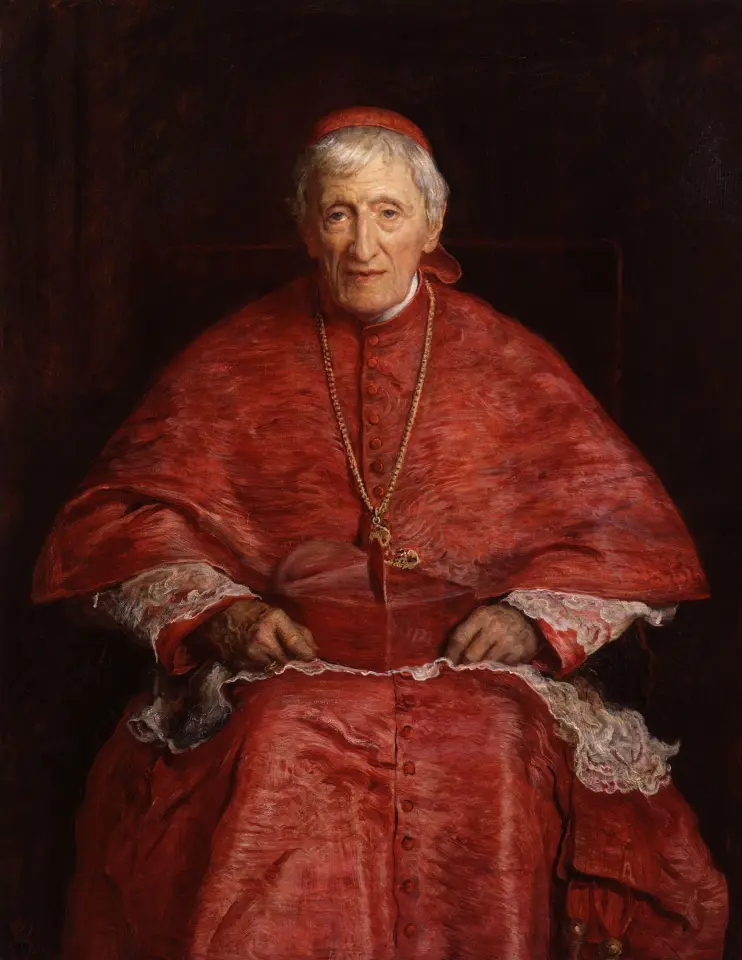
In 1845 Newman converted to Catholicism and published his Essay on the Development of Christian Doctrine. There he argued that doctrine develops under the Spirit's guidance. He later became a cardinal (1879). Most Tractarians remained Anglican, giving rise to liturgical renewal and the revival of monastic orders.
Key points
- Keble's sermon (1833) and the "Tracts for the Times"
- Newman's "Tract 90" (1841) and the end of the series
- Newman's conversion to Catholicism (1845) and his Essay on the Development of Doctrine
- Most Tractarians stayed Anglican: liturgical renewal, revival of monastic orders
- Newman's conflict with Manning (1858); made a cardinal (1879)
- Shelley: the Oxford Movement saw government reforms as an attack on the Church’s sanctity; the 1832 Act shifted power to the middle class. In July 1833 Keble preached “National Apostasy”; Newman and Pusey joined him. From 1833 the movement issued Tracts for the Times, stressing apostolic succession, Church authority and sacramental power. Their ideal was the undivided Church of the first five centuries; Tractarians called themselves Catholics and prized common worship. In 1841 Newman’s Tract 90 read the Thirty-Nine Articles in a Catholic sense, and in 1845 he joined Rome; most Tractarians stayed in the Church of England as Anglo-Catholics, valuing universal tradition but not papal supremacy
- Holifield: after 1789 Episcopalians divided: evangelicals looked to adult renewal, Hobart’s high church party saw baptism as “means and pledge” of grace. Oxford tracts persuaded a few American Episcopalians to affirm Christ’s “substantial” presence; Hobart held to a spiritual presence.
- Holmes: Newman was born into an evangelical family; the Oxford Movement asked evangelicals about tradition, mystery, sacraments, aesthetics and ecclesiology. Evangelicals replied with denial: sacraments as ‘enacted sermons’, ecclesiology unimportant; the London Missionary Society barred such disputes.
- Gunton: Newman saw later developments as the growth of an organism from a seed – not foreign accretions but the unfolding of what was implicit in the faith.
People
- John Henry Newman
- John Keble
- Henry Edward Manning
- Leo XIII
Place
Oxford; Littlemore; England
Sources disagree
Some books give a wider frame (1801 for Newman's birth/conversion arc, 1845–1879 for his Catholic career), but all agree on 1833–1845 as the movement's core span.
Sources
Primary sources
- Keble – National Apostasy, preface
- Newman – Tract 90 (Remarks on Certain Passages in the Thirty-Nine Articles), para. 6
Textbooks
- Tony Lane – Christian Thinkers (Russian edition), p. 295–299, 203
- Justo L. González – A History of Christian Thought in One Volume (Abingdon, 2014), p. 394–395
- Justo L. González – A History of Christian Thought, vol. III: From the Protestant Reformation to the Twentieth Century (Abingdon, rev. ed. 1987), p. 391–393, 414–415
- Louis Berkhof – History of Christian Doctrines (Russian edition), p. 182, 188
- Justo L. González – The Story of Christianity, vol. II (Russian edition), Part 3, ch. 26, section «Развитие событий в Великобритании»
- Bruce L. Shelley – Church History in Plain Language (Russian edition), Ch. 37, sec. «Оксфордское движение»
- The Oxford Handbook of Sacramental Theology, ed. Hans Boersma, Matthew Levering (2015), p. 464–465, 465
- The Cambridge Companion to Evangelical Theology, ed. Timothy Larsen and Daniel J. Treier (2007), p. 259, 260
- The Cambridge Companion to Christian Doctrine, ed. Colin E. Gunton (1997), p. 26
More on the doctrine
Data compiled: 2026-11-09