c. 200 – 238 · 2nd century
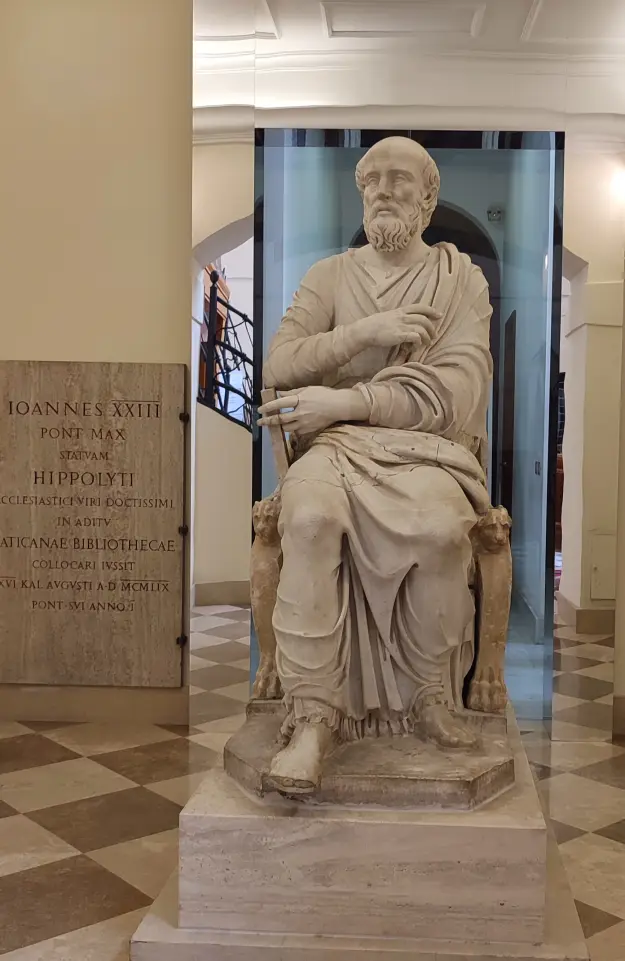
Hippolytus of Rome and the schism against bishop Callistus
Hippolytus was Rome's leading Greek-speaking theologian. He wrote the Refutation of All Heresies and the Apostolic Tradition, which contains the oldest surviving description of the rites of baptism and episcopal ordination (Apostolic Tradition 2–3, 20–22). He fought the modalism of Noetus and Montanism.
When Callistus became bishop of Rome in 217, Hippolytus refused to recognize him. He led a rival community, considering himself the lawful bishop. The schism lasted until 235.
Hippolytus (Refutation of All Heresies 9.7) accused Callistus of excessive leniency – admitting penitents guilty of grave sins; in his time, too, "second baptism was for the first time presumptuously attempted." Callistus, in turn, accused Hippolytus of "ditheism" (ibid. 9.6–7). For his part, Callistus excommunicated Sabellius himself for modalism (9.7).
In 235, during Maximinus Thrax's persecution, both rivals – pope Pontian and Hippolytus – were exiled to the Sardinian mines. According to tradition, they reconciled there, and both died.
Key points
- Hippolytus' Apostolic Tradition – the oldest rite of baptism and episcopal ordination
- Schism of 217–235: Hippolytus refused to recognize bishop Callistus
- Dispute over the Church's holiness: Callistus admitted penitent sinners, citing the parable of the tares (Refutation of All Heresies 9.7)
- Callistus excommunicated Sabellius for modalism; Callistus in turn accused Hippolytus of ditheism (Refutation of All Heresies 9.6–7)
- In 235 Pontian and Hippolytus were exiled to the Sardinian mines, where both died
People
- Hippolytus of Rome
- Callistus I
- Zephyrinus
- Sabellius
- Pontian
- Maximinus Thrax
Place
Rome; Sardinia
Sources
Primary sources
- Hippolytus of Rome – The Apostolic Tradition, ch. 2–3, 20–22
- Hippolytus of Rome – Refutation of All Heresies, bk. IX, ch. 6–7
Textbooks
- Stuart G. Hall – Doctrine and Practice in the Early Church (Russian edition), p. 17–20, 53–55
- Justo L. González – A History of Christian Thought in One Volume (Abingdon, 2014), p. 99–102
- Jaroslav Pelikan – The Christian Tradition: A History of the Development of Doctrine, vol. 1 (Russian edition), p. 123–126, 148, 164–165, 168, 174
- Louis Berkhof – History of Christian Doctrines (Russian edition), p. 40, 53, 55
More on the doctrine
- The holiness of the Church: Hippolytus and Callistus on the "mixed body" (early 3rd century (217–222))
Data compiled: 2026-11-09