early 3rd century (217–222) · 3rd century
The holiness of the Church: Hippolytus and Callistus on the "mixed body"
Of the attributes of the Church in the creeds, "holy" was named most often, and the question of holiness gave rise to the first ecclesiological controversies (Pelikan). Hippolytus defined the Church as "the holy assembly of those who live in righteousness," guaranteed by the purity of its members. Callistus, bishop of Rome, citing the parable of the wheat and the tares (Matt. 13:30) and Noah's ark (Refutation of All Heresies 9.7), held that the Church's holiness rests on forgiveness rather than on the empirical holiness of its members. Hippolytus accused him of absolving all who wished and of keeping bishops in office after mortal sin (ibid.); Tertullian, as a Montanist, attacked in On Modesty (1) a bishop who forgave adulterers.
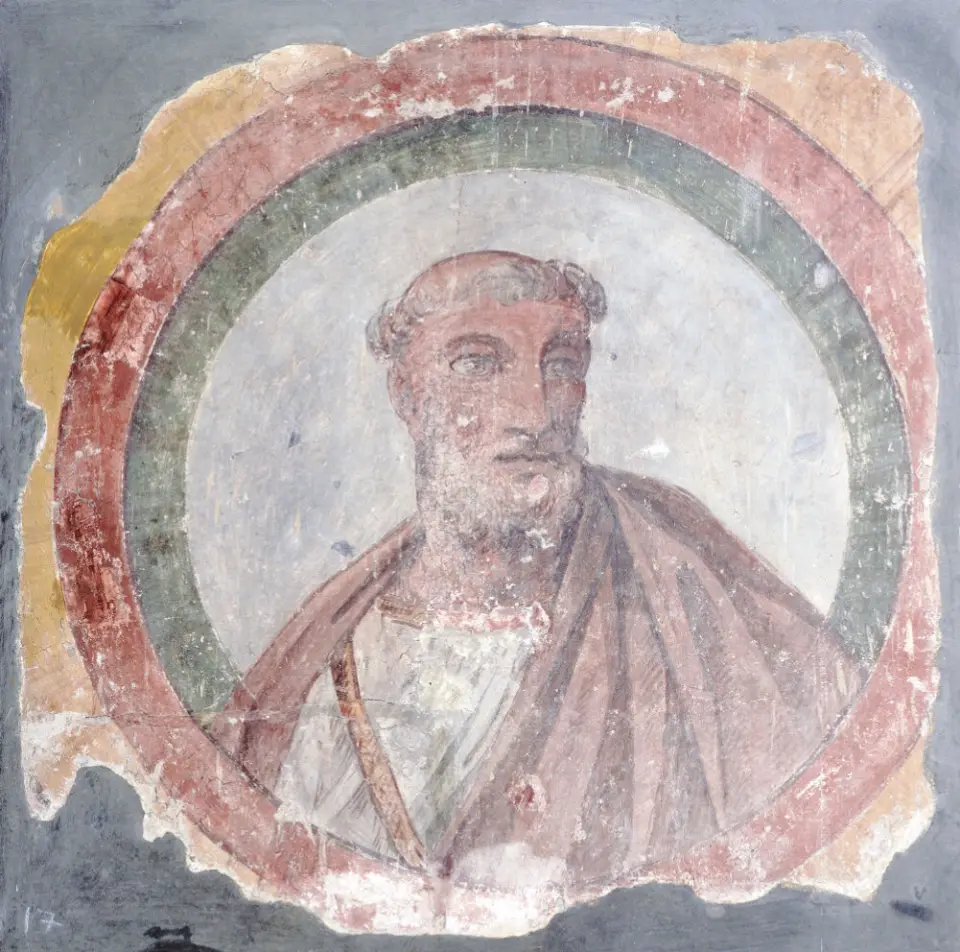
Positions
- Hippolytus
- The Church is the assembly of those who live righteously; the strictest discipline; sectarian baptisms are invalid
- Callistus
- The Church remains catholic even with unworthy members; holiness rests on forgiveness; baptism in other groups is recognized
- Tertullian as a Montanist
- The church does not forgive grave sins after baptism; the "psychics" indulge adultery
Key points
- Pelikan: neither catholics nor schismatics nor heretics disputed that the Church must be holy; the dispute was over what this holiness consists in. The charges against Callistus of breaching discipline are questionable
- Berkhof: in the sects of the pure Church (Montanists, Novatianists, Donatists) the holiness of the members came to be regarded as the sure mark of the true Church
- Hall: Tertullian departed from his earlier position: in On Repentance he himself urged forgiveness of any offense (On Repentance 4)
Outcome
The later catholic defense of the Church as a mixed body rests on the parable of the wheat and the tares (Pelikan); questions of clerical and penitential order resurfaced in the crisis of the 3rd century (Hall). Berkhof: the Church rejected the pure-church movements and increased its emphasis on episcopal organization.
People
- Hippolytus of Rome
- Callistus I
- Tertullian
Terms
- mixed body
- The Church as made up of saints and sinners, in which the tares grow among the wheat until the end of time.
- psychics – psychikoi
- For Valentinus, the middle class of people (ordinary Christians were assigned to it), capable of incomplete salvation; in Montanist terminology, ordinary church Christians as distinct from the "spiritual".
Place
Rome, Carthage
Sources disagree
Hall gives the years of Callistus' episcopate – 217–222; Pelikan does not date the dispute, calling the participants contemporaries of Tertullian.
Sources
Primary sources
- Hippolytus of Rome – Refutation of All Heresies, bk. IX, ch. 7
- Tertullian – On Modesty, ch. 1
- Tertullian – On Repentance, ch. 4
Textbooks
- Stuart G. Hall – Doctrine and Practice in the Early Church (Russian edition), p. 47, 54–55
- Jaroslav Pelikan – The Christian Tradition: A History of the Development of Doctrine, vol. 1 (Russian edition), p. 163–165
- Louis Berkhof – History of Christian Doctrines (Russian edition), p. 166–167
Related entries
- Developed in: The lapsed after the Decian persecution and the schism of Novatian (251)
- Developed in: Augustine: the mixed body, the visible and the invisible Church (early 5th century)
In church history
- Hippolytus of Rome and the schism against bishop Callistus (c. 200 – 238)
Data compiled: 2026-11-17