1552–1582 · 16th century
The Heidelberg Catechism and the rise of Reformed orthodoxy
The dispute over the Lord's Supper began in 1552 with the Hamburg pastor Joachim Westphal's book against Calvin. It produced friction within Lutheranism over Melanchthon's evasive stance. Melanchthon's followers were nicknamed "crypto-Calvinists".
Elector Palatine Frederick III wished to settle the dispute. He commissioned Zacharias Ursinus and Caspar Olevianus to write a catechism. The Heidelberg Catechism (129 questions for 52 Sundays) was adopted by synod in 1563. It expressed Reformed teaching and carried the whole Palatinate into the Calvinist camp. Lutherans, though, immediately condemned it as "Calvinist".
At the same time, thanks to Peter Martyr Vermigli and especially Theodor Beza, Calvin's successor in Geneva, predestination became the systematic core of later Reformed theology. It had not been central for Calvin himself. This theology was built on a deductive, Aristotelian method.
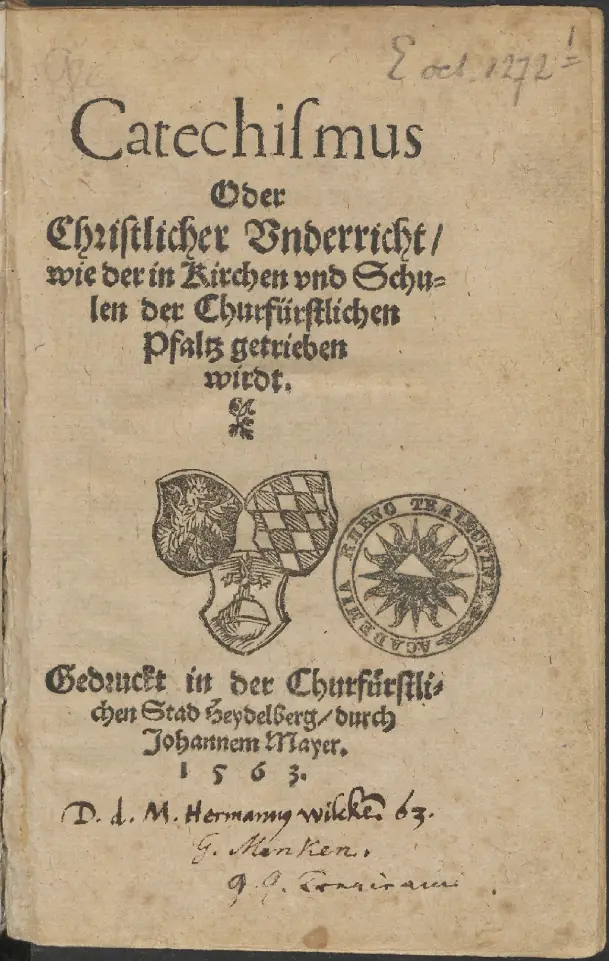
Key points
- The dispute over the Supper (Joachim Westphal, 1552) and "crypto-Calvinism"
- The Heidelberg Catechism (1563), Ursinus and Olevianus
- The term "Calvinism" arose as a polemical label
- Beza builds his theology deductively from the decrees of election
- Muller: the mid-sixteenth century saw a burst of Reformed confessions, from the Consensus Tigurinus (1549) to the Second Helvetic (1566); Lutherans debated synergism for over twenty years, while the Reformed, relying on a confession, excised it at Dort in under six months. Ursinus, the catechism’s chief author, gave lectures and “scholastic exercises” that grounded theological education; Olevianus wrote the first major Reformed treatise on the covenant, Bocquin and Zanchi systems; Olevianus and Zanchi compiled digests of Calvin
- Allen: Heidelberg Catechism Q. 66 defines a sacrament as “visible holy signs and seals”; on Christ’s presence it is deliberately vague.
People
- Zacharias Ursinus
- Caspar Olevianus
- Frederick III of the Palatinate
- Theodore Beza
- Peter Martyr Vermigli
Place
Heidelberg (the Palatinate); Geneva
Sources
- Tony Lane – Christian Thinkers (Russian edition), p. 183–185
- Alister McGrath – Reformation Thought (Russian edition: «Theological Thought of the Reformation»), p. 17, 184, 189–192, 339, 380
- Justo L. González – A History of Christian Thought, vol. III: From the Protestant Reformation to the Twentieth Century (Abingdon, rev. ed. 1987), p. 129–131, 274–275, 277–278, 304
- Justo L. González – A History of Christian Thought in One Volume (Abingdon, 2014), p. 356–358, 361–363
- Louis Berkhof – History of Christian Doctrines (Russian edition), p. 107, 174, 184–185
- The Cambridge Companion to Reformation Theology, ed. David Bagchi, David C. Steinmetz (2004), p. 146, 146–147
- The Oxford Handbook of Sacramental Theology, ed. Hans Boersma, Matthew Levering (2015), p. 353–354, 356, 358
More on the doctrine
- Reformed Orthodoxy and Predestination: from Beza and Zanchi to Turretin, Ursinus and Amyraut (1560–1685)
Data compiled: 2026-11-09