1547–1553 · 16th century
Protestant reforms under Edward VI
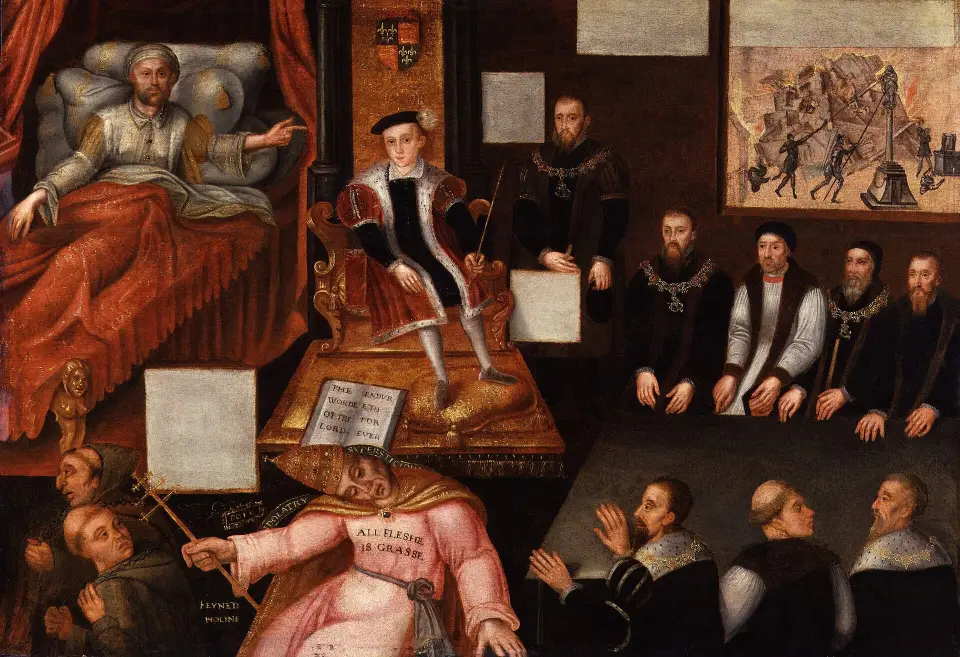
After Henry VIII's death in 1547 the throne passed to the young Edward VI. The regents – Somerset, and then Northumberland – backed a genuine Protestantization of the Church of England.
Archbishop Cranmer introduced communion in both kinds and permitted clerical marriage. He drew up an English-language "Book of Common Prayer". A cautious version appeared in 1549, followed by an openly Protestant revision in 1552, which spoke of a "table" rather than an "altar".
Protestants returned from continental exile, and Martin Bucer and Peter Martyr Vermigli came to England. Together they tilted the English Reformation toward a Calvinist and Zwinglian understanding of the sacraments. In 1553 Cranmer drew up the "Forty-Two Articles" of doctrine.
Key points
- Communion in both kinds and permission for clerical marriage
- The 1549 "Book of Common Prayer" and its openly Protestant 1552 revision
- The arrival of Bucer and Peter Martyr Vermigli in England
- Cranmer's "Forty-Two Articles" (1553)
- Hazlett: after the Augsburg Interim Bucer was exiled to England in 1549 and became Regius professor of divinity at Cambridge; On the Kingdom of Christ (1557) is a reform programme for England: a reformed church replicates the “better” early church within received structures
- Brooks: at the coronation Cranmer called Edward VI “God’s and Christ’s vicar”; the Book of Homilies (1547) was so Lutheran it angered Gardiner, who saw that justification by faith excludes the Eucharist in the Catholic sense. In 1548 communion in both kinds was permitted, and the 1548 Order of the Communion added English confession, absolution and “comfortable words” to the Latin mass: sacrifice became the people’s communion. The rite drew on Bucer’s work for Strasbourg and Cologne; copies sold at the Frankfurt Book Fair – Europe learned of “Cranmer’s revolution”. The 1549 Prayer Book, introduced by the Act of Uniformity, merged five medieval service books into one; its communion removed the idea of propitiatory sacrifice, and the Devon and Cornwall “prayer book rebellions” followed. In the prayer book preface Cranmer had ceremonies turned to vanity and superstition “cut away” and those serving decent order kept – an early via media. Cranmer called popes and their ceremonies “Antichrist”; the book was attacked by conservative Gardiner and radical Hooper (“that English Zwingli”). The 1552 revision drew on Bucer’s Censura: “mass” and “consecration” vanished and the priest stood “at the north side of the Table”, the Gloria was dropped, the Ten Commandments added, and the prayer merely recites the Supper’s institution; Cranmer’s Defence (1550) preceded it
- Trueman: under Edward VI Bucer at Cambridge and Peter Martyr at Oxford strengthened a moderate Reformed establishment against conservatives and radicals. He calls early English thought a “footnote” to the continental text; the Lutheran doctrine of the Supper had almost no defenders. Gardiner in the Tower argued that the 1549 Prayer Book fits Catholic belief in the real presence – thanks to the book’s careful language. Disputes concerned retained Catholic ceremonial and pre-Reformation elements; they subsided only after the Act of Toleration of 1689
People
- Edward VI
- Thomas Cranmer
- Edward Seymour (Somerset)
- John Dudley (Northumberland)
- Martin Bucer
- Peter Martyr Vermigli
Place
England
Sources
- Justo L. González – A History of Christian Thought, vol. III: From the Protestant Reformation to the Twentieth Century (Abingdon, rev. ed. 1987), p. 129, 137, 188–190, 197–198
- J. North – A History of the Church (Russian edition), p. 262–264
- Tony Lane – Christian Thinkers (Russian edition), p. 150, 198–199
- Justo L. González – The Story of Christianity, vol. II (Russian edition), Part 1, ch. 8
- Justo L. González – A History of Christian Thought in One Volume (Abingdon, 2014), p. 330–332
- Alister McGrath – Reformation Thought (Russian edition: «Theological Thought of the Reformation»), p. 257–258
- The Cambridge Companion to Reformation Theology, ed. David Bagchi, David C. Steinmetz (2004), p. 114, 118, 166, 166–167, 166–168, 168–169, 169–170, 173–174, 180
Data compiled: 2026-11-09