1603–1611 · 17th century
The Hampton Court Conference and the King James Bible
James I ascended the English throne in 1603. He rejected the Puritans' moderate petition and insisted on the divine institution of episcopacy ("no bishop, no king"). This stance was backed by Archbishop Bancroft's anti-Puritan canons (1604, 1606).
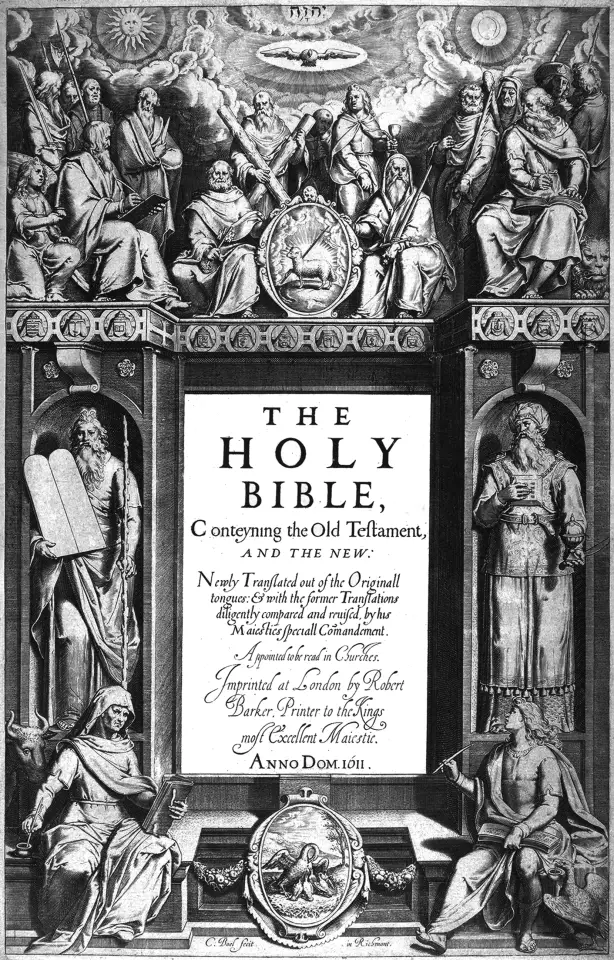
The Hampton Court Conference brought no reconciliation. Its only lasting result was a new Bible translation, published in 1611 as the King James Version.
Even this official translation retained the spurious addition of "the three that bear record in heaven" (1 John 5:7). Erasmus had earlier removed it as unattested in any Greek manuscript. This is an example of theological conservatism outweighing scholarly progress.
Key points
- James I rejected the moderate Puritan petition and insisted on episcopacy
- The Hampton Court Conference (1604) failed to reconcile the sides
- Its only result was a new Bible translation, published in 1611
- The KJV kept the spurious 1 John 5:7 addition though Erasmus had removed it
- Shelley: in 1603 James VI of Scotland became James I of England; Puritan hopes of Presbyterianism in England were dashed at once: “A Scottish Presbytery agreeth as well with a monarchy as God with the devil”. At Hampton Court (1604) he refused the Puritans everything except a new Scripture translation, which became the King James Bible; the rites, the Prayer Book and the bishops remained, and the meeting ended with a threat: “I will harry them out of this land”. Before Parliament James I defended the divine right of absolute rule: “Monarchy is the greatest thing on earth… kings are called gods”; he rejected English institutions and the people’s mood, in 1611 dissolved Parliament and ruled without it for ten years. So Puritan leaders and defenders of parliamentary power were inclined to stand together against royal power
People
- James I
- Richard Bancroft
- Erasmus of Rotterdam
Place
England; Hampton Court
Sources disagree
The dates (1603 – James I's accession, 1604 – conference and canons, 1611 – Bible published) agree across all three books.
Sources
- Justo L. González – The Story of Christianity, vol. II (Russian edition), Part 2, ch. 17
- Alister McGrath – Reformation Thought (Russian edition: «Theological Thought of the Reformation»), p. 204
- Justo L. González – A History of Christian Thought, vol. III: From the Protestant Reformation to the Twentieth Century (Abingdon, rev. ed. 1987), p. 300
- Bruce L. Shelley – Church History in Plain Language (Russian edition), Ch. 30, sec. «Противостояние с королем»
Data compiled: 2026-11-09