1607–1791 · 17th century
Religious Diversity in the American Colonies and the Road to the First Amendment
From the 17th century, North American colonies developed different religious patterns. In Virginia, founded in 1607, the planters' Anglican church prevailed. In Lord Baltimore's Maryland the 1649 Act of Toleration protected Christians of various confessions. In New England Puritan congregationalism took hold (the Mayflower Compact, Plymouth, Massachusetts). There disputes over infant baptism produced the "half-way covenant", and the 1692 Salem "witch" hysteria ended with twenty executions.
Banished from Massachusetts, Roger Williams founded Providence and the colony of Rhode Island (1631–1644) on liberty of conscience. His church became America's first Baptist church. In England the Baptists (General and Particular) emerged as a Puritan offshoot and adopted the London Confessions (1644–1742).
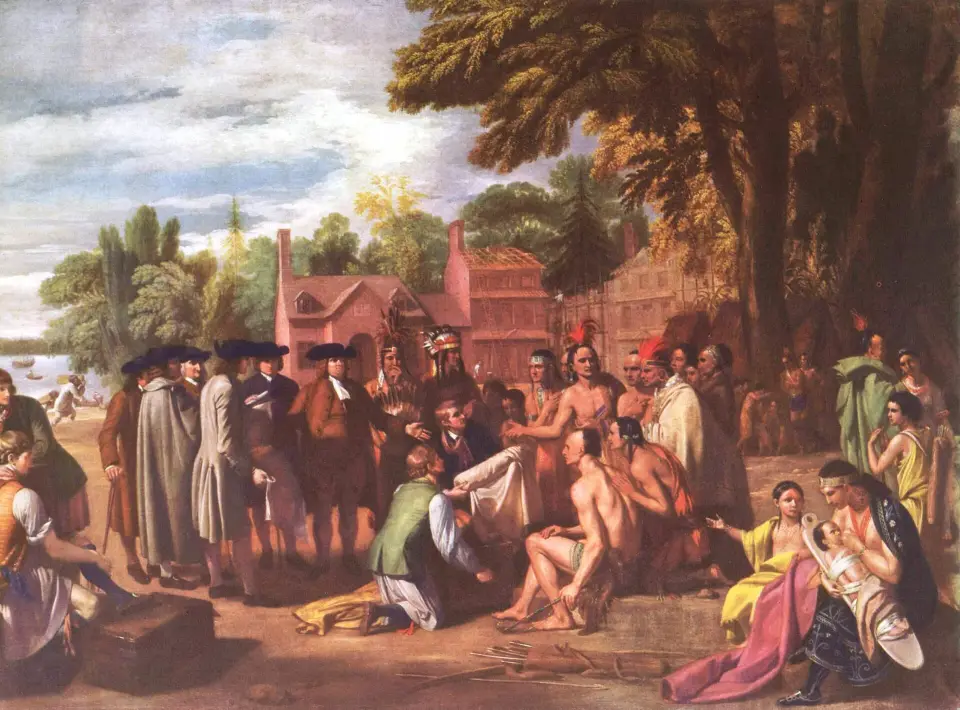
William Penn, having become a Quaker, received Pennsylvania from the crown (1681) and founded a colony of full religious freedom. Quakers were the first in America to officially condemn slavery (1758).
John Eliot's mission among Native Americans began in 1646. It comprised fourteen Christian villages and produced a Bible translation into Massachusett. King Philip's War (1675–1676) nearly destroyed it.
After the War of Independence (from 1775) the Anglican church's position weakened. Jefferson's Virginia Statute (1785–1786) together with the First Amendment (1791) established the separation of church and state and freedom of worship. The very concept of a "denomination" as a voluntary religious body took hold.
Key points
- Puritan New England colonies: Plymouth, Massachusetts, the 1692 Salem trials
- Roger Williams and Rhode Island – liberty of conscience and America's first Baptists
- William Penn and the Quaker "holy experiment" in Pennsylvania (1681)
- John Eliot's mission and its collapse in King Philip's War (1675–1676)
- The First Amendment to the US Constitution (1791) secured freedom of worship
- Shelley: in 1630 at Southampton John Cotton preached a farewell to emigrants, calling them God’s chosen people bound for the promised land – a “snapshot of Puritanism”: the Bible as guide for conversion and society, the Church as agent of transformation. The policy of Charles I and Laud (crosses, altar for table, strict Prayer Book) drove some Puritans into separatism, others to America; ten years after Laud became archbishop the Massachusetts Bay area had twenty towns and churches and sixteen thousand people. The London Company landed the first colonists at Jamestown in 1607, the Pilgrims came ashore in 1620; from 1629 to 1642 about twenty-five thousand Puritans migrated to New England. By 1648 colonists sought religious societies, but newcomers, second-generation indifference and open frontiers hindered uniformity. Apart from Virginia English authorities did not impose it: colonies were commercial ventures, and settlers were promised toleration. Quakers went to Pennsylvania, Catholics to Maryland, Dutch Reformed to New York; later came Swedish Lutherans, Huguenots, English Baptists and Scottish Presbyterians. The Massachusetts Bay Puritans wanted in the wilderness a new Zion with “due form of government both civil and ecclesiastical” (Winthrop); New England lived two generations under one religion, and absence from services and denying Christ’s resurrection brought punishment. Even in New England there was tolerance: Robinson said the Lord has “more truth yet to break forth” from His word. The Cambridge Platform of 1648 confirmed that conversion precedes church entry, and candidates gave a “private and public confession”. The attempt to legislate morality failed; the Halfway Covenant came in 1662, and under the 1691 charter property, not membership, gave the vote. Uniformity failed: dissenters could leave into the wilderness, and the loss of the charter in 1684 ended it. The Reformation unintentionally shattered Christendom, and Europe's state churches swung from repression to inactivity. In the American colonies there were too many national and religious frictions (by 1646 eighteen languages were heard on the Hudson shore), and the only way to obtain religious freedom was to grant it to all others. Churches lacked state help and protection – hence the voluntary principle: denominations gained congregations and funds without the state. The Great Awakening convinced the mass of Christians that the voluntary principle works; Edwards even said that America would be the place of Christ's millennial kingdom. Isaac Backus, key figure of the Warren Association’s committee (1771), became the chief defender of religious liberty: civil and church government “should never be confounded,” and religion is voluntary obedience to God. The voluntary principle was strengthened by Enlightenment ideas: Jefferson, Franklin and Madison based organizations on individual free consent. Revivalists and rationalists joined against established churches; the First Amendment was the fruit. In 1776 for the Great Seal Franklin proposed Moses and Pharaoh’s drowning army: “Rebellion to tyrants is obedience to God”, Jefferson the Israelites in the wilderness; though biblical meaning faded, patriots found in the Bible symbols that united the people
- Holifield: colonists brought a spectrum of sacramental views, from Catholic to Quaker rejection; pluralism let no single view go unchallenged. Southern colonies enacted laws from 1664 that baptism did not free slaves; Dutch clergy feared Africans sought it as release from bondage. New England Puritans saw the sacraments as seals of the covenant of grace and baptized only the children of church members; the synod of 1662 allowed unconverted members to have their children baptized but barred them from the Supper – the “half-way covenant.” The Baptist Isaac Backus (1750s) spoke of “ordinances,” not sacraments, and saw circumcision as a type of rebirth, not of baptism. Lutherans in New Sweden (1638) stressed traditional sacramental doctrine and ritual to set themselves apart from the Reformed Dutch.
- George: Ames’s (a pupil of Perkins) Marrow of Sacred Theology was Harvard’s first theology textbook; theology is “the knowledge of living in the presence of the living God”. In 1742 Philadelphia Baptists hired Franklin to print their first confession, the Second London Confession (1689) with two added articles on hymn singing and the laying on of hands.
- Rowland: at her 1637 trial Anne Hutchinson appealed to “an immediate revelation”; for her judges (Winthrop) this condemned her
People
- Roger Williams
- Anne Hutchinson
- William Penn
- John Eliot
- Thomas Jefferson
Place
Virginia; Maryland; New England; Rhode Island; Pennsylvania; the United States
Sources disagree
Individual episodes are dated consistently across the books; the overall range follows the earliest and latest recorded dates.
Sources
- Justo L. González – The Story of Christianity, vol. II (Russian edition), Part 2, ch. 24
- J. North – A History of the Church (Russian edition), p. 8–9, 10–11, 14
- Justo L. González – A History of Christian Thought, vol. III: From the Protestant Reformation to the Twentieth Century (Abingdon, rev. ed. 1987), p. 299–300
- Tony Lane – Christian Thinkers (Russian edition), p. 212–213
- Bruce L. Shelley – Church History in Plain Language (Russian edition), Ch. 30, introduction; Ch. 30, sec. «Против помазанника Божьего»; Ch. 31, sec. «Новый путь в Америке»; Ch. 35, sec. «Новый порядок веков»; Ch. 35, sec. «Новый порядок для церквей»; Ch. 35, sec. «Новый порядок для церквей»; «Воля Божья в обществе»; Ch. 35, sec. «Защитник религиозных свобод»
- The Oxford Handbook of Sacramental Theology, ed. Hans Boersma, Matthew Levering (2015), p. 455–457, 457–458, 458–459, 459, 460, 456
- The Cambridge Companion to Evangelical Theology, ed. Timothy Larsen and Daniel J. Treier (2007), p. 289, 289–290
- The Oxford Handbook of Apocalyptic Literature, ed. John J. Collins (2014), p. 424
Data compiled: 2026-11-09