1372–1436 · 14th century
The Great Western Schism, Jan Hus, and the Council of Constance
Under Catherine of Siena's influence, Gregory XI returned from Avignon to Rome in 1377 but soon died. The dictatorial Urban VI was elected in his place. Some cardinals declared the election invalid and elected Clement VII at Avignon. So began the Great Western Schism (1378–1417), during which Europe split its allegiance between two, and by 1409 even three, popes.
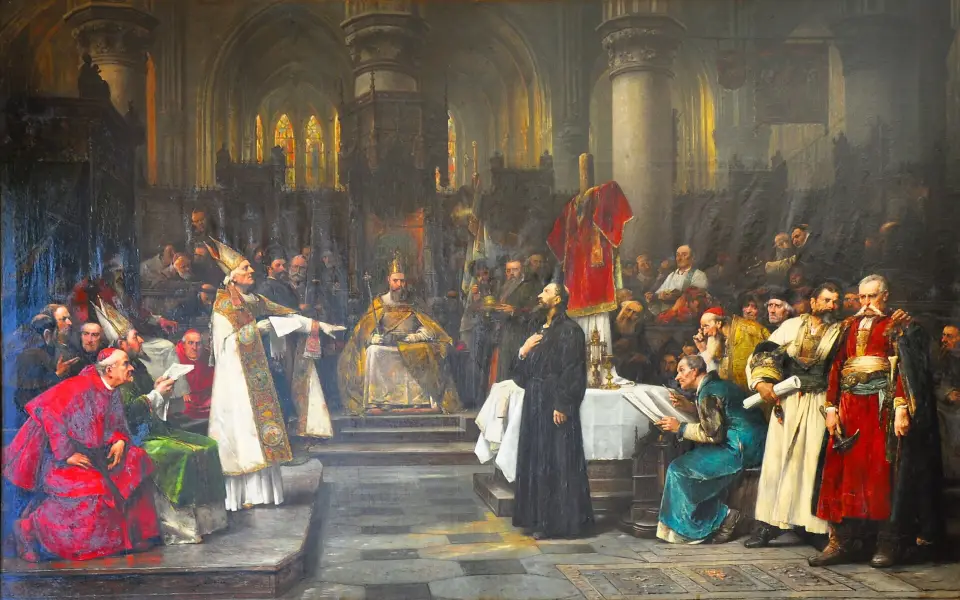
Jan Hus, rector of Prague University, was influenced by Wycliffe. He denounced clerical corruption and the sale of indulgences ('On the Church', 1413; in ch. 18 Hus recalls that he withstood the indulgences of John XXIII's bulls of 1412, about which, he says, he wrote "in another place"). Hus was excommunicated in 1412. He came to the Council of Constance (1414–1418), convened to end the schism, under Emperor Sigismund's safe-conduct. But he was arrested, refused to recant, and was burned on 6 July 1415.
His execution soon triggered the Hussite Wars in Bohemia (1420s–1430s). They ended with the Council of Basel's concessions on communion from the chalice (1436) and the formation of the Unity of the Brethren.
The Council of Constance itself deposed all three rival popes in 1417 and elected Martin V. It condemned 200 of Wycliffe's propositions and thus ended the schism. At the same time it produced conciliarism – the doctrine of a council's supremacy over the pope. This doctrine never took hold permanently: it was finally defeated by 1449 with the dissolution of the Council of Basel.
Key points
- The election of Urban VI and Clement VII: the schism begins (1378)
- Jan Hus: criticism of indulgences, excommunication, and burning at the Council of Constance (6 July 1415)
- The Council of Constance (1414–1418) deposes three popes and elects Martin V
- The Hussite Wars (1420s–1430s) and the Council of Basel's concessions (1436); conciliarism's defeat by 1449
- Fudge: the Hussite programme was codified in the Four Articles of Prague (1420): free preaching, communion in both kinds for all believers, no secular power for the clergy and punishment of serious sins (an office for this was set up in the 1420s). The loss of church wealth followed from the Hussite wars; the assembly at Čáslav in effect legalized the Four Articles for the Czech lands. Utraquism, lay communion from the chalice, was introduced in 1414 by Jakoubek of Střibro, Hus’s successor in the Bethlehem Chapel; by 1417 he and the priest Václav Koranda began to communicate all the baptized, infants included, and Prague synods ratified this. Jakoubek justified the chalice by revelation; it became the Hussite symbol, and the “warriors of God” went into battle under its sign. The Hussites divided into moderates (Praguers) and radicals – Taborites and Oreb. At Tábor secular law was replaced by the “law of God”, and the Taborites gave up slaves, debts and secular authority structures; extreme groups – Pikarts and Adamites – seemed to devalue the sacrament. In 1433 a Hussite delegation was invited to the Council of Basel, where it argued for the Four Articles. After 1437 the Hussite tradition split: the Bohemian Brethren kept the radical aims, the conservative Utraquists were led by Jan Rokycana; both streams survived into the sixteenth century and met the reformations of Luther and Calvin. Hus was a medieval Catholic reformer, not a premature Protestant, and the ‘forerunner’ motif does not fit Bohemia: early Hussite reform was moral rather than doctrinal, going back to Jan Milíč of Kroměříž and Matthew of Janov.
- Levy: Hus (burned 6 July 1415) did not reject transubstantiation: he taught concomitance and that a priest’s immorality does not cancel Christ’s presence. He tried to restrain veneration of Christ’s blood, denied that blood remained on relics, and blamed Wilsnack’s miracles on priestly greed. In 1414 Jakoubek of Stříbro introduced communion in both kinds; the Council of Constance (15 June 1415) upheld lay communion in bread alone, and the Compacts of Prague (1433; Jihlava, 1436) granted the chalice to the Czechs until Pius II revoked them in 1462. Jakoubek taught that Christ himself instituted the drinking of his blood under wine, so those taking only bread do not properly receive it. He granted concomitance, but the body as food is promised to those at the bread, the blood as drink to those at the cup, else two forms were idle; for him communion in both kinds was not an early-church custom open to change but Christ’s direct command to every Christian. Against the lay chalice theologians argued: the hierarchy may set practice; Christ did not command it; it is not needed for salvation. Peter Pulka (1415): Christ let the Church fix the circumstances of a sacrament’s use, not change its substance (risk of spilling, carrying wine). Andrew of Brod held ‘drink of it, all of you’ was said only to apostles; Nicholas of Cusa urged spirit over letter and defended bread alone for laity.
- Shelley: after the pope’s return to Rome (1377) Urban VI was elected but proved a dictator, and French cardinals elected Clement VII at Avignon. The schism lasted 39 years: France and Scotland backed Clement, Italy, the Empire and England Urban; universities, kings and bishops had to decide. In 1395 Paris professors proposed a Council, but canon law let only a pope convene one – hence the formula ‘necessity is the highest law’. Wycliffe and Hus were linked by the marriage of Richard II and Anne of Bohemia (1383): students travelled between London and Prague. Hus, rector and preacher of Bethlehem Chapel, took Wycliffe’s view of the Church as the elect; its walls contrasted the deeds of pope and Christ. Archbishop Zbyněk excommunicated Hus; Hus condemned the sale of indulgences, left for South Bohemia under the interdict and wrote On the Church. Coming to Constance at Sigismund’s invitation, Hus was seized at once by the inquisition and spent eight months in prison. Once witnesses confirmed guilt the accused had to recant or burn; judges believed the witnesses and condemned Hus for heresies he never taught. He would submit if shown errors from Scripture but could not recant heresies he did not hold; in prison he prayed for a fearless heart and right faith, and his last letters are among its greatest literature. On 6 July 1415, on the way to execution, Hus saw his books burning, laughed, and called to onlookers not to believe the lies told about him. At the Devil’s Place he prayed on his knees and refused to recant: ‘God is my witness that the evidence against me is false’; he had written, taught and preached for gospel truth and gladly died. The Bohemian movement refused to die with Hus and split into moderate Chalice-men (Utraquists) and militant Taborites; the Taborites fought empire and Catholic Church until wars exhausted them, and an independent church survived as the Czech Brethren, “a root in dry ground”. By the late 15th century conciliarist hopes were rejected and Wyclif’s and Hus’s revolutions crushed: the papacy could not be reformed from within.
- Weber: the fiercest medieval millenarians were the Taborites, Hus’s followers; after his execution (1415) they fought pope and emperor for fifteen years. They believed they lived in the last days and must cleanse the world of sin before Christ came, so they killed enemies, mostly in battle; some practised community of goods. They finally reconciled with emperor and pope, but the memory of their violence lasted to the Reformation.
People
- Gregory XI
- Urban VI
- Clement VII
- Catherine of Siena
- Jan Hus
- Sigismund
- Jerome of Prague
- Martin V
- Jan Žižka
- Marsilius of Padua
- Jakoubek of Střibro
- Václav Koranda
- Jan Rokycana
- Andrew of Brod
- Peter Pulka
- Nicholas of Cusa
Place
Rome; Avignon; Prague; Constance; Basel
Sources disagree
Lane in one place dates the Great Schism to '1378–1414', elsewhere to '1378–1450' (conciliarism); most books agree on 1378–1417 for the schism proper. Fudge: after 1437 war ceased and the Hussite reforms were recognized by the official church; Fudge does not give 1436.
Sources
Primary sources
- Jan Hus – On the Church (De Ecclesia), ch. 18
Textbooks
- Tony Lane – Christian Thinkers (Russian edition), p. 90, 133–134, 138, 141–143
- Alister McGrath – Reformation Thought (Russian edition: «Theological Thought of the Reformation»), p. 52–53, 376
- Justo L. González – A History of Christian Thought in One Volume (Abingdon, 2014), p. 259–260, 265, 267, 269
- Justo L. González – The Story of Christianity, vol. I (Russian edition), Ch. 26, sec. 26.3; ch. 27, sec. 27.1, 27.3
- J. North – A History of the Church (Russian edition), p. 203–209, 222–223
- The Cambridge Companion to Reformation Theology, ed. David Bagchi, David C. Steinmetz (2004), p. 33, 37, 34–35, 34, 35, 37–38, 36, 38
- The Oxford Handbook of Sacramental Theology, ed. Hans Boersma, Matthew Levering (2015), p. 299, 299–300, 300–301, 302–304, 304
- Bruce L. Shelley – Church History in Plain Language (Russian edition), Ch. 22, sec. «Пленение Его Святейшества», «Папский раскол»; Ch. 23, sec. «Проход в Богемию»; Ch. 23, sec. «Проход в Богемию», «Инквизиция», «Прочь еретиков!»; Ch. 23, sec. «Прочь еретиков!»
- The Oxford Handbook of Eschatology, ed. Jerry L. Walls (2008), Ch. 20, sec. «The Middle Ages»
More on the doctrine
- Conciliarism: the authority of the council over the pope (1378–1417)
- Wyclif and Hus: the invisible Church of the elect and the authority of the unworthy (1379–1415)
Data compiled: 2026-11-09