1379–1415 · 14th century
Wyclif and Hus: the invisible Church of the elect and the authority of the unworthy
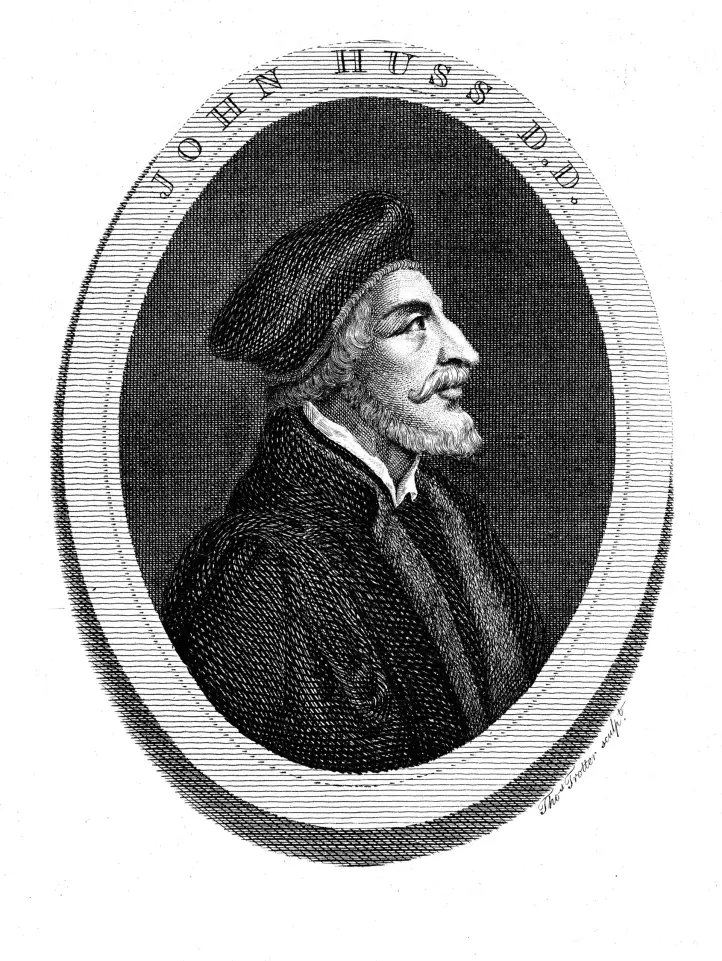
Wyclif taught that true dominion belongs to God alone and is only "lent" to human beings; church authority that uses it unjustly loses its right to the obedience of the laity. Drawing on the Augustinian distinction between the visible and the invisible Church, he regarded the invisible Church as the body of the elect, and in On the Power of the Pope (1379) he wrote that the papal office was instituted by man, does not extend to secular government and depends on moral character; a pope who does not follow Christ is Antichrist. Following him, Jan Hus moved from the institutional, hierarchical church to the invisible Church of the elect, distinguishing those who are in the Church "in reality," "in name only" and "outside the church" (Hus, On the Church 3, gives four classes: "in name and in fact", "neither in fact nor in name", "in name only", and "in fact, although they may seem in name to be outside"), and denied the authority of wicked church leaders.
Positions
- Wyclif
- The legitimacy of authority depends on godliness; a pope who does not follow Christ is Antichrist; later he rejected the papacy altogether
- Hus
- The true members of the Church are the predestined; wicked leadership has no authority; unlike Wyclif, he remained loyal to the doctrine of transubstantiation
- Moderate Hussites (according to Fudge)
- Scripture is the supreme but not the exclusive authority: following Hus they held that authority resided in scripture, tradition and reason; radical biblicism was found only at Tábor; when the Bible was set against the exclusive claims of popes and bishops, primacy went to the Bible, and in 1421 a national convocation decreed that every priest in the land should own a copy of the Bible
Key points
- González: the invisible Church is the body of the elect, the visible includes both elect and reprobate; they cannot be distinguished with absolute certainty. He places Hus and Wyclif on the path of reform, alongside councils and mysticism, as a response to the loss of papal prestige
- Lane: according to Wyclif, the wealth of monastic orders called to poverty is held unjustly; the doctrine of the invisible Church led to a call to turn from the institutional church to the Bible
- Fudge: on the eucharist Hus and Příbram kept transubstantiation, Taborite radicals rejected it, and Pikarts and Adamites devalued the sacrament; the charge of Wycliffite remanentism fits only the radicals; all Hussites agreed only on the laity’s right to the chalice. In soteriology the Hussites stood nearer Aquinas than Luther: “faith formed by love” prevailed, and good works, including sacraments, served salvation; they stayed Augustinian on predestination with “practical Pelagianism”. Justification was no burning issue: the guiding concept of Hussite reform was the “law of God”: biblical and patristic teaching, free preaching, utraquism, Sermon on the Mount ethics. By abolishing “pagan and German laws” the radicals were advocating a theocratic rule of the law of God
- Shelley: Wycliffe saw the earthly Church as a group of the elect; because of predestination no one, not even the pope, knows whether he is in the Church. For Wycliffe the Church is a unity without papal primacies and hierarchies; neither masses nor indulgences can condition the elect’s salvation. Wycliffe condemned indulgences, pilgrimages, image veneration, saint worship and the treasury of merit, but kept purgatory and last anointing; he found confession useful if voluntary and called compulsory confession “the bonds of Antichrist”; preaching outweighs any sacrament
Outcome
Wyclif was removed from teaching in 1381; Hus was excommunicated (1410), condemned by the Council of Constance and burned on 6 July 1415 (Lane).
People
- John Wycliffe
- Jan Hus
- Jan Příbram
Terms
- dominion
- The right to rule, which belongs to God and is only lent to creatures.
- simony
- The buying and selling of church offices.
Place
Oxford, Prague, Constance
Sources disagree
González: Wyclif's dates c. 1329–1384; Lane: On the Power of the Pope in 1379, Hus' On the Church after 1412.
Sources
Primary sources
- Jan Hus – On the Church (De Ecclesia), ch. 3
Textbooks
- Justo L. González – A History of Christian Thought in One Volume (Abingdon, 2014), p. 267–268
- Tony Lane – Christian Thinkers (Russian edition), p. 137–141
- The Cambridge Companion to Reformation Theology, ed. David Bagchi, David C. Steinmetz (2004), p. 35–36, 35, 36, 33–34
- Bruce L. Shelley – Church History in Plain Language (Russian edition), Ch. 23, sec. «От реформатора к протестанту»
Related entries
- Develops: Augustine: the mixed body, the visible and the invisible Church (early 5th century)
In church history
- John Wycliffe and the Lollards (c. 1330–1428)
- The Great Western Schism, Jan Hus, and the Council of Constance (1372–1436)
Data compiled: 2026-11-17