1071–1099 · 11th century
The First Crusade and the Capture of Jerusalem
In 1071 the Seljuk Turks crushed the Byzantine army at Manzikert and took Asia Minor. Emperor Alexios I appealed to Pope Urban II for military help. At the Council of Clermont in 1095 Urban called for the rescue of Constantinople and the liberation of the Holy Land, promising forgiveness of sins. The crowd answered with the cry "Deus vult."
Even before the organized expedition, unruly crowds of peasants and the poor set out, led by Peter the Hermit. Along the way they carried out pogroms against Jews. Near Nicaea they were almost wiped out by the Turks.
The main knightly army was led by Godfrey of Bouillon, Raymond, Bohemond and Tancred. It took Nicaea and, after a long siege, Antioch. On 15 July 1099 it stormed Jerusalem, massacring Muslims and Jews. Godfrey of Bouillon became ruler of Jerusalem. His brother Baldwin I became the first king of the Kingdom of Jerusalem in 1100.
The Crusade's success owed partly to the disunity of the Muslim world. Military-monastic orders later arose – the Templars (1118) and the Hospitallers.
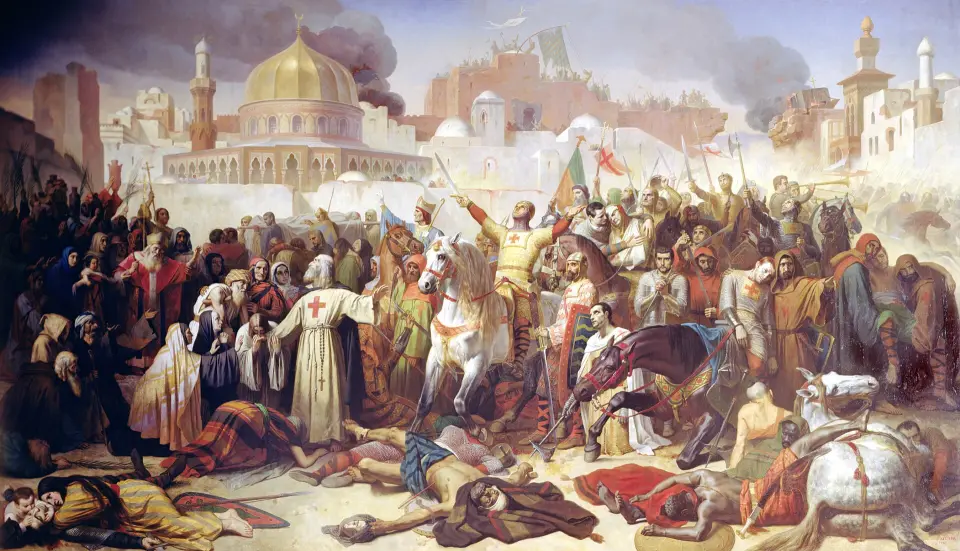
Key points
- Byzantium's defeat at Manzikert (1071) and Alexios I's appeal to the pope
- Urban II's call at the Council of Clermont (1095)
- The People's Crusade and its destruction near Nicaea
- The capture of Jerusalem on 15 July 1099 and the founding of the Crusader states
- Shelley: after Manzikert (1071) and the harassment of pilgrims, Urban II called for a crusade in 1095; the crowd answered, “Deus Vult!” Crusaders had motives beyond zeal (adventure, profit) but knew of spiritual rewards, including forgiveness of sins, and most revered Christ’s land. For Urban and his successors this was a new kind of holy war: Augustine’s just-war principles ‘burned to ashes in the fire of the holy cause’. Attacks on Jews began, Christians were plundered too, and Muslims were killed brutally: corpses were cut open in search of gold, flesh sometimes eaten. Alexius Comnenus expected mercenaries but got an unruly horde of ‘former robbers’ (Urban’s words) and rushed it against the Turks. The First Crusade was the most successful of seven: no more than five thousand knights and foot soldiers beat the divided Turks and took Jerusalem; a contemporary says blood in the temple was ‘knee-deep to a horseman’, and at night the crusaders, hands bloodied, prayed at the Holy Sepulchre, weeping for ‘new and endless joy’. A Latin feudal Kingdom of Jerusalem arose and lasted until 1291. The crusades produced three semi-monastic orders – Templars, Hospitallers and Teutonic Knights – combining monasticism and militarism: they protected pilgrims, could field five hundred knights, and their castles guarded roads and passes. The papacy’s chief gain was luxury; popes overlooked that holy places guarantee no Christian joys and the sword was never God’s tool for church growth. Indulgences grew from confession: forgiveness of guilt is followed by penance, a “temporal” punishment served after death in purgatory. Full remission was first granted by Urban II at Clermont to crusaders going to Jerusalem from “pious zeal” – the Church had long claimed such power; when popes needed money, these benefits were also given to those who contributed, opening a way to raise funds for hospitals and cathedrals.
- Weber: the crusades had millennial motives: by one version of Urban II’s 1095 sermon, the campaign would help faith “bloom again in these last times”, and the Antichrist would soon begin to reign in Jerusalem and must find enough Christians to fight him. People’s Crusade peasants expected Jesus’ kingdom and killed Jews on the way, taking them for followers of the Antichrist from the tribe of Dan.
People
- Urban II
- Peter the Hermit
- Godfrey of Bouillon
- Baldwin I
- Bohemond
- Tancred
- Alexios I
Place
Clermont; Nicaea; Antioch; Jerusalem
Sources
- Justo L. González – The Story of Christianity, vol. I (Russian edition), Ch. 24, sec. 24.1
- J. North – A History of the Church (Russian edition), p. 170–175, 180–181
- Bruce L. Shelley – Church History in Plain Language (Russian edition), Ch. 19, sec. «Взять крест ради Христа»; Ch. 19, sec. «Хроника крестовых походов»; Ch. 19, sec. «Итог святого дела»
- The Oxford Handbook of Eschatology, ed. Jerry L. Walls (2008), Ch. 20, sec. «The Middle Ages»
Data compiled: 2026-11-09