362 · 4th century
The Council of Alexandria (362) and the Reconciliation of Nicenes and Homoiousians
Having returned from exile under Julian, Athanasius took a decisive step toward reconciliation at the Council of Alexandria. The council recognized that verbal differences did not matter as long as the meaning was the same. Both the formula "one hypostasis" and "three hypostases" were acceptable, without falling into Sabellianism or tritheism. This separated the meanings of ousia and hypostasis, which became the foundation of eastern theology.
The council also affirmed the existence in Christ of a full human soul, in response to the forerunners of Apollinaris's teaching. It condemned the Pneumatomachians, who denied the divinity of the Holy Spirit.
At the same time, a separate schism continued in Antioch. The episcopal see was held simultaneously by Meletius, recognized by "the whole East," and Paulinus. Paulinus had been consecrated by Lucifer of Cagliari and was supported by Athanasius, Rome, and Alexandria. The schism lasted until 388.
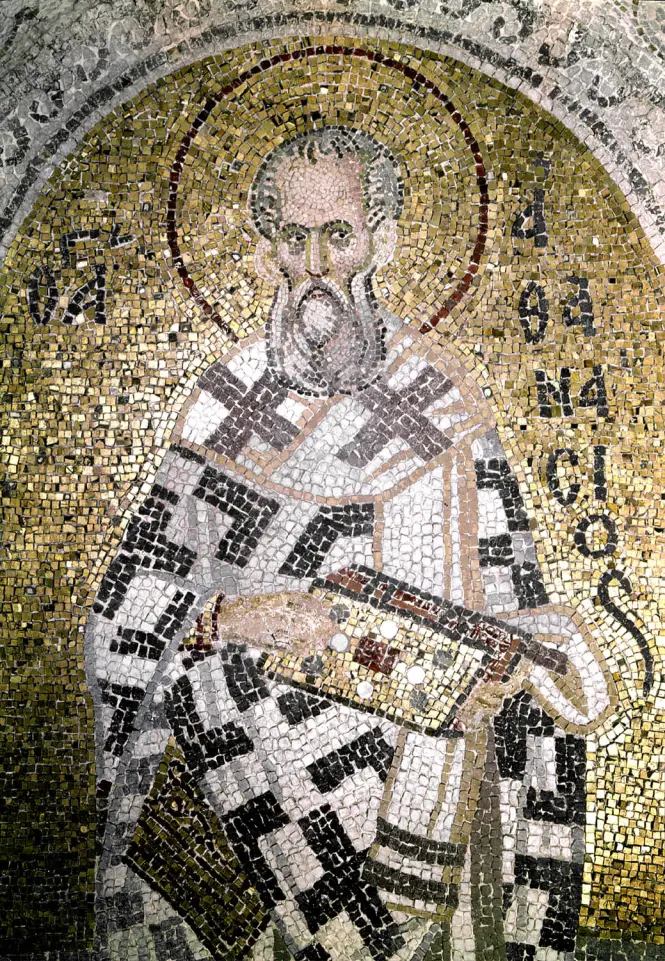
Key points
- Recognition of "one hypostasis" and "three hypostases" as equally orthodox
- Separation of the concepts ousia and hypostasis
- Affirmation of Christ's full human soul against Apollinaris
- Condemnation of the Pneumatomachians
- The parallel Antiochene schism of Meletius and Paulinus
People
- Athanasius the Great
- Apollinaris of Laodicea
- Meletius of Antioch
- Paulinus of Antioch
- Lucifer of Cagliari
- Eusebius of Vercelli
Place
Alexandria, Antioch
Sources disagree
Lebedev, following Hefele, considers Socrates's report that the council banned the word "substance" to be doubtful.
Sources
- Justo L. González – A History of Christian Thought in One Volume (Abingdon, 2014), p. 124–125, 133
- Louis Berkhof – History of Christian Doctrines (Russian edition), p. 69–70
- Justo L. González – The Story of Christianity, vol. I (Russian edition), Ch. 12, sec. 12.3–12.4
- Stuart G. Hall – Doctrine and Practice in the Early Church (Russian edition), p. 98–101
- Tony Lane – Christian Thinkers (Russian edition), p. 39
- A. P. Lebedev – History of the Ecumenical Councils, part I, p. 92, 94–95, 99, 113–115, 250–251, 303, 305, 307, 341
More on the doctrine
- Athanasius, Letters to Serapion: The Deity of the Holy Spirit and the Synod of Alexandria (362) (359/360)
- The anti-Nicene parties (Anomoeans, Homoeans, Homoiousians) and the reconciliation of 362–363 (355–363)
Data compiled: 2026-11-09