361–363 · 4th century
Julian the Apostate and the Attempt to Revive Paganism
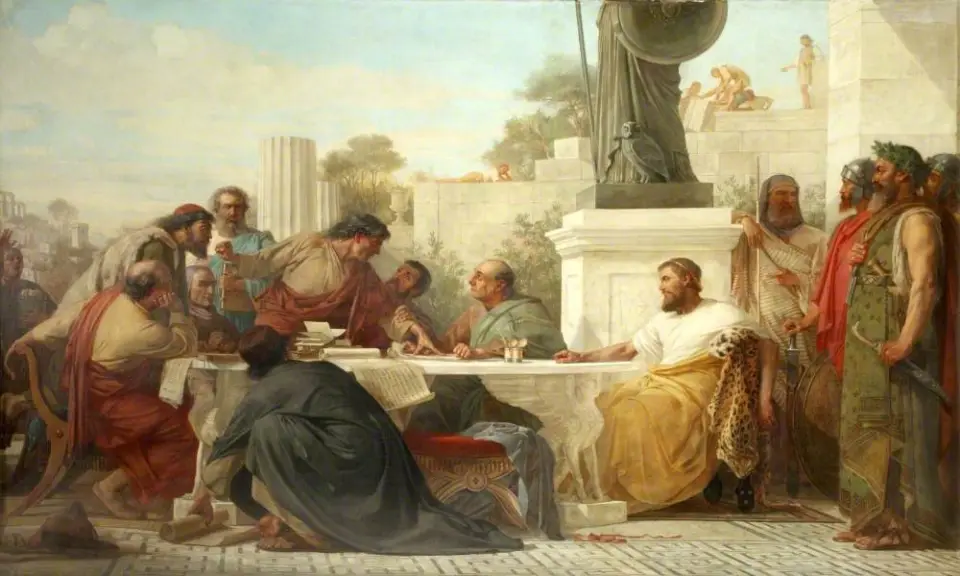
Julian had survived the massacre of his relatives and received a Christian upbringing. But in Athens, where he met Basil of Caesarea, he turned to Hellenic religion. After the death of Constantius II he became sole emperor in 361.
He restored property to the temples and created a pagan hierarchy modeled on the church, requiring charity of the priests. He wrote "Against the Galileans" and attempted to rebuild the Jerusalem Temple. In 362 he banned Christians from teaching classical literature. In the view of one book, this was the heaviest blow to the church of his entire reign.
He recalled all exiled bishops, including Athanasius, who was exiled again under him. He hoped the warring parties would weaken each other. But faced with the pagan threat, they unexpectedly reconciled.
Julian died in 363 on a campaign against Persia. With his death paganism ceased to be a serious political force.
Key points
- Conversion in Athens, acquaintance with Basil the Great
- A pagan hierarchy modeled on the church
- The 362 ban on Christians teaching the classics
- Recall of all exiled bishops
- Death on the Persian campaign in 363
People
- Julian the Apostate
- Constantius II
- Basil the Great
- Athanasius the Great
Place
Constantinople, Gaul, Persia
Sources
- Justo L. González – A History of Christian Thought in One Volume (Abingdon, 2014), p. 124–125
- Justo L. González – The Story of Christianity, vol. I (Russian edition), Ch. 11, sec. 11.1
- J. North – A History of the Church (Russian edition), p. 72–73
- Stuart G. Hall – Doctrine and Practice in the Early Church (Russian edition), p. 9, 98
Data compiled: 2026-11-09