359/360 · 4th century
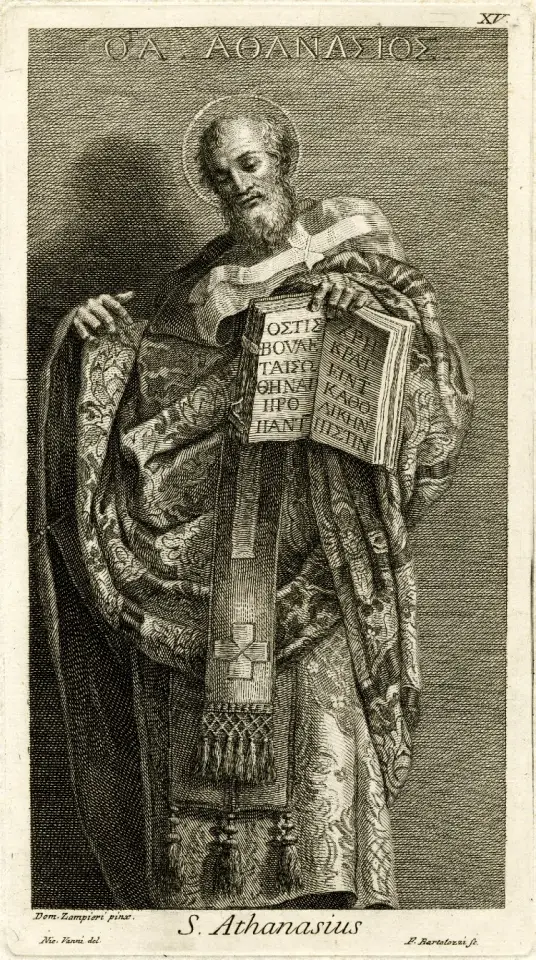
Athanasius, Letters to Serapion: The Deity of the Holy Spirit and the Synod of Alexandria (362)
At Nicaea all that was said about the Spirit was "and in the Holy Spirit," and until the mid-4th century attention was focused on the relation of the Father and the Son. In 359/360 Bishop Serapion informed Athanasius of an Egyptian group that acknowledged the deity of the Son but held the Spirit to be created out of nothing; Athanasius called them "figurists" (tropici). In the Letters to Serapion he set out for the first time a detailed doctrine of the Trinity and maintained that the Spirit is consubstantial with the Father and "proceeds from the Father" (John 15:26): if the Spirit is related to the Son as the Son to the Father, neither is a creature. The Synod of Alexandria in 362 condemned the view that the Spirit is a creature and so extended the controversy to the Holy Spirit.
Positions
- The Egyptian group ("Tropici")
- The Son is God, the Holy Spirit is a creature made from nothing: Nicenes regarding the Son and Arians regarding the Spirit
- Athanasius
- The Spirit belongs to the Son and is given by him, and is therefore consubstantial; "the Spirit of God is not an angel, nor a creature, but proper to the Godhead" (Isa. 63:14)
- The Pneumatomachi at the synod of 362 (Eustathius of Sebaste, Marathonius of Nicomedia)
- The Son is consubstantial with the Father, the Spirit is not
Key points
- Pelikan: Athanasius's argument drew mockery from his opponents: the Spirit turns out to be the Father's "grandson". Athanasius and Basil used the analogy of the human spirit and the self (1 Cor. 2:11) cautiously because of the danger of Sabellianism
- González: the synod of 362 declared that verbal differences do not matter if the meaning is the same and opened the way to union between the Nicenes and the conservative majority. Athanasius's main weakness was the lack of a stable terminology for plurality and unity in the Trinity; he left this task to the Cappadocians
- Lebedev: according to Harnack, the new predicates of the Spirit in the Creed of Constantinople are best explained by comparison with the Letters to Serapion
- Anatolios: in Serapion of Thmuis’s eucharistic prayer (c. 359) the epiclesis is addressed to the Word, not the Spirit: “that the bread become the Word’s body”. This is no indistinction of Word and Spirit but the Eucharist as representing the Incarnation; Athanasius stressed Son and Spirit’s inseparability, not indistinguishability
Outcome
The question of the Holy Spirit was brought to the fore; the deity of the Spirit came to be affirmed by analogy with the deity of the Son.
People
- Athanasius the Great
- Serapion
- Didymus the Blind
- Eustathius of Sebaste
- Marathonius of Nicomedia
Terms
- figurists – tropici
- Athanasius's name for those who denied the deity of the Spirit.
- Pneumatomachi – pneumatomachoi
- "Enemies of the Spirit", who denied the equality of the Holy Spirit with the Father and the Son.
Place
Egypt, Alexandria
Sources disagree
Lane: Letters to Serapion – 359/360; Hall: the letter to Serapion – 360; the Synod of Alexandria – 362 (González). González does not date Athanasius's teaching on the Spirit separately. Lebedev (following Harnack): the Letters to Serapion – 356–362.
Sources
- A. P. Lebedev – History of the Ecumenical Councils, part I, p. 84–95, 99, 250–251, 269, 303, 305, 341
- Jaroslav Pelikan – The Christian Tradition: A History of the Development of Doctrine, vol. 1 (Russian edition), p. 226–228
- Justo L. González – A History of Christian Thought in One Volume (Abingdon, 2014), p. 124–125, 133
- Tony Lane – Christian Thinkers (Russian edition), p. 41
- The Oxford Handbook of Sacramental Theology, ed. Hans Boersma, Matthew Levering (2015), p. 193–194
Related entries
- Leads to: The Controversy with the Pneumatomachi (Macedonians), Basil's On the Holy Spirit and the Council of Constantinople (381) (360–381 (council – 381))
- Develops: The Nicene definition: "consubstantial with the Father" (325)
In church history
Data compiled: 2026-11-17