373–397 · 4th century
Ambrose Becomes Bishop of Milan
After the death of the Arian-leaning bishop Auxentius in 373, an election in Milan threatened to turn into a riot. The provincial governor Ambrose came to calm it. A child's cry of "Ambrose for bishop!" was taken up by the crowd. Although still only a catechumen, he was baptized and passed through all the clerical ranks within eight days. He was consecrated bishop on December 1, 373.
Ambrose spread in the West a theology close to that of the Cappadocians. He introduced the allegorical method of interpretation and congregational hymn-singing to the Latin West. He also defended the church's independence from the imperial court. In 385–386 he refused to surrender the Milanese basilicas to the Arian-leaning empress Justina. In 390, threatening excommunication, he compelled Theodosius I to do public penance for the massacre at Thessalonica.
His preaching, including his allegorical reading of Scripture, helped prepare the way for Augustine's conversion.
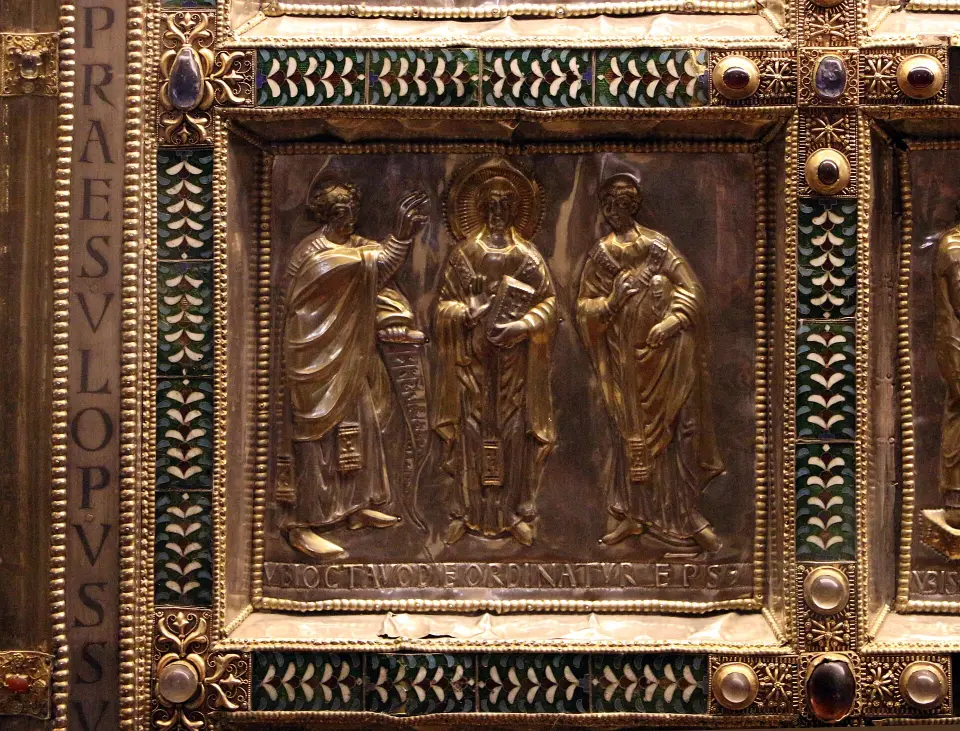
Key points
- Elected bishop while still a catechumen (373)
- Introduction of congregational hymn-singing in the West
- Refusal to hand the basilicas to Empress Justina (385–386)
- Theodosius's penance after the massacre at Thessalonica (390)
- Prepared the ground for Augustine's conversion
- Shelley: in 390 in Greece a governor jailed a charioteer, and the people rioted and killed the governor; Theodosius ordered the rioters punished, and in Thessalonica's circus soldiers killed seven thousand people in three hours. Ambrose, who saw himself as the empire's conscience, demanded the emperor's repentance: “Sin is removed only by tears and penitence” – and refused to admit Theodosius to communion until he confessed his sin. Theodosius laid aside his imperial robes before the assembly and asked forgiveness, repeatedly, before admission to the sacraments at Christmas. Ambrose's threat of excommunication became a weapon of the Western Church, while no bishop in Constantinople went so far
People
- Ambrose of Milan
- Auxentius of Milan
- Valentinian I
- Justina
- Theodosius I
- Symmachus
- Augustine
Place
Milan
Sources disagree
Lane (p. 35) gives 374 as the year of election; González (Story of Christianity, vol. I) and Hall give the precise date December 1, 373.
Sources
- Stuart G. Hall – Doctrine and Practice in the Early Church (Russian edition), p. 107, 112–113
- Justo L. González – The Story of Christianity, vol. I (Russian edition), Ch. 14, sec. 14.1
- Tony Lane – Christian Thinkers (Russian edition), p. 47–49
- Jaroslav Pelikan – The Christian Tradition: A History of the Development of Doctrine, vol. 1 (Russian edition), p. 44
- Bruce L. Shelley – Church History in Plain Language (Russian edition), Ch. 9, sec. «Церковь обретает власть»
Data compiled: 2026-11-09