1559 · 16th century
Calvin: The Accommodation of Revelation and the Inner Testimony of the Spirit
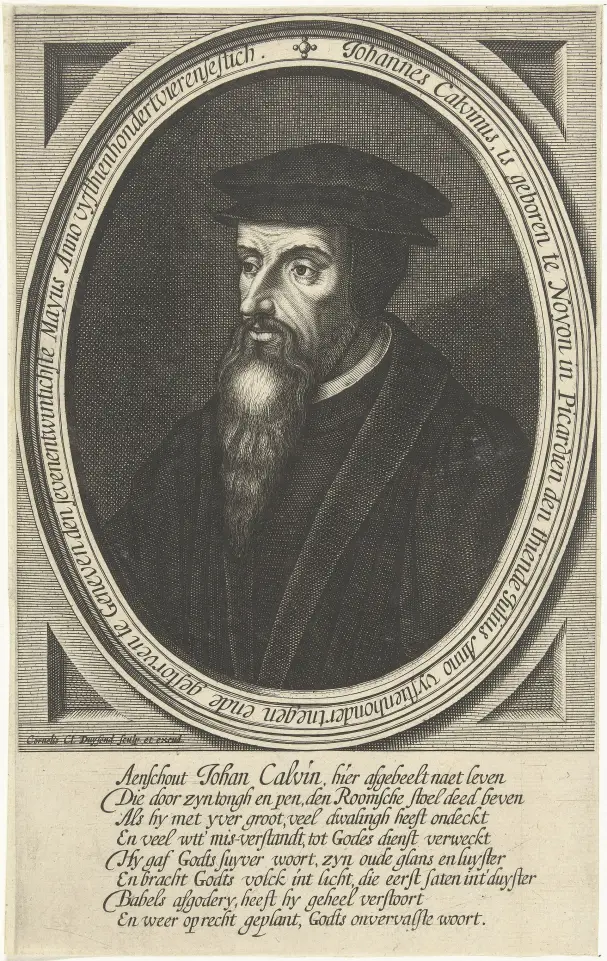
Calvin begins the Institutes (1.1.1) by saying that nearly all human knowledge consists of the knowledge of God and the knowledge of ourselves. The natural awareness of divinity only renders human beings inexcusable (1.5.14), and in revelation God "accommodates" himself to our limited perception, as a good orator to an audience or a mother to her child; biblical anthropomorphisms are God's "baby talk": God, Calvin says, "lisps with us as nurses are wont to do with little children" (1.13.1). Scripture can be called the Word of God because its content is Jesus Christ himself; it does not borrow its authority from the Church, but the Church is built on the foundation of the prophets and apostles, now found in Scripture (1.7.1–2). Rational grounds for believing Scripture are not enough to prove that it is the Word of God: that is known only by the inner testimony of the Spirit (1.7.4–5).
Positions
- Luther (1539)
- Rejected Copernicus's theory by appeal to Scripture (Joshua stopped the sun)
- Calvin
- The purpose of Scripture is knowledge of Jesus Christ, not infallible information about astronomy or medicine; the "six days" of Gen. 1 need not mean six literal days
- Gregory the Great (as reported by González)
- Images are books for the illiterate
Key points
- González: we cannot know God not only as sinners but also as finite creatures before the infinite God
- "Revelations of the Spirit" are not preferable to the plain text: any spirit that does not lead to Scripture and through it to Christ is rejected (Institutes 1.9.1–3)
- Calvin rejects images as not grounded in Scripture; for him the distinction between dulia and latria is mere words (Institutes 1.12.2–3), but he did not go as far as Zwingli
- McGrath: the sentence about Copernicus and the Holy Spirit attributed to Calvin is found in none of his known writings; McGrath sees in Calvin's approach the liberation of the natural sciences from theological constraints
- Steinmetz: Calvin softened “blindness” of fallen reason: people keep a limited natural knowledge of God, but not one fit to ground natural theology. His images – sparks of a dying fire, lightning at night, an old man’s spectacles; Scripture corrects the reading of opera Dei by oracula Dei. Following Cicero, Calvin affirmed an innate sensus divinitatis in all peoples – a sense that God exists, not a conclusion of proofs; hence atheism is unnatural. Without corrected vision people make idols, and healing reason and will needs both Scripture and the Holy Spirit
- Zachman: Calvin’s Christ is the image of the invisible God and God’s accommodation to our littleness; his divinity is revealed only in the works of his humanity. Law and Gospel are two forms of Christ’s self-disclosure: the Law shows him in types as coming, the Gospel as come; the Law remains necessary
Outcome
Scripture was understood as a self-sufficient authority confirmed by the inner testimony of the Spirit; Scripture is the foundation of the Church, not the Church the foundation of Scripture's authority.
People
- John Calvin
- Martin Luther
- Huldrych Zwingli
Terms
- accommodation
- God's adaptation of revelation to limited human capacities; this explains the anthropomorphisms of Scripture.
- inner testimony of the Spirit
- That by which alone it is confirmed that Scripture is the Word of God; for Brunner, the present revelation of Christ to the believer.
Place
Geneva
Sources disagree
González presents the teaching according to the 1559 Institutes (the one-volume history – 1536–1559); McGrath does not date the doctrine of accommodation, linking it to the 1543 preface; Luther's remark about Copernicus – June 4, 1539.
Sources
Primary sources
- Calvin – Institutes of the Christian Religion, bk. I, ch. 1, sec. 1; ch. 5, sec. 14; ch. 7, sec. 1–5; ch. 9, sec. 1–3; ch. 12, sec. 2–3; ch. 13, sec. 1
Textbooks
- Justo L. González – A History of Christian Thought in One Volume (Abingdon, 2014), p. 312
- Justo L. González – A History of Christian Thought, vol. III: From the Protestant Reformation to the Twentieth Century (Abingdon, rev. ed. 1987), p. 141–142
- Alister McGrath – Reformation Thought (Russian edition: «Theological Thought of the Reformation»), p. 324–328
- The Cambridge Companion to Reformation Theology, ed. David Bagchi, David C. Steinmetz (2004), p. 131–132, 132–133
- The Oxford Handbook of Christology, ed. Francesca Aran Murphy (2015), p. 352–354
Data compiled: 2026-11-17