c. 1515 (1513–1521) · 16th century
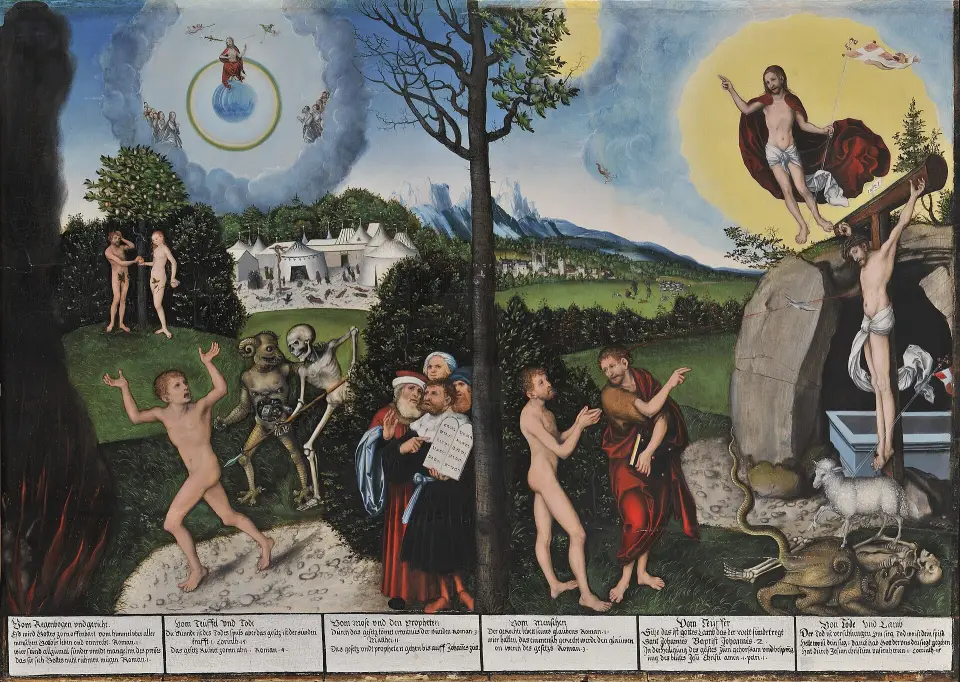
Luther: The Discovery of the "Righteousness of God" and Justification by Faith Alone
Trained in the via moderna, Luther in his first lectures on the Psalms (1513–1515) still taught that God by covenant justifies the one who "does what is in him," and he understood the "righteousness of God" in Rom. 1:17 as the punishing attribute of the Judge. Meditating on the words "the righteous shall live by faith," he came to understand it as passive righteousness – a gift by which the merciful God justifies through faith; according to McGrath, scholars date this breakthrough to about 1515. For Luther, justifying righteousness is the "alien" righteousness of Christ, imputed to the sinner rather than implanted in him, hence the formula "at once righteous and a sinner." Faith is not a work of the mind or will but a work of the Holy Spirit and personal trust in God's promises, uniting the believer with Christ as a bride with her bridegroom; good works are the fruit, not the means, of righteousness. González calls the dialectic of law and gospel the heart of his theology: the law exposes sin, and the gospel is God's undeserved "yes," which declares the law fulfilled for us.
Positions
- Via moderna (Biel), the early Luther
- A person must do his very best, and then God by covenant will give grace; God's righteousness is just retribution
- Augustine (according to McGrath)
- Justifying righteousness is given and becomes internal, part of the person
- Luther
- Justifying righteousness is alien, external, imputed; "faith alone justifies without our works"; from the early 1520s "to justify" means "to reckon righteous," a standing rather than a condition
- The "enthusiasts"
- Having the Spirit, Christians are free from the commandments of the law; Luther replied that the Christian is free from the curse of the law but not from the law as God's will
Key points
- McGrath: the discovery was a “rediscovery” of Augustine, yet Luther introduced elements Augustine would not have accepted. Luther thought that the church of his day had fallen into Pelagianism, and the last authoritative ruling on justification had been given in 418.
- Lane: this was not yet the “truly Protestant” doctrine – the forensic understanding of justification took shape in the early 1520s
- Berkhof: repentance in Matt. 4:17 is inner contrition, a fruit of grace, not works of satisfaction; justification by faith is the article by which the church "stands or falls"
- The Freedom of a Christian (1520): the Christian is a free lord of all and a servant of all; "we are free not from works but from false opinions about works"
- The law has a civil function (restraining the wicked) and a "theological" one (exposing sin); the Old Testament is not identical with law, nor the New with gospel
- Hendrix: Luther’s “Reformation discovery” cannot be severed from the indulgence dispute; it was a struggle against the late medieval path of salvation. In the Disputation against Scholastic Theology (1517) Luther rejected preparing for grace by doing “what is in one” (facere quod in se est), and inverted Aristotle: one does righteous works only after God has made one righteous. In explaining the seventh thesis (1518) Luther wrote that conscience finds peace in Christ’s promise to the pope (Matt 16:19), not in papal power. At Augsburg (1518) Cardinal Cajetan called “new” and “erroneous” the teaching that none is justified except by faith; Luther answered with Rom 1:17 and defined faith as “nothing but believing what God promises and reveals” – Cajetan’s objection crystallised his doctrine of justification. In On Good Works (1520) Luther separates true works, done in faith and by God’s command – not only religious acts but also everyday labor in one’s calling – from false ones (fasts, indulgences, pilgrimages) for merit. It expounds the Ten Commandments: trusting God above all, the first, fulfils all; faith is “master and life of all works”.
- Bagchi: before Trent Catholics granted Luther was right on justification by faith; the closeness was apparent only, as his “faith” was wider than fides.
- Lugioyo: Luther said his first mass in 1507 and later at Erfurt in terror (Brecht), seeing Christ as a stern judge and lawgiver. In the late medieval scheme (Oberman) Christ’s righteousness was completed by human works – for Gabriel Biel, without our merits Christ’s merits would be insufficient; the 1515 discovery: God’s grace alone gives the sinner both iustitia Christi and iustitia Dei at once.
- Shelley: Catholics generally followed Augustine, for whom righteousness is given and gained through life; Luther taught imputation. “Imputation” is a bookkeeping term: God credits Jesus’ righteousness to the believer’s account; it is external, and the person remains a sinner. Protestants call the declaration of righteousness justification and later growth sanctification, in contrast to the Catholic teaching of faith plus works. Luther saw two systems in the Bible – Law and Gospel. The Law’s promises hold on conditions and torment one who cannot meet them, yet the Law plays a vital role by exposing spiritual poverty and need of grace; the Gospel promises unconditionally since God himself meets the conditions. Gospel passages exist in the Old Testament (much in Isaiah) and the New (John, Paul) but not, for example, in the Epistle of James.
- Morgan: Augustine grasped God's righteousness as his gift to the ungodly (Rom. 4:5); successors lost it, and Luther rediscovered it before finding Augustine.
Outcome
Justification by faith as a gift became the basis of Luther's reform program; by 1517 his theology had taken its basic shape, and the forensic understanding of justification became the distinctive mark of Protestant doctrine.
People
- Martin Luther
- Gabriel Biel
- Johann von Staupitz
- Andreas Karlstadt
- Augustine
Terms
- righteousness of God – iustitia Dei
- At first the punishing attribute of God, then the passive righteousness given to the sinner and received by faith.
- alien righteousness – iustitia aliena
- The righteousness of Christ outside the believer, imputed to him.
- at once righteous and a sinner – simul iustus et peccator
- Righteous in God's sight and by his promise, a sinner in reality.
- trust – fiducia
- Readiness to rely on God's promises; the strength of faith lies in the reliability of the one believed in.
Place
Wittenberg
Sources disagree
The date of the "discovery" is disputed: Lane – from 1508 to 1519 (the change is visible in writings of 1514/15); McGrath – about 1515, although Luther himself in the 1545 preface connects the memory with 1519; González – between the Psalms lectures (1513) and 1517. Lane places the shift to a forensic understanding of justification in the early 1520s. Hendrix: most scholars agree that Luther arrived at a new understanding of justification by the end of 1518, but they disagree about the dating, the location and the precise content of the 'Reformation discovery' taken as a single conversion experience (as Luther himself described it in 1545); E. Bizer and O. Bayer linked it to the moment when faith ceased to be determined by humility and was reoriented toward God's Word as promise, whereas, according to Hendrix, Luther continued to insist on humility and repentance. Lugioyo (following Oberman): Luther's reformation discovery – 1515
Sources
- Louis Berkhof – History of Christian Doctrines (Russian edition), p. 160
- Justo L. González – A History of Christian Thought in One Volume (Abingdon, 2014), p. 283, 289–292
- Justo L. González – A History of Christian Thought, vol. III: From the Protestant Reformation to the Twentieth Century (Abingdon, rev. ed. 1987), p. 34–35, 52–54, 56–59
- Alister McGrath – Reformation Thought (Russian edition: «Theological Thought of the Reformation»), p. 50, 139–148, 156–158
- Tony Lane – Christian Thinkers (Russian edition), p. 155, 157–158, 160–161
- The Cambridge Companion to Reformation Theology, ed. David Bagchi, David C. Steinmetz (2004), p. 53–54, 54–55, 53, 55, 58–59, 239–240
- The Oxford Handbook of Christology, ed. Francesca Aran Murphy (2015), p. 330–331, 331
- Bruce L. Shelley – Church History in Plain Language (Russian edition), Ch. 24, врезка «Оправдание верой»; Ch. 24, врезка «Закон и Евангелие»
- The Cambridge Companion to St Paul, ed. James D. G. Dunn (2003), p. 263
Related entries
- Rejects: The Via Moderna and the Schola Augustiniana Moderna: The Dispute over Meriting the First Grace (14th–15th centuries)
- Developed in: Luther: the doctrine of the two kingdoms (1520s)
- Developed in: Justification in Protestantism after Luther: Zwingli, Melanchthon's Forensic Justification, Bucer's Double Justification (1520–1571)
- Developed in: Controversies in Lutheranism after Luther – Antinomian, Synergist, Majorist, Osiandrian – and the Formula of Concord (1528–1577)
- Answered by: The Tridentine Decree on Justification and the Anathemas against Protestant Teaching (1547)
- Answered by: Bonhoeffer, The Cost of Discipleship: Cheap and Costly Grace (1937)
In church history
Data compiled: 2026-11-17