1567–1606 · 16th century
Catholic Controversies on Grace after Trent: Baius, Báñez, Molina and the De Auxiliis Controversy
Trent defined that one cannot turn to God without prevenient grace, but that the will can and must cooperate with it; how to reconcile these statements remained a matter of controversy. In Salamanca Báñez taught that God gives efficacious grace to the elect and withholds it from the reprobate; in Louvain Baius held that the fall had corrupted human nature itself, and in 1567 Pius V condemned seventy-nine of his propositions. The Jesuit Luis de Molina, in the Concord of Free Will with the Gifts of Grace (Lisbon, 1588), proposed the notion of "middle knowledge" and taught that grace is made efficacious by the consent of the will. The Dominicans replied that grace is efficacious in itself, and the de auxiliis controversy moved to Rome; in 1606 Paul V decided not to decide, allowing both positions and forbidding mutual accusations of heresy.
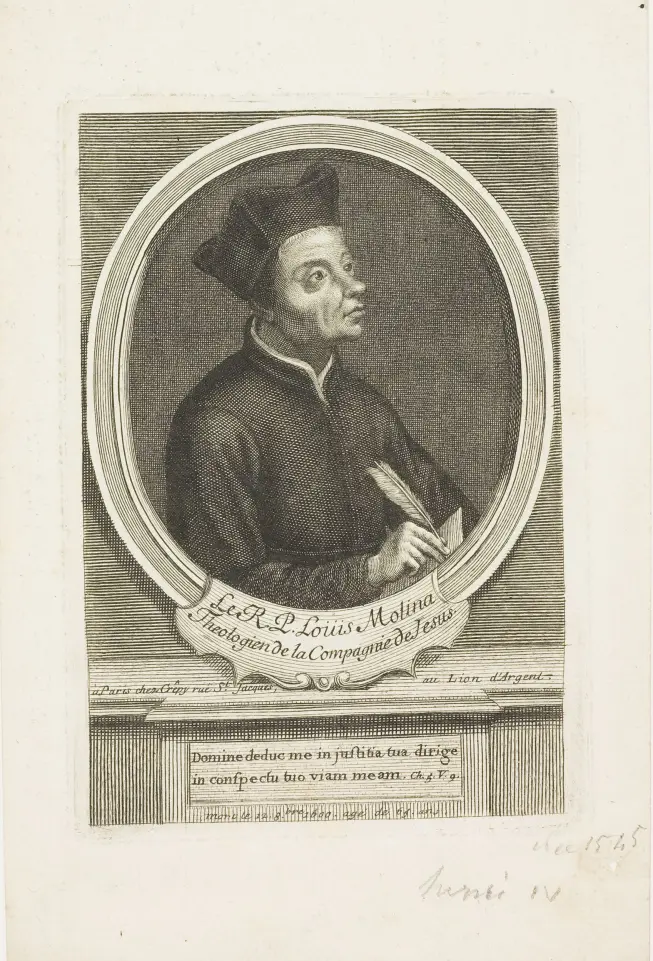
Positions
- Báñez and the Dominicans
- The cause of conversion is help from above, the cause of unbelief is its absence; grace is efficacious in itself (ab intrinseco); the "physical premotion" of the will by grace
- Baius
- Through the fall humanity lost not a supernatural gift but something of its very nature; the perverted will cannot will the good
- Molina and the Jesuits
- Freedom is freedom not only from coercion but also from necessity; there is no difference between sufficient and efficacious grace – the consent of the will makes it efficacious (ab extrinseco); predestination depends on foreknowledge; "physical premotion" denies freedom
Key points
- Molina answered the Protestant charge of Pelagianism: after the fall supernatural virtues and “original justice” were lost, not natural freedom
- Molina: God’s “general concurrence” is sufficient for faith
- The first edition of the Concord appeared with Báñez's objections and Molina's reply; Dominican opposition was immediate and fierce
- The Valladolid disputation (1594); a commission set up by Clement VIII (1597) declared in 1598 that Molina's views were contrary to Augustine and Thomas and close to the Pelagians
- Paul V (1606): the Dominicans are not Calvinists, since grace perfects freedom; the Molinists are not Pelagians, since the initium fidei lies in grace
- Paul V (1611) and Urban VIII (1625, 1641) ordered writings on grace to be submitted to the Inquisition
- González: the dispute resembles that of Luther and Erasmus
Outcome
Both positions were allowed while mutual accusations of heresy were forbidden; according to González, the controversies remained unresolved, and the Molinist dispute was overshadowed by the Jansenist one.
People
- Domingo Báñez
- Michael Baius
- Luis de Molina
- Lessius
- Ignatius of Loyola
- Pius V
- Clement VIII
- Paul V
Terms
- middle knowledge – scientia media
- The knowledge by which God knows future contingent events that depend on free creatures; it stands between "natural" knowledge of the possible and "free" knowledge of what God has willed.
- physical premotion
- The Dominican concept of grace acting upon the will, set against the Molinist "simultaneous concurrence".
- congregations on aids – congregationes de auxiliis
- Conferences in Rome on divine aid to human freedom.
Place
Salamanca, Louvain, Lisbon, Valladolid, Rome
Sources disagree
The condemnation of Baius – 1567; Molina's Concord – 1588 (in the one-volume HCT, 1588 is the year the Dominicans questioned its orthodoxy); Valladolid – 1594; the commission – 1597–1598; the conferences – from 1602; Paul V's decision – 1606 (González, vol. III).
Sources
- Justo L. González – A History of Christian Thought in One Volume (Abingdon, 2014), p. 345–346
- Justo L. González – A History of Christian Thought, vol. III: From the Protestant Reformation to the Twentieth Century (Abingdon, rev. ed. 1987), p. 230–236
Related entries
- Develops: The Tridentine Decree on Justification and the Anathemas against Protestant Teaching (1547)
- Answered by: Jansenism: Jansen's Augustinus, Arnauld, Pascal and the Condemnations from In eminenti to Unigenitus (1640–1713)
Data compiled: 2026-11-17