16th–18th centuries · 15th century
Socinus against substitutionary atonement and Grotius's "governmental theory"
Socinus, according to Berkhof, removed the foundation of the Reformers' teaching – the idea of God's justice demanding the punishment of sin: grace and Christ's merits are incompatible, guilt is personal, substitution is impossible, and forgiveness is an act of pure mercy upon repentance; Christ saves by opening the way of faith and obedience and giving an example. Hugo Grotius proposed a "middle course": the law concerning the sinner is positive and can be relaxed; Christ's sufferings are a nominal equivalent that God agrees to accept, and their reason is the moral government of the universe, since without expressing the inviolability of the law it is unsafe to forgive. According to González, Christ in Grotius suffered not to pay for sins nor to give an example, but to show that God, though ready to forgive, regards the breaking of the law as a serious guilt. The Arminians Curcellaeus and Limborch likewise steered between Socinianism and church teaching, and in the United States the "governmental theory" became predominant.
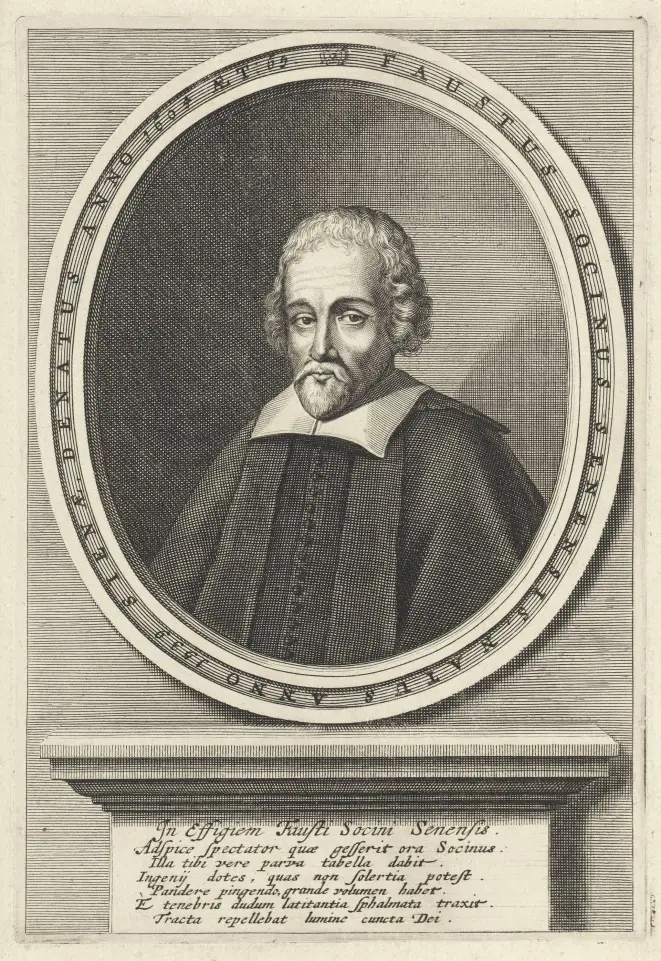
Positions
- Socinus
- Forgiveness is free, without satisfaction; substitution is impossible; satisfaction and imputation contradict each other
- Grotius
- The law is positive; Christ gave a nominal equivalent; the purpose is maintaining the moral order
- Arminians (Curcellaeus, Limborch)
- Christ's death is a sacrifice, but not payment of a debt – a condition of forgiveness; the atonement is universal in intent, its efficacy depends on the sinner's will
- The Reformers
- A real equivalent; penal substitutionary satisfaction
Key points
- Berkhof: Socinianism is a "concoction" of condemned heresies: Pelagianism, adoptionism, the moral influence theory and the theory of Scotus. Grotius’s work shows affinity both with the Reformers and with Socinianism. In 1650 Pynchon opposed the teaching that Christ suffered the same torments as the damned (Norton’s reply – 1653); Bellamy proposed an “American doctrine of the atonement” – essentially Grotius’s theory
- Grotius’s work is the Defense of the Catholic Faith concerning the Satisfaction of Christ against Faustus Socinus of Siena
- Elliott: Socinians held God could forgive without satisfaction; Goodwin replied God chose substitutionary atonement to show justice. Grotius (1617) saw Christ’s death as public warning and display of righteousness; Limborch, value by the Father’s estimation
Outcome
Berkhof rejects Socinianism as rationalistic and considers Grotius's theory an intermediate one that answers Socinus poorly; the Synod of Dort rejected the Arminian position, and in the United States the governmental theory became predominant.
People
- Faustus Socinus
- Hugo Grotius
- Curcellaeus
- Philipp van Limborch
- William Pynchon
- Norton
- Bellamy
- Hopkins
- Emmons
Terms
- governmental theory
- The atonement as the maintenance of the moral government of the universe.
Place
the Netherlands, the United States
Sources disagree
Berkhof does not date Socinus (16th–17th centuries) or Grotius (17th century); González: On the Truth of the Christian Religion – 1622, Grotius lived 1583–1645; Pynchon – 1650, Norton – 1653 (Berkhof). The years in the fields are approximate.
Sources
- Louis Berkhof – History of Christian Doctrines (Russian edition), p. 134–138, 143–144
- Justo L. González – A History of Christian Thought, vol. III: From the Protestant Reformation to the Twentieth Century (Abingdon, rev. ed. 1987), p. 292
- The Oxford Handbook of Christology, ed. Francesca Aran Murphy (2015), p. 367–368
Related entries
- Rejects: The Reformers and Calvin: penal substitutionary satisfaction (16th century (Institutes of 1559))
- Answered by: For whom did Christ die: limited atonement from Gottschalk to Dort, Westminster and Owen (1618–1733)
In church history
Data compiled: 2026-11-17