16th century (Institutes of 1559) · 15th century
The Reformers and Calvin: penal substitutionary satisfaction
According to Berkhof, the doctrine of the atonement was not a matter of dispute between the Reformers and Rome – the differences concerned the application of Christ's work. The Reformers largely followed Anselm, but saw sin as transgression of the law and guilt rather than as an offense to honor, so that the atonement is a penal substitutionary sacrifice in the sphere of public law; they rejected the alternative "satisfaction or punishment": satisfaction was accomplished through punishment. They distinguished active obedience (fulfilling the law) and passive obedience (suffering and death), and supplemented mystical union with the appropriation of Christ's merits by faith. Calvin understood Christ's work as satisfaction: by his obedience unto death Christ merited forgiveness for us, but it is the inner working of the Holy Spirit, whose chief work is faith (Institutes 3.1.4), that makes this effective for the believer. The ground of Christ's merit, according to McGrath, Calvin saw not in the sacrifice itself but in God's decision to accept it as sufficient.
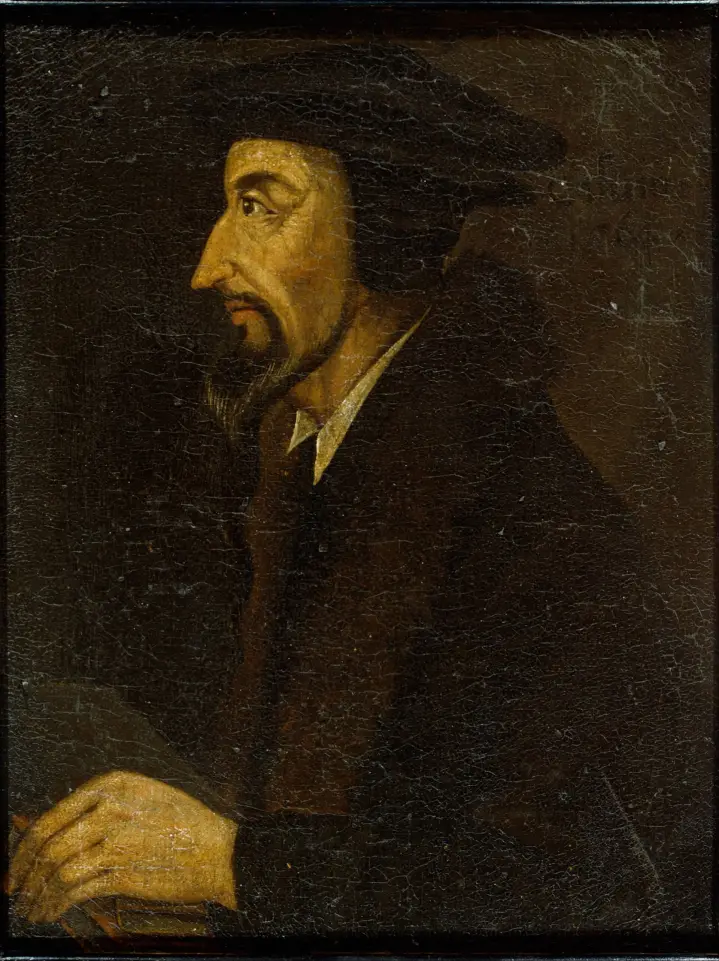
Positions
- Anselm
- Absolute necessity; a gift to God's honor
- The Reformers
- Hypothetical necessity; a penal substitutionary sacrifice
- Calvin (according to McGrath)
- The value of the merit is determined by the decision of God's will: "apart from God's good pleasure Christ could not merit anything" (Institutes 2.17.1)
- Luther (according to McGrath)
- Christ's divinity is a sufficient ground for the uniqueness of his death
Key points
- Berkhof: for Calvin the necessity of the atonement flowed from God’s decision about what is best for us (Institutes 2.12.1: the necessity was not "simple or absolute" but "flowed from the divine decree"); unlike Scotus, Calvin does not make the atonement dependent on arbitrary will
- McGrath: Calvin’s voluntarist position is set out in the 1559 Institutes after his correspondence with Lelio Sozzini; it continues the tradition of Ockham and Gregory of Rimini rather than directly that of Scotus
- González: Calvin's definition of faith is "a firm and certain knowledge of God's benevolence towards us", sealed upon our hearts by the Holy Spirit (Institutes 3.2.7)
- Lugioyo: contrary to Aulén, Luther in The Misuse of the Mass (1521) speaks of appeasing God’s wrath and satisfaction for sin made once for all by the Son; in the catechisms (as Arnold notes) he goes beyond Anselm, placing the appeasement in Christ’s divinity as well as his humanity. Luther’s theory of the atonement cannot be reduced to an Anselmian one.
- Zachman: for Calvin Christ’s death propitiates God’s wrath and changes his stance toward us; “satisfaction” means the transfer of our guilt to Christ (cf. Institutes 2.16.5–6: the punishment "was transferred to the head of the Son of God").
- Holmes: Fuller denied or redefined penal substitution, which earlier evangelical leaders had used unreflectively; it was not exclusively evangelical. Packer and Stott saw it as an evangelical mark, but historically it is not; Steve Chalke called it ‘cosmic child abuse’.
Outcome
The Reformers developed the theory of penal substitutionary satisfaction and raised the atonement from the sphere of private rights into the sphere of public law (Berkhof).
People
- John Calvin
- Martin Luther
- Lelio Sozzini
- Anselm of Canterbury
Terms
- active and passive obedience
- Christ's fulfilment of the law, and his sufferings and death.
- the ground of Christ's merit – ratio meriti Christi
- Why Christ's death is sufficient for the redemption of humanity.
Place
Geneva
Sources disagree
Berkhof: the Reformation period (16th century); McGrath: correspondence with Lelio Sozzini – 1555, the answers incorporated into the 1559 Institutes; González – according to the 1559 Institutes.
Sources
Primary sources
- Calvin – Institutes of the Christian Religion, bk. II, ch. 12, sec. 1; ch. 16, sec. 5–6; ch. 17, sec. 1; bk. III, ch. 1, sec. 4; ch. 2, sec. 7
Textbooks
- Louis Berkhof – History of Christian Doctrines (Russian edition), p. 133–134
- Justo L. González – A History of Christian Thought, vol. III: From the Protestant Reformation to the Twentieth Century (Abingdon, rev. ed. 1987), p. 154–155
- Alister McGrath – Reformation Thought (Russian edition: «Theological Thought of the Reformation»), p. 123–125
- The Oxford Handbook of Christology, ed. Francesca Aran Murphy (2015), p. 335–336, 355–360
- The Cambridge Companion to Evangelical Theology, ed. Timothy Larsen and Daniel J. Treier (2007), p. 256–257, 268
Related entries
- Develops: Anselm, Why God Became Man: satisfaction of God's honor (c. 1097–1100)
- Develops: The Via Moderna and the Schola Augustiniana Moderna: The Dispute over Meriting the First Grace (14th–15th centuries)
- Rejected in: Socinus against substitutionary atonement and Grotius's "governmental theory" (16th–18th centuries)
Data compiled: 2026-11-17