Middle Ages · 11th century
The Scholastics on the atonement: Lombard, Bonaventure, Aquinas and Duns Scotus's "acceptation"
Peter Lombard, Bonaventure and Thomas Aquinas, according to Berkhof, adopted elements of Anselm and Abelard without joining them into an inner unity: Lombard begins with Christ's merits, but answers the question of how his death frees us in Abelard's way – it reveals to us God's love. Thomas absorbed his predecessors' thought more fully than the others: the atonement is not absolutely necessary – God could have forgiven without satisfaction, but chose to require it; Christ's passion effects salvation as merit, as superabundant satisfaction through the mystical union of head and members, as a voluntary sacrifice and as redemption from bondage; the devil has no rights, and no ransom was paid to him. Duns Scotus made the atonement dependent on God's arbitrary decision: satisfaction was necessary only because God willed it, and the finite merit of Christ's human nature was accepted by God as sufficient (acceptilation, or acceptation).
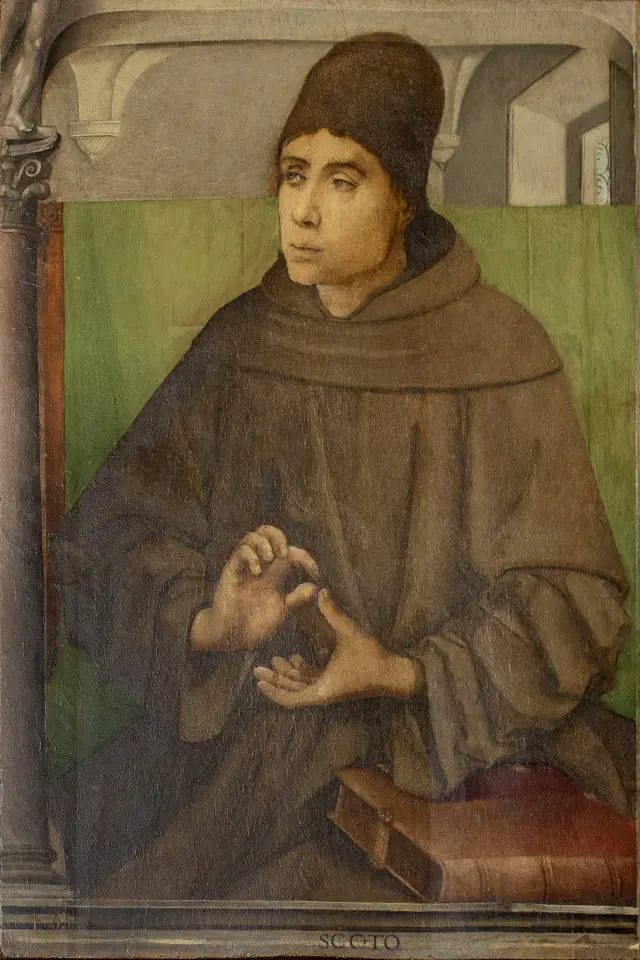
Positions
- Bonaventure
- Satisfaction through Christ's merits and sufferings as the most fitting means; the communication of blessings through the relation of head and members of the body
- Thomas Aquinas
- The atonement is relatively necessary and depends on God's will; Christ's merits extend through his whole earthly life
- Duns Scotus
- Everything depends on God's arbitrary decision; God could have accepted even the work of an angel
- Anselm
- The atonement is absolutely necessary
Key points
- Berkhof: in Thomas there is an anticipation of the distinction between active and passive obedience and the idea of mystical union; the element of arbitrariness in Thomas became a bridge to Scotus, and Scotus's teaching the basis of the later dispute over the necessity of the atonement
- Satisfaction does not save without baptism and penance (Thomas)
- Scotus denies the infinite value of Christ's merits, since they are the merits of a finite human nature
- Hogg: Aquinas, drawing on Anselm, held Christ’s death both necessary and the best means of deliverance from sin (ST III, q.46, a.1); Scotus objected: man’s offense is not infinite, Christ’s work has no infinite value, and people can add their own works
- Van Nieuwenhove: Bonaventure accepts “satisfaction” as the most fitting but not the only way; merit lies in Christ’s love and obedience; satisfaction changes not God but us, and the incarnation also completes creation, a thought Scotus developed. Thomas takes satisfaction from Anselm but distinguishes punishment (against one's will) from satisfaction (voluntary, as in penance); hence his teaching is not penal but “the reconciliation of friendship” (reconciliatio amicitiae). Christ as Head of the Body gives satisfaction belonging to all the faithful as members: salvation by participation, not substitution. God could have saved humanity in another way (III, q.1, a.2); on whether God would become incarnate without sin Thomas seems to prefer yes, though Scripture favours the other view (III, q.1, a.3). Thomas pays more attention to Christ's life (III, q.35–45) than his predecessors. The cross’s value lies in Christ’s love and obedience, not in sufferings; so he rejects appeasing an angry God. The Word suffers in his human, not divine nature (III, q.46, a.12) – unlike Moltmann and others who attribute suffering to God as God. Scotus accepts satisfaction but denies the infinity of Adam’s sin and the need of the God-man: a pure creature could satisfy too. Christ’s merit rests on God’s acceptatio; per Yang it is not arbitrary but rests on an eternal decree, so Scotus’s voluntarism is moderate
Outcome
Thomas's teaching became the official theology of the Roman church; Berkhof judges it inferior to Anselm in coherence but superior in its emphasis on merit and mystical union.
People
- Peter Lombard
- Bonaventure
- Thomas Aquinas
- John Duns Scotus
Terms
- acceptilation (acceptation)
- God's acceptance of a finite merit as sufficient by his will; the second name is Mackintosh's.
Sources disagree
Berkhof gives no dates and places these teachings in the Middle Ages; the years in year_start/year_end are approximate (the period after Anselm and Abelard).
Sources
- Louis Berkhof – History of Christian Doctrines (Russian edition), p. 128–131
- The Oxford Handbook of Christology, ed. Francesca Aran Murphy (2015), p. 255, 312–314, 314–316, 316–318, 318–320
Related entries
- Develops: Anselm, Why God Became Man: satisfaction of God's honor (c. 1097–1100)
- Develops: Abelard and Bernard of Clairvaux: the "moral influence theory" (12th century (synod of 1141))
- Develops: Duns Scotus and the Nominalists: The Primacy of the Will, God's Absolute and Ordained Power (14th–15th centuries)
In church history
- John Duns Scotus – the 'Subtle Doctor' (c. 1265–1308)
Data compiled: 2026-11-17