2nd–4th centuries · 1st century
Ransom to Satan, the deception of the devil and Christ's victory: Origen and Gregory of Nyssa
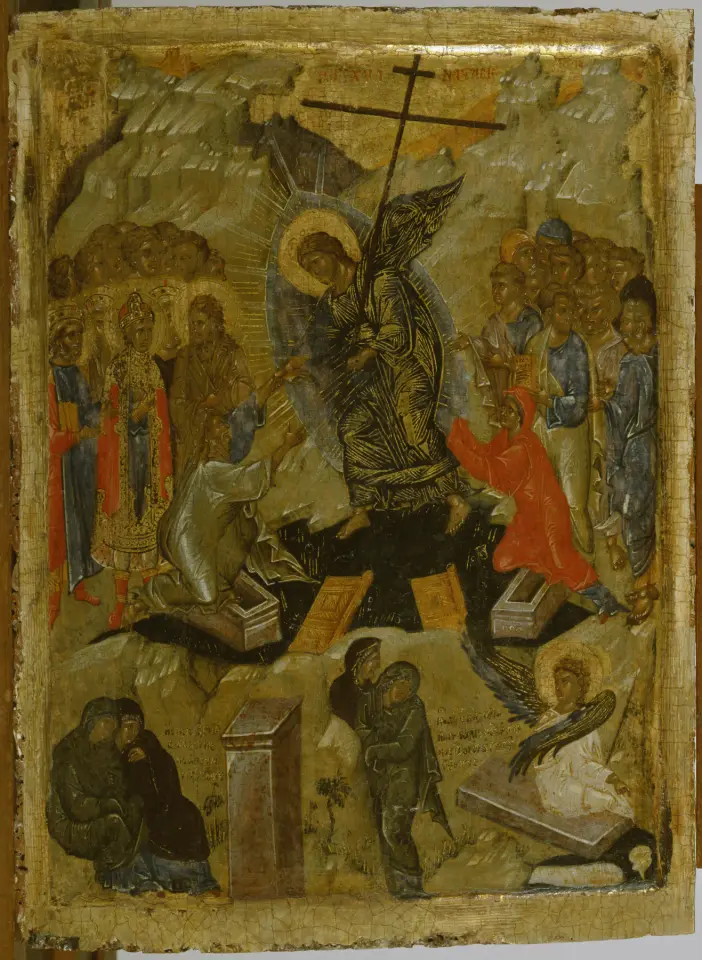
According to Pelikan, the Fathers of the 2nd–3rd centuries placed a particularly strong emphasis on the saving significance of the resurrection, hence the "classic" theory of the atonement as Christ's victory over humanity's enemies: Origen wrote that Christ's death began the overthrow of the devil's dominion, and Irenaeus that Christ as man conquered by "binding the strong man". Origen, according to Berkhof, offered several views of Christ's work without unity – deification of nature, example, sacrifice for sin, liberation from Satan's power – and introduced a new idea: Satan accepted Christ as a ransom, not realizing that he could not hold the Sinless One. Gregory of Nyssa (Great Catechism 22–26) developed the idea: the ransom was paid to the one who held humankind in his power; the Deity was hidden under the veil of our nature so that, "as with ravenous fish, the hook of the Deity might be gulped down along with the bait of flesh" (ch. 24); the deception was a just recompense for the deceiver, and in the end the adversary himself will benefit from the Incarnation (ch. 26), while Gregory of Nazianzus mockingly rejected the ransom to Satan and the idea that the Father demanded a ransom. Christ's descent into hell was also connected with the victory over the devil.
Positions
- Origen
- The ransom was accepted by Satan, who was deceived; the redemptive influence extends to all fallen spirits, including Satan
- Clement of Alexandria
- Christ is above all Lawgiver, Teacher and the Way to immortality; self-giving as ransom without emphasis on propitiation
- Gregory of Nyssa
- The deception of Satan is justified: the deceiver got what he deserved and will himself ultimately be saved (Great Catechism 26)
- Gregory of Nazianzus
- The ransom to Satan is rejected; the Father did not demand a ransom
Key points
- Pelikan: the image of Christ the victor has a more important place in Orthodox interpretations of salvation than in Western dogmatics. The descent into hell is first mentioned in Syriac materials; in the West it entered the creed not earlier than 370 and was understood as triumph over the devil
- Berkhof: Chrysostom and Cyril stress the immense value of Christ's death; Cyril – the infinite value of the death of a Divine Person. The idea of the deception of Satan became widespread in Greek patristics
- Russell: Origen (Commentary on Romans 3.8) reasoned that a ransom must have been paid to Satan, who gained dominion over humankind through the Fall, and that Satan was deceived, because he could not have overcome the sinless Christ. In the West Ambrose of Milan took up the argument, setting it out in transactional terms: the Lord’s blood was the price that “had to be paid to the devil” (Ep. 72.8); Christ was sacrificed in our stead to satisfy the norms of justice (De Fuga 44; Expos. Ev. Luc. 4.7). Augustine was more circumspect: he says nothing of a ransom to the devil, who had no rights over us (De Trin. 4.16), and victory over him was a by-product of reconciling humanity with God through Christ’s death and resurrection (Enchiridion 108). Nevertheless the forensic model became dominant in the West, for reasons not yet adequately investigated. Gregory Nazianzen found a ransom paid to the devil outrageous; the ransom is God himself, paid “for the sake of the economy”. Nyssen (the hook) and Maximus (the devil’s deception) show Christ’s victory is not by force; in the East communion and deification outweigh sacrifice. Origen’s detractors read him as letting the devil and his angels be saved at the apokatastasis; Augustine and Theophilus of Alexandria rejected this as unbiblical. In homilies demons are real beings who gather at a sinner’s death; Christ’s victory is certain, but salvation is not automatic
Outcome
Different lines of the doctrine of the atonement persisted in the Greek Church (Berkhof); the descent into hell became fixed in the Western creed as a victory over the devil, while the atonement itself was increasingly interpreted as satisfaction (Pelikan).
People
- Origen
- Clement of Alexandria
- Irenaeus of Lyons
- Gregory of Nyssa
- Gregory of Nazianzus
- John Chrysostom
- Cyril of Alexandria
- Ephrem the Syrian
Terms
- ransom to Satan
- The idea that Christ's death was a payment to Satan, who was deceived, unable to hold the Sinless One.
Place
Alexandria
Sources disagree
The books give no exact dates: Clement and Origen – 2nd–3rd centuries (Berkhof), Pelikan – 2nd–3rd centuries; the Great Catechism – 4th century (Berkhof); the descent into hell in the Apostles' Creed – not earlier than 370 (Pelikan).
Sources
Primary sources
- Gregory of Nyssa – The Great Catechism, ch. 22–26
Textbooks
- Jaroslav Pelikan – The Christian Tradition: A History of the Development of Doctrine, vol. 1 (Russian edition), p. 154–156
- Louis Berkhof – History of Christian Doctrines (Russian edition), p. 48–49, 119–120
- The Oxford Handbook of Christology, ed. Francesca Aran Murphy (2015), p. 206–207, 207–208, 206
Related entries
- Rejected in: Anselm, Why God Became Man: satisfaction of God's honor (c. 1097–1100)
- Developed in: Aulén, Christus Victor: the classic, or dramatic, idea of the atonement (1930)
Data compiled: 2026-11-17