1930 · 20th century
Aulén, Christus Victor: the classic, or dramatic, idea of the atonement
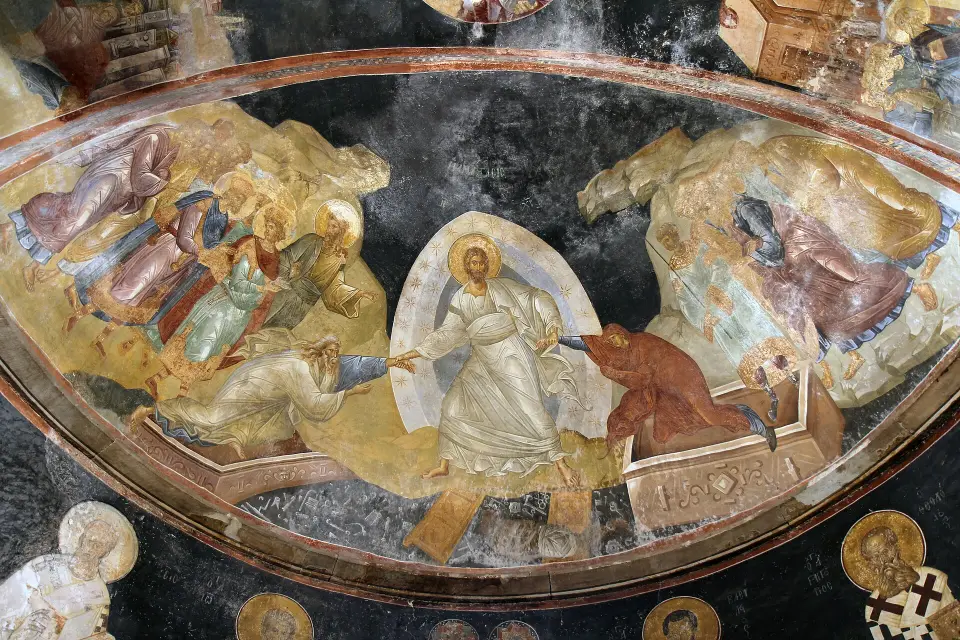
After Ritschl it was customary to contrast Anselm's "objective" theory (Christ satisfied God's justice) and Abelard's "subjective" theory (Christ's death changes us, not God's attitude to us). Gustaf Aulén of the Lund school argued that in the ancient church there was a third, "classic" or "dramatic" view: the atonement as Christ's "divine conflict and victory" over the powers of evil under which we stood – God's work "from first to last". This idea, according to Aulén, dominates the New Testament and Irenaeus and was voiced again "more boldly and more fully" by Luther; it was neglected because it was expressed in "mythological" language. Aulén refused to interpret the ancient texts about the victory over the Evil One as metaphors: only in the classic theory is there a genuine "drama of redemption".
Positions
- Anselm (objective theory)
- Christ is the substitutionary payment that satisfied God's justice
- Abelard (subjective theory)
- Christ is an example; his death changes man
- Aulén (classic theory)
- Christ is the Victor over the powers of evil; sin is bondage, undone by the defeat of these powers
- Lane
- Aulén, like Ritschl, was wrong to present the doctrines as rival alternatives; they are complementary aspects of Christ's single work
Key points
- González: Aulén relied on Anders Nygren’s “motif research” (Agape and Eros, 1930 and 1936); the Lund school, independently of Barth, re-examined Luther and rediscovered Irenaeus. The merit of the Lund theologians was restoring the significance of evil and attention to the corporate nature of evil and salvation
- Lane: Aulén is unfair to Anselm; many Fathers saw Christ at the same time as restoring us before God, awakening love, and winning the victory over evil
Outcome
The work stimulated further discussion of the atonement (Lane); the Lund school offered a response to liberalism parallel to and complementing Barth, and influenced the ecumenical movement (González).
People
- Gustaf Aulén
- Anders Nygren
- Albrecht Ritschl
- Adolf von Harnack
- Irenaeus of Lyons
- Martin Luther
Terms
- classic (dramatic) idea of the atonement
- The divine conflict and victory of Christ over the powers of evil.
- limited dualism
- The Lund theologians' insistence on a real struggle between God and the powers of evil without falling into Manichaean dualism.
Place
Lund
Sources disagree
Discrepancy: Lane – the Christus Victor lectures were delivered in 1930; González (both books) dates Christus Victor to 1948; 1930 is taken as the main date following Lane, as the date of the lectures themselves.
Sources
- Justo L. González – A History of Christian Thought in One Volume (Abingdon, 2014), p. 417–418
- Justo L. González – A History of Christian Thought, vol. III: From the Protestant Reformation to the Twentieth Century (Abingdon, rev. ed. 1987), p. 456–457
- Tony Lane – Christian Thinkers (Russian edition), p. 259–261
Related entries
- Rejects: Anselm, Why God Became Man: satisfaction of God's honor (c. 1097–1100)
- Rejects: Abelard and Bernard of Clairvaux: the "moral influence theory" (12th century (synod of 1141))
- Develops: Ransom to Satan, the deception of the devil and Christ's victory: Origen and Gregory of Nyssa (2nd–4th centuries)
Data compiled: 2026-11-17