18th – early 19th century · 18th century
The modern period: Clarke, the New England theologians, Schleiermacher and "Sabellian" interpretations
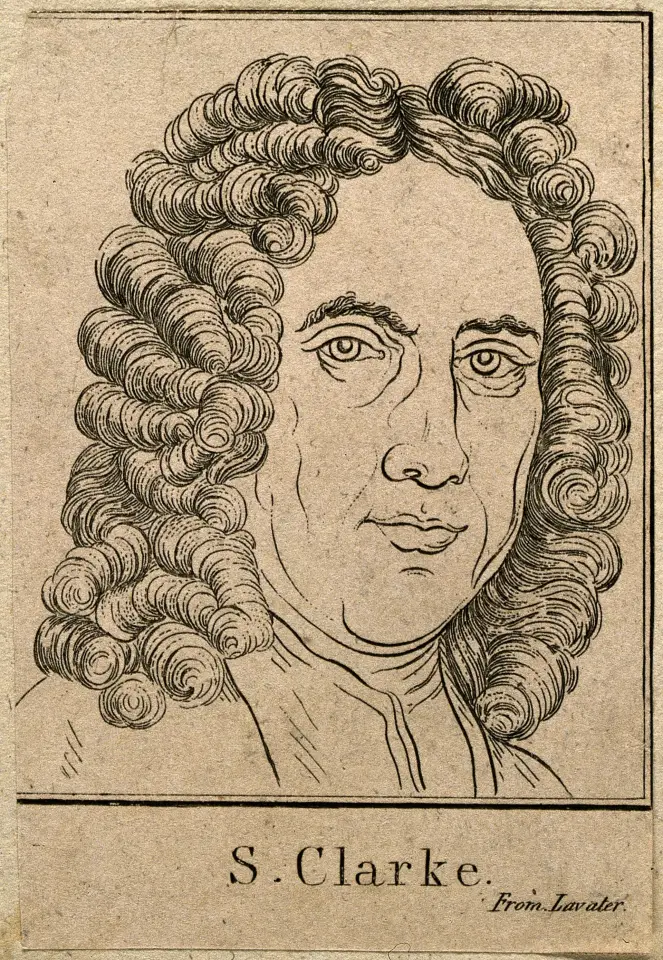
Berkhof traces in the 18th–19th centuries a departure from the classical doctrine of the Trinity in two directions. Samuel Clarke, in his work on the Trinity (1712), came close, according to Berkhof, to the Arian view: the Father is the supreme and only God, the Son receives his being by the elective will of the Father, the Spirit is subordinate to the Son. Some New England theologians rejected eternal generation, regarding the trinitarian names as designations of distinctions revealed in the work of redemption. In Swedenborg, Schleiermacher, Hegel and Dorner Berkhof finds Sabellian interpretations. Schleiermacher, according to Grenz and Olson, considered the doctrine of the Trinity useless for theology and placed only a brief note at the end of The Christian Faith.
Positions
- Samuel Clarke
- The Father is the Source of all; the Son receives being and qualities by the Father's will, not by necessity; the Spirit has his essence from the Father through the Son; Clarke does not decide whether the Son is begotten from the Father's substance or created from nothing, and whether he is eternal.
- Emmons, Moses Stuart
- Eternal generation is "eternal nonsense" (Emmons), a contradiction in terms opposed to the equality of Father and Son; the names Father, Son and Spirit denote distinctions manifested in the work of redemption, not eternal relations (Stuart).
- Schleiermacher
- The doctrine of the Trinity "is not connected with religious consciousness"; he did not deny it but found many contradictions in its historical expression. According to Berkhof: the Father is God as unknown unity, the Son is God entering personal existence in Jesus, the Spirit is the life of the risen Christ in the Church.
Key points
- Berkhof: the work of Clarke, court preacher to Queen Anne, is an approach to Arianism; Sabellian interpretations are found also in Hegel and Dorner, and in Ritschl and many modernists the views of Paul of Samosata reappear.
- Swedenborg saw the distinctions in the eternal God-man, who took flesh in the Son and acts through the Spirit
- Grenz and Olson: Schleiermacher’s God is not an anthropomorphic person but an absolute eternal power present in all things
- Grenz and Olson: the charges of pantheism are unfounded, and they prefer the term “panentheism”
- Helmer: Schleiermacher rejected “eternal distinctions” in God, admitting only statements drawn from the experience of redemption in Jesus of Nazareth. He placed the Trinity at the end of The Christian Faith; Helmer reads this not as rejection of orthodoxy but as a result of his theory of language. Schleiermacher admitted a “modified Sabellianism” as an alternative to the Athanasian Trinity: Son and Spirit are historically irreducible to each other; the Trinity is the culmination of redemptive history, “much more hidden than revealed”. In Hegel the Trinity is the system’s ground and goal, in Schleiermacher the culmination of faith statements on the redemptive work of Jesus and Spirit; both systems showed how seriously the Trinity must be taken in Western thought and prepared the 20th-century “trinitarian renaissance”
Outcome
The doctrine of the eternal relations of the Persons was weakened, and the Trinity was removed from the center of theology (Grenz and Olson on Schleiermacher); Berkhof assesses these views as a return to ancient heresies – Arianism, Sabellianism and the teaching of Paul of Samosata.
People
- Samuel Clarke
- Emmons
- Moses Stuart
- Swedenborg
- Friedrich Schleiermacher
- Georg Wilhelm Friedrich Hegel
- Dorner
- Albrecht Ritschl
Place
England, New England, Germany
Sources disagree
Clarke – 1712 (Berkhof); Schleiermacher's The Christian Faith – 1821–1830 (Grenz and Olson). Berkhof does not date Emmons, Stuart, Swedenborg, Hegel and Dorner (18th–19th centuries).
Sources
- Louis Berkhof – History of Christian Doctrines (Russian edition), p. 66
- Stanley Grenz, Roger Olson – 20th-Century Theology: God and the World in a Transitional Age (Russian edition), p. 64
- The Cambridge Companion to the Trinity, ed. Peter C. Phan (2011), p. 174–175, 175–177, 177–178
Related entries
- Develops: Joachim of Fiore: the three ages of history and the expectation of the Age of the Spirit (1177–1202)
- Rejected in: The revival of the doctrine of the Trinity in the 20th century: Barth, Rahner, Moltmann, Pannenberg (1932–1988)
In church history
Data compiled: 2026-11-17