1177–1202 · 12th century
Joachim of Fiore: the three ages of history and the expectation of the Age of the Spirit
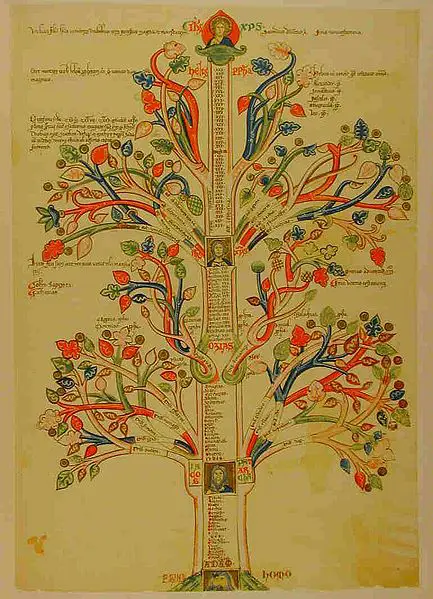
Joachim of Fiore, a Cistercian from Calabria, was the first to divide history into three ages according to the number of the Persons of the Trinity. The Age of the Father runs from Adam to Christ, the period of the Old Testament and of life under the Law; the Age of the Son is the period of the New Testament, of the clergy and of grace, which will last forty-two generations of thirty years and in 1260 will give way to the Age of the Spirit. The Age of the Spirit is a time of contemplative monasticism and of the freedom of spiritual understanding: a new order will convert the whole world, the present corrupt church will be replaced by a new spiritual church, and the New Testament sacraments by new ones. Joachim was not condemned in his lifetime; according to González, at first the significance of the scheme for the life of the Church was not realized, but the "Spiritual" Franciscans saw themselves as representatives of the age of the Spirit.
Positions
- Joachim of Fiore
- Three ages according to the Persons of the Trinity; from 1260 the Age of the Spirit, a new spiritual church and new sacraments
- The "Spiritual" Franciscans (including John of Parma)
- Saw themselves as representatives of the age of the Spirit
Key points
- Lane: three popes urged Joachim to write down his teaching; his ideas influenced radical Anabaptist groups and some currents of Protestantism
- Bonaventure and others were forced to deal with the consequences of Joachimism
- Weber: in the Middle Ages apocalyptic millennialism stayed popular among ordinary Christians, though historians doubt mass hysteria around 1000. In 950 the monk Adso predicted that the Antichrist would appear under the “last emperor”, who would be killed by Christ (or Michael); many aspired to that role, including Frederick Barbarossa, who drowned in 1190 on the Third Crusade. Joachim’s (c. 1132–1202) Exposition on the Apocalypse offered an alternative to Augustine – three eras: of the Father, Son and Spirit. The age of the Son was to end in 1260 after a conflict of two popes – the evil Antichrist and a godly evangelist; the godly pope recruits new orders for a mission to Jews, Muslims and pagans; then the age of the Spirit follows. It is the first clearly articulated utopian vision of Christian millennialism; distant tribes will join the devil’s last rebellion. The Spiritual Franciscans saw themselves in Joachim’s prophecies and called popes Antichrist, staying in conflict with them; Dolcino in 1305 founded a commune and taught abolition of private property, and in 1307 he was captured and burned
- Rowland: Joachim got the key to the Apocalypse by vision, not study: God gave him “the spirit of understanding” of scripture’s mysteries. Joachim began “decoding” Revelation (the dragon’s fifth head is Saladin); a line runs from him via Mede to US fundamentalists. History as the arena of God’s saving purposes made Joachite eschatology politically nonconformist, a break with the Augustinian reading
Outcome
Joachim's Trinitarian teaching was rejected by the Fourth Lateran Council (1215), and some of his ideas were condemned in the 13th century; his scheme was taken up by radical movements.
People
- Joachim of Fiore
- John of Parma
- Bonaventure
- Adso
- Fra Dolcino of Novara
Terms
- three ages
- The age of the Father (Law), the age of the Son (grace), the age of the Spirit (freedom of contemplation).
Place
Calabria (Corazzo)
Sources disagree
Lane dates Joachim's abbacy at Corazzo to 1177, the founding of a new monastery to 1182, and his death to 1202; González (HCT) gives only the year of his death (1202) and places the condemnation of the Trinitarian teaching at the Fourth Lateran Council.
Sources
- Justo L. González – A History of Christian Thought in One Volume (Abingdon, 2014), p. 228
- Tony Lane – Christian Thinkers (Russian edition), p. 116–117
- The Oxford Handbook of Eschatology, ed. Jerry L. Walls (2008), Ch. 20, sec. «The Middle Ages»
- The Oxford Handbook of Apocalyptic Literature, ed. John J. Collins (2014), p. 426, 427
Related entries
- Rejected in: The Fourth Lateran Council: transubstantiation and obligatory confession (1215)
- Developed in: The modern period: Clarke, the New England theologians, Schleiermacher and "Sabellian" interpretations (18th – early 19th century)
- Developed in: Hegel: Spirit, Dialectic and Christianity as the Absolute Religion (1770–1831 (Hegel's lifespan))
Data compiled: 2026-11-17