1799–1834 · 18th century
Schleiermacher and the "Speeches on Religion": the Birth of Liberal Theology
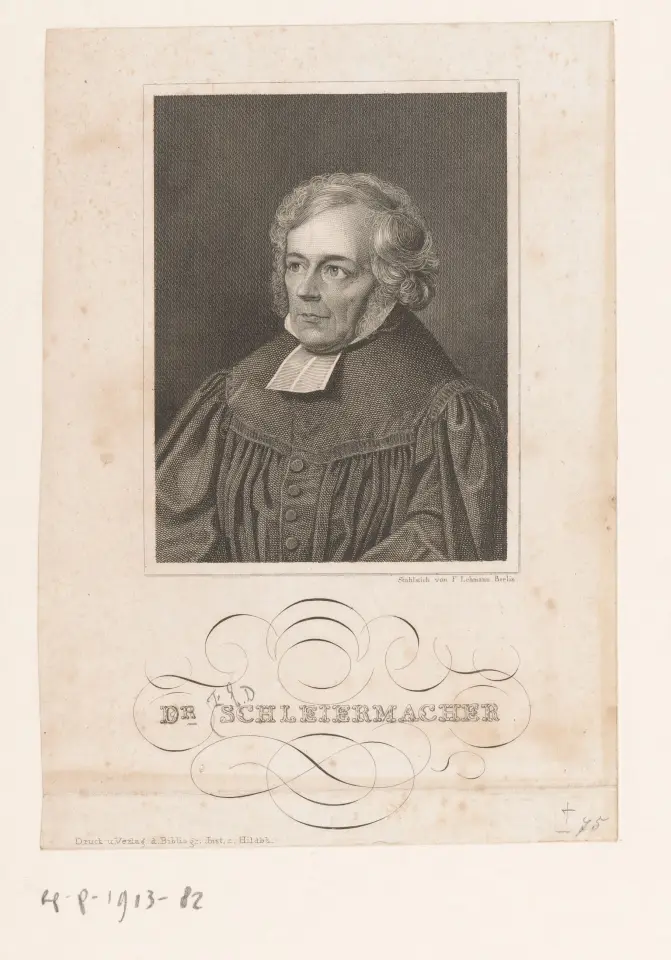
Friedrich Schleiermacher (1768–1834) was born in Breslau to a Reformed army chaplain. His father had undergone a spiritual renewal through the Moravian Brethren. Schleiermacher was raised in Pietist schools and seminary, and at Halle he came under the influence of Humean and Kantian skepticism.
He was ordained in 1790. He served as chaplain of Berlin's Charité hospital (1796–1802) and grew close in Berlin to the circle of Romantics led by Goethe.
In 1799 he published On Religion: Speeches to Its Cultured Despisers. The book was rapturously received across Europe and laid the foundation of liberal Protestant theology. The Christian Faith (1821–22, rev. 1830) followed – arguably the most influential theological work of the 19th century.
Key points
- Schleiermacher's Pietist, Moravian upbringing
- Ordination (1790) and ministry in Berlin among the Romantics
- "Speeches on Religion" (1799), rapturously received in Europe
- The beginning of liberal Protestant theology; The Christian Faith (1821–22, rev. 1830)
- Shelley: Schleiermacher (1768–1834) located the heart of religion in “absolute dependence on God,” not in proofs and dogmas. The liberal bridge’s second pillar was Christian experience; Romanticism made intuition and feeling an encounter with a power beyond reason. If something so intimate and indisputable governs every soul, why worry about formal and external creeds? Lewis Stearns (1891): criticism and rationalism ‘cannot disturb Christian reality’, as a wave on the Maine coast cannot threaten granite cliffs.
- Gunton: convinced by Kant, Schleiermacher made experience the matrix of theology: “Christian doctrines are accounts of the Christian religious affections”.
People
- Friedrich Schleiermacher
- Johann Wolfgang von Goethe
- Napoleon Bonaparte
- Karl Barth
Place
Breslau; Halle; Berlin
Sources disagree
All books agree on 1799 as the publication year of the Speeches on Religion; the reworked Christian Faith (1821–1822) belongs to the following period.
Sources
- Stanley Grenz, Roger Olson – 20th-Century Theology: God and the World in a Transitional Age (Russian edition), p. 51–53, 57; p. 51, 53–54
- Tony Lane – Christian Thinkers (Russian edition), p. 234–237; p. 236–237
- J. North – A History of the Church (Russian edition), p. 314
- Justo L. González – A History of Christian Thought, vol. III: From the Protestant Reformation to the Twentieth Century (Abingdon, rev. ed. 1987), p. 357–358; p. 357–369
- Justo L. González – The Story of Christianity, vol. II (Russian edition), Part 3, ch. 28
- Justo L. González – A History of Christian Thought in One Volume (Abingdon, 2014), p. 388–390
- Louis Berkhof – History of Christian Doctrines (Russian edition), p. 81–82, 142, 146
- Bruce L. Shelley – Church History in Plain Language (Russian edition), Ch. 40, sec. «Голоса либерализма»; Ch. 40, sec. «Влияние библейского критицизма»
- The Cambridge Companion to Christian Doctrine, ed. Colin E. Gunton (1997), p. 38
More on the doctrine
- Schleiermacher: Religion as Feeling and Theology as the Expression of Religious Self-Consciousness (1799–1830)
- The modern period: Clarke, the New England theologians, Schleiermacher and "Sabellian" interpretations (18th – early 19th century)
Data compiled: 2026-11-09