1520 · 16th century
Luther: the Church of the Word and the priesthood of all believers
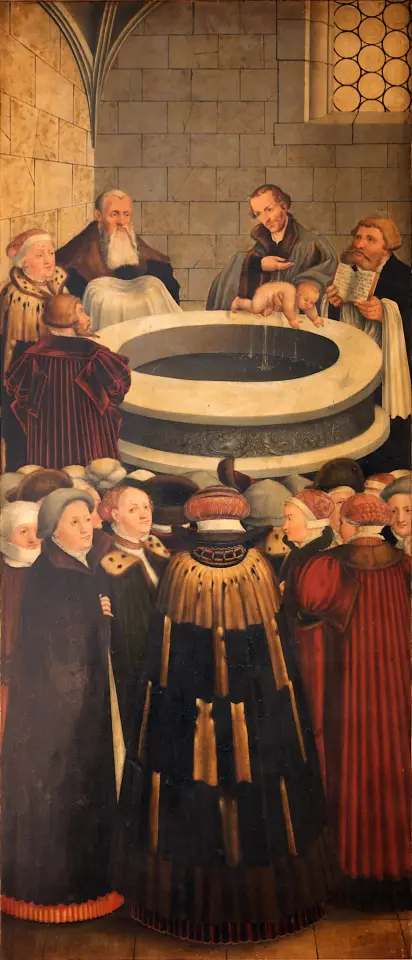
Luther was not an individualist: he spoke of "Mother Church" and, like Cyprian, of no salvation outside the Church, but he differed from the Church of his day in defining its nature and authority. The supreme authority in the Church is the Word of God; the true Church is recognized by the pure preaching of the Gospel and the sacraments, not by apostolic succession or papal headship. In the treatise To the Christian Nobility (1520, part I) he rejected the division into spiritual and temporal estates: all Christians are "truly of the Spiritual Estate", with "no difference among them, save of office alone"; "we are all consecrated as priests by baptism". The universal priesthood means that each is a priest for others, but public preaching is entrusted to those who are called, and the call is confirmed by the community.
Positions
- The Roman Catholic side
- The Church is an external society with a visible head; authority comes from office and historical succession; clergy and laity are two different estates
- Luther
- The supreme authority is the Word of God; all the baptized are priests, the difference is only in function
- The radicals ("sectarians")
- A direct call from the Spirit; rejection of tradition; Luther calls them "liars and deceivers"
Key points
- Berkhof: not two Churches but two aspects of one – the invisible (faith, communion with Christ) and the visible; in the visible there are always hypocrites
- McGrath: Luther acknowledged that the papal church has the true Scriptures, baptism, the sacrament of the altar, the keys and the ministry, yet called the pope Antichrist (so also González). His insistence on a visible, instituted Church is hard to distinguish from the Catholic position. Warfield called the Reformation the triumph of Augustine’s doctrine of grace over Augustine’s doctrine of the Church. Protestants, except for the English and Swedish churches, lacked the historical succession of the episcopate and stressed doctrinal continuity
- Confronted with the radicals, Luther affirmed the need for a visible, established Church as a means of grace
- For Luther justification by faith is “the article by which the Church stands or falls”
- Hendrix: in To the Christian Nobility (1520, part I) Luther applied 1 Cor. 2:15 (“the spiritual judges all things”), usually applied to the pope, to all Christians. The right to interpret Scripture belongs to the Christian community, not to individuals; it commissions some for “the ministry of Word and sacraments”. The German New Testament (“September Testament”, 1522) made Scripture more accessible to all believers. In On the Papacy in Rome (1520) Luther defined the Church as a spiritual community around Word and sacraments, not a hierarchy.
- Shelley: Troeltsch called Protestantism a “modification of Catholicism”; for Luther the Church is the community of believers and every useful calling is holy.
Outcome
The hierarchical model was undermined while an ordained ministry by call was retained. After Regensburg (1541) and Trent (1545), according to McGrath, the Protestant churches had to be recognized as permanent, and the question "where is the true Church to be found?" became central for the second generation of reformers.
People
- Martin Luther
- Philip Melanchthon
- Johann Eck
Terms
- priesthood of all believers
- All baptized Christians share the priesthood; the difference lies only in the functions performed.
- status – Stand
- The equal priestly status of all the baptized.
- office – Amt
- A specific function performed by a chosen member of the community.
- mediated call
- A call to the ministry of the Word through human means – the prince, the magistrate or the congregation.
Place
Wittenberg, Leipzig
Sources disagree
Lane, González and McGrath date the programmatic treatises to 1520; González and McGrath treat Luther's ecclesiology as a whole within 1517/1518–1546; the Leipzig Disputation in 1519 (McGrath).
Sources
Primary sources
- Luther – To the Christian Nobility of the German Nation, pt. 1
Textbooks
- Louis Berkhof – History of Christian Doctrines (Russian edition), p. 173
- Justo L. González – A History of Christian Thought in One Volume (Abingdon, 2014), p. 292–293
- Justo L. González – A History of Christian Thought, vol. III: From the Protestant Reformation to the Twentieth Century (Abingdon, rev. ed. 1987), p. 39–40, 59–61
- Alister McGrath – Reformation Thought (Russian edition: «Theological Thought of the Reformation»), p. 152–155, 193, 210–211, 270–275, 291–292
- Tony Lane – Christian Thinkers (Russian edition), p. 157
- The Cambridge Companion to Reformation Theology, ed. David Bagchi, David C. Steinmetz (2004), p. 57–58, 58, 65–66
- Bruce L. Shelley – Church History in Plain Language (Russian edition), Ch. 24, sec. «Смысл протестантизма», «Долгое влияние Лютера»; врезки
Related entries
- Develops: Augustine: the mixed body, the visible and the invisible Church (early 5th century)
- Develops: Luther: The Word of God and the Primacy of the Gospel over Tradition (Leipzig Disputation, 1519) (1519)
In church history
Data compiled: 2026-11-17