1520 · 16th century
Luther's three reformation treatises and the bull "Exsurge Domine"
In 1520 Luther issued three programmatic works: "To the Christian Nobility of the German Nation", "On the Babylonian Captivity of the Church", and "On the Freedom of a Christian". In the first he rejected the papalists' "three walls" and wrote that no one can procure "a true free council" so well as the temporal authorities (part I). In the second, drawing on humanist philology, he denied that there are seven sacraments: at first he kept three – baptism, penance and the bread – and at the end concluded that, strictly speaking, there are only two, baptism and the bread, since penance has no visible, divinely appointed sign. The third set out his doctrine of justification by faith alone.
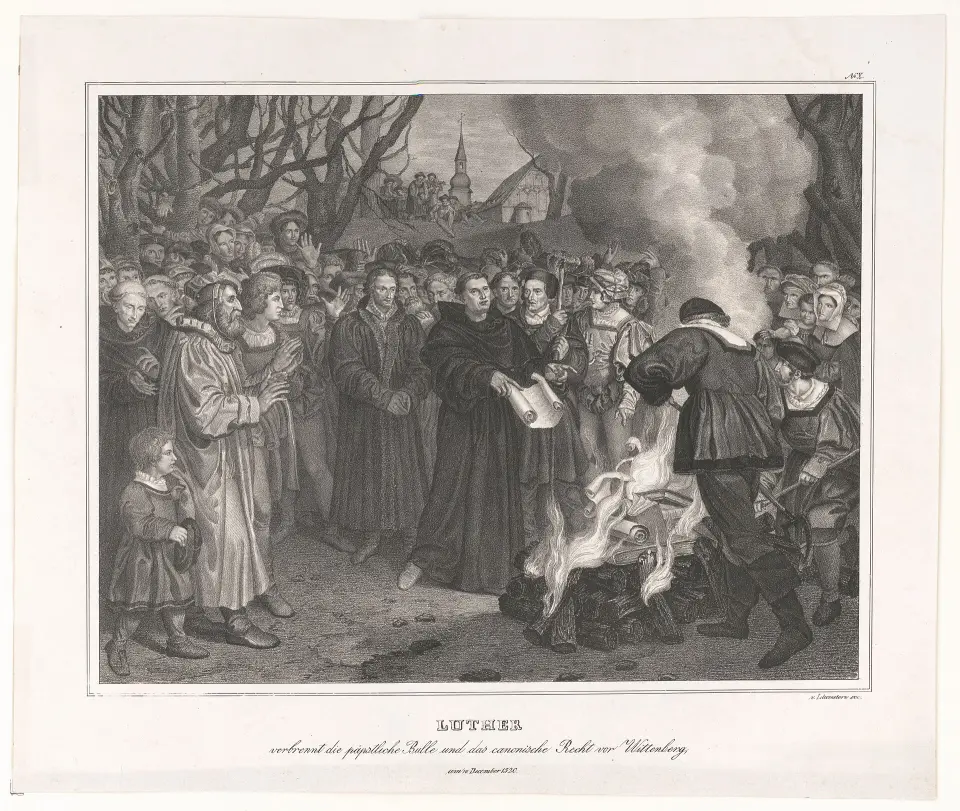
That same year Pope Leo X's bull "Exsurge Domine" condemned Luther as a heretic. Luther publicly burned the bull together with books of canon law. This marked the final break with Rome.
Key points
- Luther's three programmatic works of 1520
- Of the seven sacraments three were kept at first – baptism, penance and the bread – and at the end, "with perfect accuracy", only baptism and the bread (Babylonian Captivity)
- Condemnation by the universities of Cologne, Louvain and Paris (1519–1520)
- The bull "Exsurge Domine" and Luther's public burning of it
- Bagchi: Eck took on not only the detailed refutation of Luther’s theology but its condemnation, agitating for the bull Exsurge Domine, and promulgated the bull in Germany; anti-Lutheran polemic dominated the scene until 1525
- Shelley: the bull Exsurge Domine (1520) declared forty-one of Luther’s theses heretical and gave him sixty days to recant; Luther burned canon law and scholastic works outside Wittenberg’s gates, and in January 1521 the pope excommunicated him. In To the Christian Nobility Luther urged princes to reform the Church and strip bishops of wealth and power, and in the Babylonian Captivity he kept two sacraments – Baptism and Communion, instituted by Christ, performed in the believing community
- Mattox: in February 1520 Luther read Valla on the Donation of Constantine, and his critique of the church’s sacramental system grew more radical.
People
- Martin Luther
- Leo X
- Johann Eck
- Ulrich von Hutten
Place
Wittenberg
Sources
Primary sources
- Luther – To the Christian Nobility of the German Nation, pt. 1
- Luther – The Babylonian Captivity of the Church, introduction; sec. 7
Textbooks
- Alister McGrath – Reformation Thought (Russian edition: «Theological Thought of the Reformation»), p. 221–222, 235–241, 255, 291–301, 377
- J. North – A History of the Church (Russian edition), p. 241
- Tony Lane – Christian Thinkers (Russian edition), p. 159–162
- Justo L. González – A History of Christian Thought, vol. III: From the Protestant Reformation to the Twentieth Century (Abingdon, rev. ed. 1987), p. 39–41, 61, 65–66
- Justo L. González – A History of Christian Thought in One Volume (Abingdon, 2014), p. 284–285, 286–295
- The Cambridge Companion to Reformation Theology, ed. David Bagchi, David C. Steinmetz (2004), p. 232
- Bruce L. Shelley – Church History in Plain Language (Russian edition), Ch. 24, introduction; sec. «Еретик, преступник, герой»; Ch. 24, sec. «Лютер и папская власть»
- The Oxford Handbook of Sacramental Theology, ed. Hans Boersma, Matthew Levering (2015), p. 330
More on the doctrine
- Luther, The Babylonian Captivity of the Church: two sacraments and real presence without transubstantiation (1520)
- Luther: the Church of the Word and the priesthood of all believers (1520)
Data compiled: 2026-11-09