1519 · 16th century
Luther: The Word of God and the Primacy of the Gospel over Tradition (Leipzig Disputation, 1519)
For Luther the Word of God is the starting point of theology: the eternal Word, the second Person of the Trinity, God's power in creation, the incarnate Lord, the Scripture that bears witness to him, and the preaching through which believers hear the Word. At the Leipzig Disputation of 1519, Eck forced Luther to declare that the authority of the Bible is above that of popes and councils, which had erred, and accused him of being a Hussite. To Catholics who said that the Church had created Scripture and the canon, Luther replied that the Church established the canon, but the Gospel established the Church. He therefore defended the primacy of the Gospel to which Scripture bears witness, and allowed himself freedom with the canon: according to González, Luther was not a biblicist.
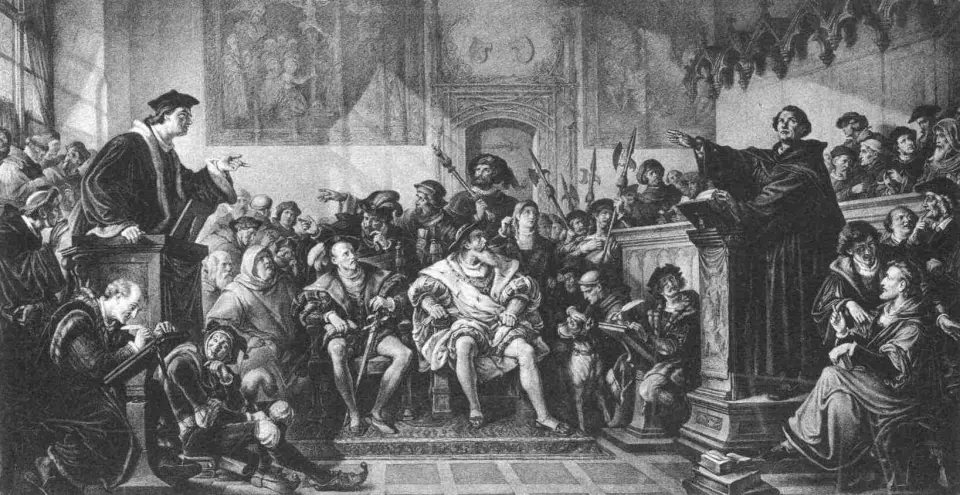
Positions
- Roman Catholics
- The Church created Scripture and established the canon, and therefore has authority over Scripture; it may be interpreted only by the authority of tradition
- The "enthusiasts"
- The revelation of the Spirit goes beyond Scripture; Old Testament commandments should be applied literally
- Luther
- Scripture interprets itself; the Spirit, its author, teaches nothing but the Gospel; "whatever preaches Christ would be apostolic"
Key points
- Tradition that contradicts the "plain sense of Scripture" is rejected; Scripture stands above tradition, the church, theologians and Luther himself
- The primary form of the Gospel is living oral preaching; the apostles began to write later to protect it from distortion
- Luther did not regard the Epistle of James as apostolic and was inclined to exclude it from the canon; he treated the Apocalypse similarly
- Luther: the law of Moses, including the Ten Commandments, is the Jews’ civil law and does not bind Christians; what binds in it binds by natural law
- Luther: the value of the Old Testament lies in its promises of Christ (How Christians Should Regard Moses)
- González: after Leipzig Luther soon acknowledged that he agreed with Hus on many points
- Hendrix: in 1518 Luther told Cajetan the pope is “not above but below the Word of God”; at Leipzig (1519) he doubted papal divine right. By Worms (1521) Scripture stood above other authorities for him, yet he did not strip the fathers of all authority
Outcome
Luther proclaimed the primacy of the Gospel and of Scripture over tradition and church authorities, though not over Christ; revelation received a christological center.
People
- Martin Luther
- Johann Eck
- Jan Hus
- Sylvester Prierias
Terms
- outer and inner Word
- The outer is the Word in Scripture; the inner is the Holy Spirit, who makes it heard by the heart.
Place
Leipzig, Wittenberg
Sources disagree
The Leipzig Disputation – 1519 (González, both works). The books do not date the other positions precisely: González (A History of Christian Thought, vol. III) – 1518–1521, and after 1521 for the sermon on Moses; the one-volume history – 1517–1546.
Sources
- Justo L. González – A History of Christian Thought in One Volume (Abingdon, 2014), p. 284, 287–289
- Justo L. González – A History of Christian Thought, vol. III: From the Protestant Reformation to the Twentieth Century (Abingdon, rev. ed. 1987), p. 39, 47–52
- The Cambridge Companion to Reformation Theology, ed. David Bagchi, David C. Steinmetz (2004), p. 56–57, 57
Related entries
- Develops: Wyclif: Scripture above Tradition, Councils and Popes; Condemnation at Constance (1378)
- Developed in: Sola Scriptura: The Formal Principle of the Reformation and the Dispute over the Right to Interpret Scripture (1520s)
- Developed in: Luther: the Church of the Word and the priesthood of all believers (1520)
In church history
- The Leipzig Disputation between Luther and Eck (July 1519)
Data compiled: 2026-11-17