1520–1571 · 16th century
Justification in Protestantism after Luther: Zwingli, Melanchthon's Forensic Justification, Bucer's Double Justification
McGrath shows that already in the 1520s the reformers understood justification in different ways. For Luther it was the center of theology, while in the early Swiss circle reformation meant above all the improvement of life and morals: Zwingli saw Christ as an external moral example, placed moral renewal above salvation and, unlike Luther, regarded law and gospel as essentially one. Melanchthon distinguished declared righteousness ("justification"), which God pronounces in the heavenly court, from imparted righteousness ("sanctification"); McGrath calls this a complete break with the teaching of the church, in which justification had included both declaration and becoming righteous. In the 1530s Bucer proposed a double justification – the forgiveness of the ungodly and the obedience of the godly with the help of the Spirit. The English reformers fixed justification by faith alone in the Thirty-Nine Articles (Art. 11).
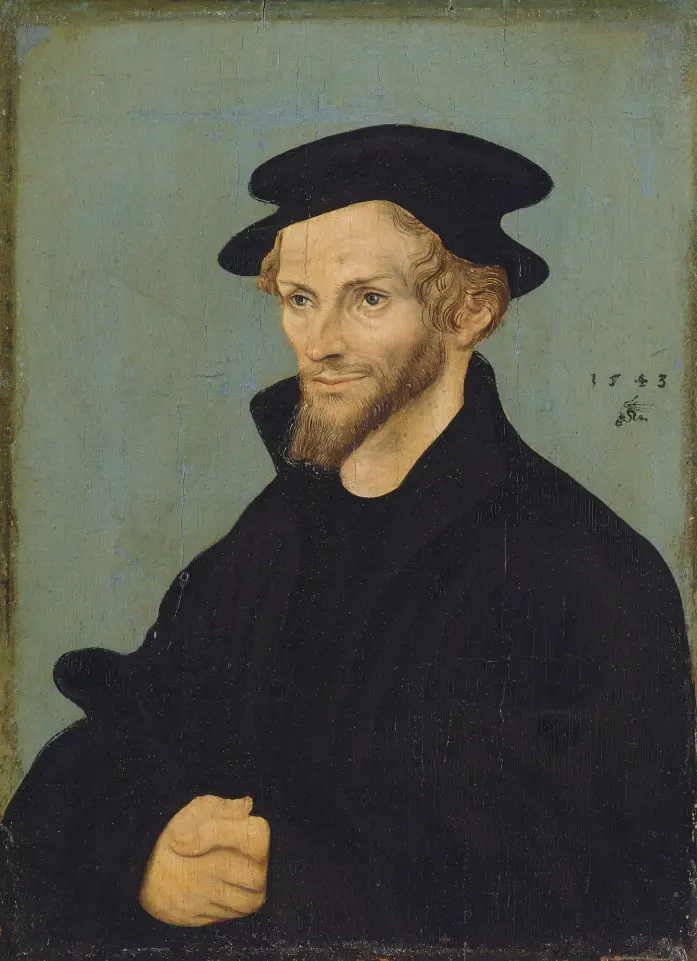
Positions
- Luther
- Scripture proclaims God's promises; justification is given independently of moral actions; law and gospel are opposed
- Zwingli, Vadian
- Scripture contains God's moral demands; Christ is an external example; the law "expounds the will and nature of the Deity" and is not abolished by the gospel
- Melanchthon
- Justification is only a declaration of righteousness; righteousness is imputed; sanctification is separate
- Bucer
- Justification in two stages – forgiveness and obedient following of the gospel; the absence of moral regeneration means the first stage is absent too
Key points
- Zwingli distinguishes the eternal moral law, the ceremonial law and the civil law; the moral law is summed up in the commandment of love and is identical with the natural law
- Melanchthon's distinction was adopted by almost all the major reformers and became the accepted difference between Protestants and Roman Catholics
- McGrath: Bucer's theory seemed artificial and reduced Christ to an external moral example
- Tyndale: the purpose of Romans is to prove that a person is justified by faith alone; Frith preferred to say that God does not impute sin
- Thirty-Nine Articles: art. 11 – we are accounted righteous only for the merit of Christ through faith; art. 14 – works of supererogation are "arrogancy and impiety"
- Kusukawa: the Loci communes grew from Melanchthon's lectures on Romans; students' notes appeared without his knowledge; he corrected the text by Sept. 1521. The 1521 edition was no “systematic exposition”: Melanchthon left aside God, the Trinity, creation and incarnation as matters of divine mystery and stressed law and gospel, sin and grace, sola fide; in the 1535 edition he added Christ's two natures, creation and the Trinity (partly in view of Servetus' antitrinitarianism). Melanchthon named three causes of conversion – the Word, the Holy Spirit and the human will: “God draws, but he draws him who is willing”; he stressed the forensic character of justification to counter the determinism he ascribed to Zwingli
- Hazlett: for Bucer justification is “the chief article of divine wisdom”; his difference from Luther and Zwingli needn’t be exaggerated: agreed at Marburg. Sola fide secured faith’s origin in God’s goodness; Bucer joined faith and works closely – “justification” includes both (fire and heat). Bucer rejected scholastic “unformed faith” without love, antinomianism and perfectionism, admitting “weak faith”, since sin continues in believers. He saw concord in “twofold justification” (sinners by faith, the justified by good works as God’s recognition of his gifts) and faith formed by love
- Brooks: in 1537 Cranmer challenged Henry VIII’s annotations: works after justification please God, before it are not accepted however good they seem to men. This is a kinship with Lutheranism; per Null, in the 1530s Cranmer read Paul within Luther’s justificatio sola fide rather than scholastic terms
- Trueman: Tyndale in his 1525 prologue drew on Luther’s of 1522 but with a positive view of law and the Spirit’s transforming work. In “double justification” he read Paul’s and James’s “alone”: faith justifies before God, works before the world; there was no “pure Lutheran phase”. Tyndale’s practical bent produced the covenant idea (1525–1536, fully in the 1534 preface): God keeps his promises if man keeps his laws. Works do not merit justification but flow from it, as a father rewards children; the covenant gave laypeople a simple framework for reading the Bible
- Packull: Anabaptists accepted justification by faith but objected to forensic, alien righteousness extra nos: a justification that changed status rather than the person seemed to them a make-believe one; it must make one righteous (fromm), regenerate and show itself in discipleship (Nachfolge). Denck, Hut, Schiemer continued Müntzer's debate with Luther on true faith (the sweet Christ versus the bitter Christ). Marpeck accepted the preached Word's role in giving birth to justifying faith; Scharnschlager repeated “by faith alone”; per Bender, Marpeck's circle stood “halfway” between the Swiss Brethren and the Lutherans on justification. Riedemann called Christ “our righteousness and goodness”
- Morgan: in the Augsburg Confession (1530) Melanchthon introduced the idea of imputation (from Romans 4); it became standard Lutheran doctrine.
Outcome
The forensic understanding of justification and its distinction from sanctification became common Protestant teaching; Bucer's double justification did not spread; the Council of Trent declared Melanchthon's views false.
People
- Martin Luther
- Huldrych Zwingli
- Joachim Vadian
- Philip Melanchthon
- Martin Bucer
- William Tyndale
- John Frith
- Thomas Cranmer
Terms
- forensic justification
- A legal approach: the sinner is declared righteous in the heavenly court (in foro divino).
- justification of the ungodly – iustificatio impii
- For Bucer, the first stage – the forgiveness of sins.
- justification of the godly – iustificatio pii
- For Bucer, the second stage – moral fulfillment of the gospel's demands.
Place
Zurich, Wittenberg, Strasbourg, England
Sources disagree
McGrath does not date Melanchthon's formulation; Bucer's double justification appears in writings of the 1530s; Zwingli's rapprochement with Luther – in the 1520s; the Thirty-Nine Articles were agreed in Convocation at London "in the Year 1562" (Old Style) and confirmed again in 1571 (so the text itself; González – 1571).
Sources
Primary sources
- Thirty-Nine Articles of Religion, art. 11, 14
Textbooks
- Justo L. González – A History of Christian Thought in One Volume (Abingdon, 2014), p. 298–299, 301
- Justo L. González – A History of Christian Thought, vol. III: From the Protestant Reformation to the Twentieth Century (Abingdon, rev. ed. 1987), p. 80–81, 194–195
- Alister McGrath – Reformation Thought (Russian edition: «Theological Thought of the Reformation»), p. 158–159, 162–165
- The Cambridge Companion to Reformation Theology, ed. David Bagchi, David C. Steinmetz (2004), p. 69–70, 69–71, 119–120, 120, 164–165, 174–175, 175–176, 216–218
- The Cambridge Companion to St Paul, ed. James D. G. Dunn (2003), p. 264
Related entries
- Develops: Luther: The Discovery of the "Righteousness of God" and Justification by Faith Alone (c. 1515 (1513–1521))
- Developed in: Controversies in Lutheranism after Luther – Antinomian, Synergist, Majorist, Osiandrian – and the Formula of Concord (1528–1577)
- Answered by: Calvin: Union with Christ, "Double Grace" and the Third Use of the Law (1536–1559)
- Rejected in: The Tridentine Decree on Justification and the Anathemas against Protestant Teaching (1547)
Data compiled: 2026-11-17