1536–1559 · 16th century
Calvin: Union with Christ, "Double Grace" and the Third Use of the Law
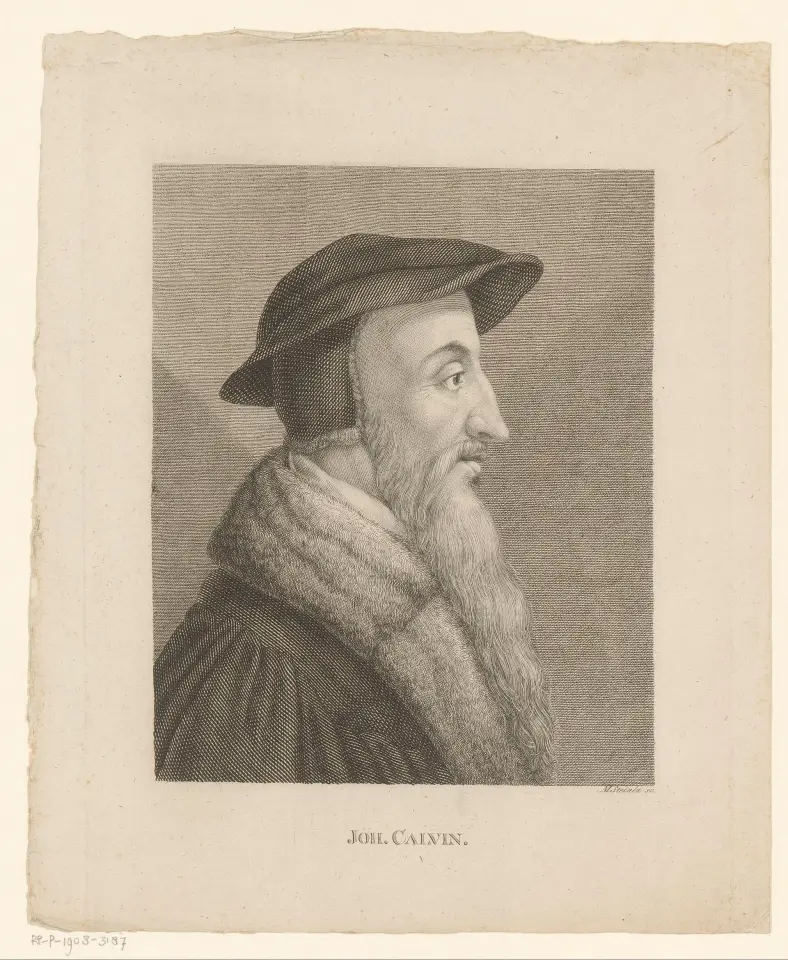
According to Calvin, Christ's death does not of itself make salvation effective for all: Christ and all his benefits are made available to the believer by the secret working of the Holy Spirit (Institutes 3.1.1), whose chief work is faith (3.1.4). Faith unites the believer with Christ in a "mystical union" (3.11.10), and this union yields a "double grace" (3.11.1): justification and regeneration in the image of Christ; unlike Bucer, both effects flow from the union rather than one from the other (McGrath). Calvin (3.11.2) defines justification as "the acceptance with which God receives us into his favor as if we were righteous" – the forgiveness of sins and the imputation of Christ's righteousness, which clothes the sinner like a garment. Against Osiander (3.11.5–12) he rejected a "mixture of substances," and he regarded works not as the ground but as the result and sign of justification. For Calvin the law is almost continuous with the gospel, and its "third use" (2.7.12) – revealing God's will to believers – became typical of the Reformed tradition.
Positions
- Bucer
- Justification brings about regeneration
- Osiander
- The essence of Christ is present in the believer, who is "essentially" justified
- Calvin
- Both justification and regeneration result from union with Christ through faith; justification is the imputation of Christ's righteousness without a mixture of substances
- Luther
- The law is the opposite of the gospel
Key points
- Faith is "a firm and sure knowledge of the divine favor toward us", founded on the truth of a free promise in Christ, revealed to our minds and sealed on our hearts by the Holy Spirit (Institutes 3.2.7)
- Berkhof: for Calvin regeneration, repentance and faith are not preparatory stages but blessings of the covenant of grace flowing from union; justification is instantaneous and gives the believer assurance
- González: justification is also an act of regeneration: God gradually restores the image of God in the elect. A greater emphasis than Luther's on the Christian's manner of life in time created a marked difference between the Lutheran and Reformed traditions
- Treatise on the Christian Life: we are not our own but the Lord's, and self-denial (ch. 2); bearing the cross (ch. 3); the book notes its influence on Puritanism
- Steinmetz: justification by faith set aside medieval penitential practice for Calvin; faith precedes repentance, and repentance is the godly’s daily work. Sanctification by the Spirit is a lifelong process; Calvin, like Luther, recommended private confession to a pastor as a useful discipline
Outcome
The model of union with Christ and double grace became established in the later Reformation; the Reformed way of salvation, while agreeing with Luther on justification by faith, differed from the Lutheran order.
People
- John Calvin
- Martin Bucer
- Andreas Osiander
- Martin Luther
Terms
- mystical union
- The union of the believer with Christ through faith.
- double grace
- Justification and regeneration as the twofold effect of union with Christ.
- mixture of substances
- According to Calvin, the consequence of Osiander's teaching on the indwelling of Christ's essence in the believer.
- third use of the law
- The law as a rule revealing God's will to believers, by which the regenerate shape and regulate their whole life (alongside exposing sin and restraining the wicked).
Place
Geneva
Sources disagree
Dates follow the editions of the Institutes (1536; final edition 1559); McGrath dates the formulation of union and double grace to the 1540s–1550s; the controversy with Osiander – the 1550s (González).
Sources
Primary sources
- Calvin – Institutes of the Christian Religion, bk. II, ch. 7, sec. 12; bk. III, ch. 1, sec. 1, 4; ch. 2, sec. 1, 7; ch. 11, sec. 1–2, 5–12
- Calvin – On the Christian Life, ch. 2–3
Textbooks
- Louis Berkhof – History of Christian Doctrines (Russian edition), p. 161–162
- Justo L. González – A History of Christian Thought in One Volume (Abingdon, 2014), p. 313–317
- Justo L. González – A History of Christian Thought, vol. III: From the Protestant Reformation to the Twentieth Century (Abingdon, rev. ed. 1987), p. 155–158
- Alister McGrath – Reformation Thought (Russian edition: «Theological Thought of the Reformation»), p. 165
- Tony Lane – Christian Thinkers (Russian edition), p. 179
- The Cambridge Companion to Reformation Theology, ed. David Bagchi, David C. Steinmetz (2004), p. 135–136
Related entries
- Developed in: Predestination among the Reformers: Zwingli and Calvin (1523–1559)
- Response to: Justification in Protestantism after Luther: Zwingli, Melanchthon's Forensic Justification, Bucer's Double Justification (1520–1571)
Data compiled: 2026-11-17