1516 · 16th century
"Back to the Sources": Erasmus's Greek New Testament and Humanist Textual Criticism
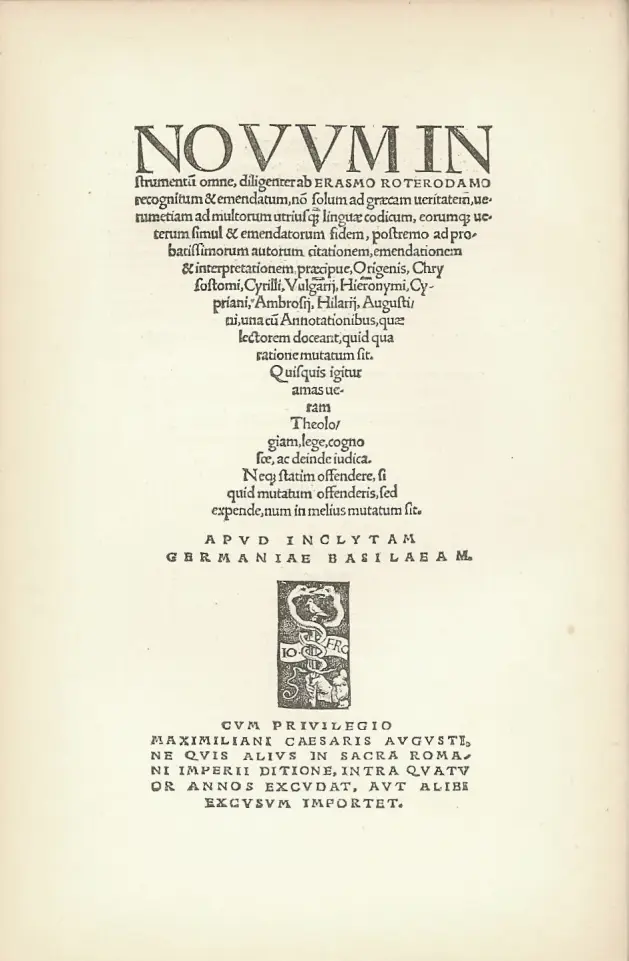
Northern Christian humanism called for a return to the Hebrew and Greek Bible and to the early fathers of the Church. In 1516 Erasmus published the first printed Greek text of the New Testament (Novum Instrumentum omne) with a new Latin translation correcting inaccuracies of the Vulgate, and annotations; four years later the Complutensian Polyglot appeared at Alcalá under the direction of Ximénez. Lorenzo Valla applied textual criticism to the Donation of Constantine and proved it a forgery, while complete editions of the fathers made it possible to check whether their views were being represented correctly. González sees in this the beginning of modern biblical scholarship.
Positions
- Erasmus
- Part of the verse 1 John 5:7 (the Comma Johanneum) is a later addition absent from the Greek manuscripts
- Conservatives (according to McGrath)
- The verse is an important testimony to the Trinity
- Humanists, Erasmus, Zwingli
- Value the fathers for their antiquity and eloquence, preferring Jerome and Origen
- Luther and Karlstadt
- The criterion is reliability in interpreting the New Testament; first place goes to Augustine
Key points
- Lane: the work was hasty and based on a few manuscripts; Erasmus wrote: "I would wish the plowman to sing a text of Scripture at his plow"
- McGrath: only four manuscripts were used for most of the New Testament. Critical methods exposed "pseudo-Augustinian" works; Amerbach published Augustine in eleven volumes in 1506. Theological conservatism often prevailed over scholarly progress: even the King James Version (1611) retained the spurious verse of 1 John 5:7
- Rummel: in 1516 Erasmus’s edition appeared with the Greek text and a corrected Vulgate – the first Greek text available to the public; Erasmus revised it four times, and the annotations became a collection of patristic material answering theologians’ criticism. Erasmus’s homiletic Paraphrases on the New Testament (from 1517) were popular in the Netherlands and England; Edward VI ordered a copy in every parish. In commentaries on Psalms 28 (1530) and 83 (1533) Erasmus, under cover of political advice, made spiritual renewal a precondition for solving problems. With Froben’s press he prepared great editions of Jerome and Augustine and published Origen, Chrysostom, Irenaeus, Cyprian, Hilary, Ambrose; in prefaces he reproached clergy for falling short of the fathers and indirectly criticized theologians, praising patristic learning and plain faith
Outcome
The Reformers obtained a reliable text of the New Testament; humanist textual scholarship, in the books' assessment, prepared the way for the Reformation and began modern biblical scholarship.
People
- Erasmus of Rotterdam
- Francisco Jiménez de Cisneros
- Lorenzo Valla
- the Amerbachs
Terms
- humanism
- Interest in the classical past; in the North, Christian humanism.
Place
Basel, Alcalá de Henares
Sources disagree
The Greek New Testament – 1516 (all books). The Complutensian Polyglot: González (A History of Christian Thought, vol. III) – four years later, 1520; in González's one-volume history – compiled in 1517, published in 1522.
Sources
- Justo L. González – A History of Christian Thought in One Volume (Abingdon, 2014), p. 279–282, 336–337
- Justo L. González – A History of Christian Thought, vol. III: From the Protestant Reformation to the Twentieth Century (Abingdon, rev. ed. 1987), p. 23–24, 29
- Alister McGrath – Reformation Thought (Russian edition: «Theological Thought of the Reformation»), p. 23–24, 85–86, 93–94, 204
- Tony Lane – Christian Thinkers (Russian edition), p. 148, 151–152
- The Cambridge Companion to Reformation Theology, ed. David Bagchi, David C. Steinmetz (2004), p. 45, 45–46, 46
Related entries
- Develops: Northern Humanism and "Back to the Sources" (ad fontes); Erasmus's "Philosophy of Christ" (early 16th century)
- Developed in: Luther, The Babylonian Captivity of the Church: two sacraments and real presence without transubstantiation (1520)
In church history
- Christian humanism and Erasmus's "philosophy of Christ" (late 15th – early 16th c.)
Data compiled: 2026-11-17