early 16th century · 15th century
Northern Humanism and "Back to the Sources" (ad fontes); Erasmus's "Philosophy of Christ"
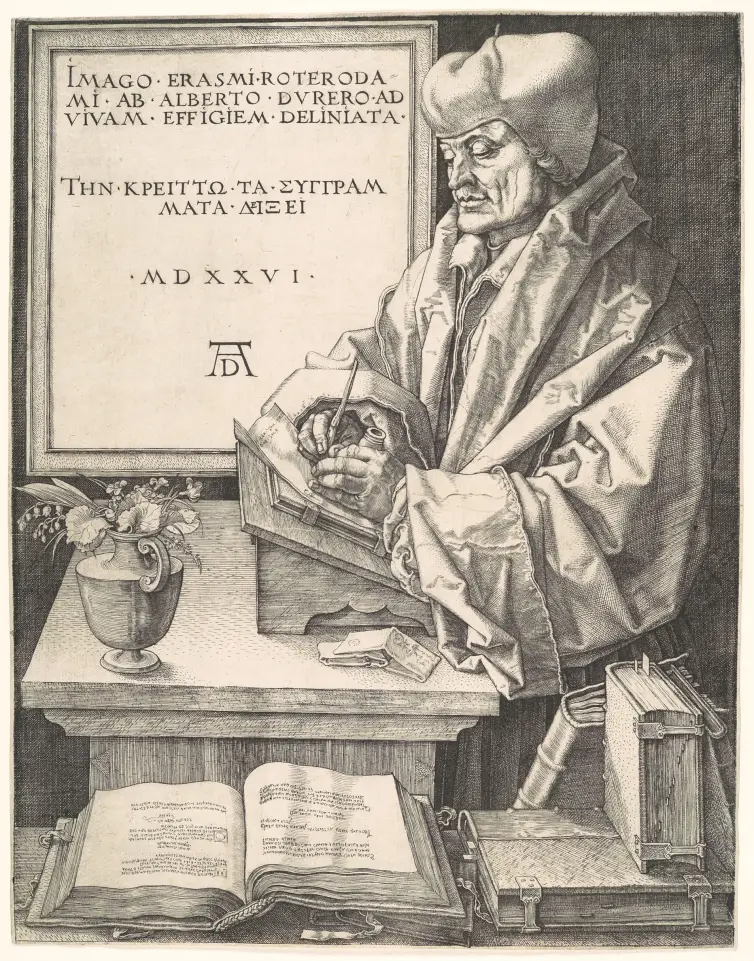
McGrath, following Kristeller, defines humanism not as a unified philosophy but as a cultural movement concerned with eloquence (bonae litterae); northern humanism added a program for the "rebirth of Christianity." The slogan ad fontes meant removing the filter of medieval commentaries and turning directly to the Bible and the Fathers; readers hoped to encounter the risen Christ anew through Scripture. Erasmus wanted a reform of ethics, not of dogma: the essence of Christianity is the "philosophy of Christ," a simple teaching and an ordered way of life; since the Logos acts wherever there is wisdom, he could ask "Saint Socrates" to pray for him. Luther, according to McGrath, used the textual achievements of humanism but demanded a reform of doctrine, not of morals.
Positions
- Erasmus, Zwingli and the humanists
- What is needed is a reform of the Church's life and morals, a return to the simplicity of apostolic Christianity
- Luther
- Scholastic theology is mistaken; a doctrinal reform is needed, above all in the doctrine of justification
Key points
- McGrath: the first five centuries were the "golden age of Christianity"; for Luther the program came down to the formula "the Bible and St. Augustine"
- The Reformation was influenced above all by northern, not Italian, humanism
- Erasmus believed all the traditional doctrines but held that scholasticism had burdened the simple teaching
- Erasmus remained a Catholic, expecting reform from the Church itself
- Rummel: Erasmus, a priest’s illegitimate son, became an Augustinian canon (1487), was ordained in 1492, and in six years at Paris took no doctorate; he received his Turin doctorate only in 1506, per saltum, so whether Erasmus was a theologian remained disputed. He turned to theology after his 1499 trip to England under Colet’s influence. Theologians resented the humanist philologists; the Paris faculty in 1531 deemed linguists only “grammatici”. Erasmus saw three stages of theology – simple faith, faith enriched by rhetoric (patristic peak) and faith obscured by dialectic (scholasticism); he proposed starting theology with the three biblical languages and demanded eloquence reaching the heart – Trinkaus called it theologia rhetorica. The Enchiridion (1501; printed 1503) saw over thirty reprints in five years; Erasmus ranks inner devotion above outward rites: monachatus non est pietas, monasticism is a “way of life that may or may not be beneficial” depending on temperament. Erasmus’s resemblance to Luther was superficial: he corrected abuses, not doctrine, and accepted papal primacy and church tradition. By the late 1520s both Catholics and Protestants distrusted him; after Trent his writings were put on the Index, yet Protestants used his editions
- Hazlett: Bucer’s formation combined humanist, Erasmian, Aristotelian, Thomist and Lutheran influences; the Schlettstadt humanist school aimed at renewing church and society through antiquity and the Bible, and Erasmus-enthusiasm grew in a Dominican seminary. From Erasmus Bucer took synkatabasis but sought real agreement; he appealed to epieikeia, allowing pluralism in adiaphora. He thought many disputes verbal; he saw the best philosophers’ “gifts of God” as the Spirit’s witness but not “Christians before Christ”
Outcome
The turn to the New Testament and the patristic writers became the common basis of the magisterial reformers' program; according to González, Erasmus was the last of the moderate non-schismatic reformers and the beginning of an age of books and scholarship.
People
- Erasmus of Rotterdam
- Paul Oskar Kristeller
- Martin Luther
- Martin Bucer
Terms
- back to the sources – ad fontes
- A return to the original texts without the medieval "filter" of commentaries.
- rebirth of Christianity – Christianismus renascens
- The slogan of a return to the spirit and form of the apostolic and early Church.
- philosophy of Christ
- In Erasmus, Christianity as a simple teaching and a rational, moderate way of life.
Sources disagree
McGrath: the 1510s – early 1520s, tied to the Greek New Testament (1516); González: 1516–1521 and the first third of the 16th century.
Sources
- Justo L. González – A History of Christian Thought in One Volume (Abingdon, 2014), p. 279–282
- Justo L. González – A History of Christian Thought, vol. III: From the Protestant Reformation to the Twentieth Century (Abingdon, rev. ed. 1987), p. 24–29
- Alister McGrath – Reformation Thought (Russian edition: «Theological Thought of the Reformation»), p. 9–10, 32–33, 67–69, 71–73, 91–92, 95–96
- The Cambridge Companion to Reformation Theology, ed. David Bagchi, David C. Steinmetz (2004), p. 40–41, 41–42, 43–45, 46–47, 47–48, 43–44, 44, 114–115, 117–118
Related entries
- Response to: Duns Scotus, Ockham and Nominalism: The Breakdown of the Medieval Synthesis of Faith and Reason (14th–15th centuries)
- Developed in: "Back to the Sources": Erasmus's Greek New Testament and Humanist Textual Criticism (1516)
- Developed in: Calvin, Institutes of the Christian Religion: From the Catechism of 1536 to the System of 1559 (1536–1559)
In church history
- Christian humanism and Erasmus's "philosophy of Christ" (late 15th – early 16th c.)
Data compiled: 2026-11-17