9th–11th centuries (1054) · 8th century
The East–West schism as a dispute over the nature of the Church and the primacy of Peter
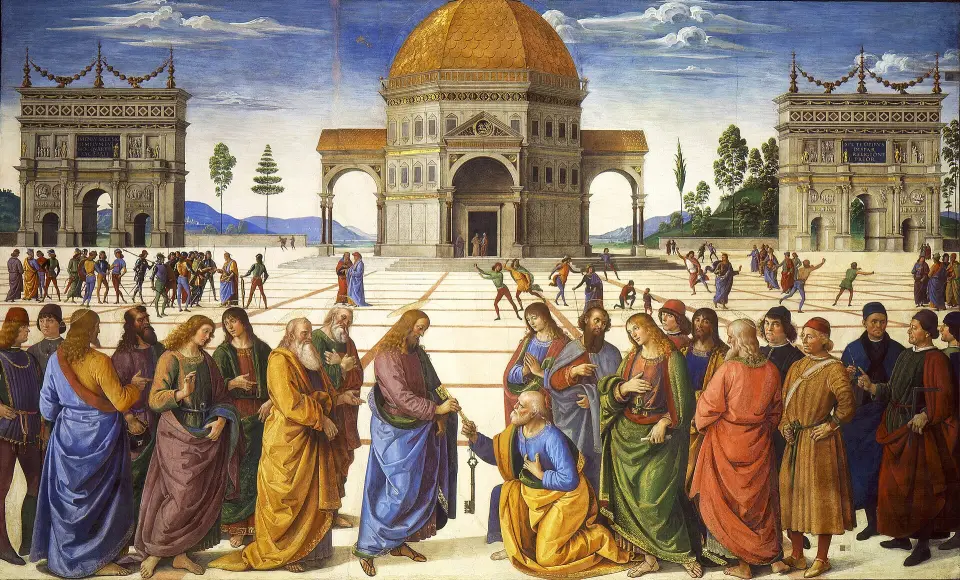
Pelikan argues that from the 9th to the 11th century the schism itself became the chief doctrinal problem, and in the "Photian schism" differences ranging from Trinitarian doctrine to the nature of the Church erupted into open conflict. Latin exegesis (Nicholas I) saw in the words "You are Peter" (Matt. 16:18) an affirmation of the primacy of the Roman see, while Greek theologians took the rock to be Peter's confession and ascribed the power of the keys to all faithful bishops; in Pelikan's formula, for the East the pope is first because he is orthodox, for the West he is orthodox because he is first. Photius declared the papal claims groundless in his treatise Against the Primacy. On 16 July 1054 the legate Humbert laid on the altar of Hagia Sophia the excommunication of Michael Cerularius, and Cerularius' council condemned the West.
Positions
- Nicholas I, Humbert
- Christ's words establish the primacy of the Roman see, "which presides over all the churches"; no heresiarch ever sat on the Roman see
- Greek theologians, Photius
- The keys are given to all who confess Christ; the papal claims are groundless – Peter was bishop of Antioch before Rome
- Byzantine polemicists
- If Rome claims primacy through Peter, Byzantium is first through Andrew "the first-called"
- Michael Cerularius
- "The pope is a heretic"; the West has departed from the true faith (Filioque, unleavened bread, etc.)
Key points
- Pelikan: Eastern defenders of orthodoxy in the Monothelite and icon controversies themselves appealed to Rome as the "apostolic first see"
- Photius cited the case of Pope Honorius, condemned by the council of 681, as proof that popes err in doctrine
- At the First Vatican Council the Honorius case was called the “strongest obstacle” to the dogma of infallibility
- The parties distinguished between schism and heresy and recognized adiaphora (Photius, Nicholas I), but the boundary with doctrine remained vague
- Both sides acknowledged one norm – Scripture, councils, fathers, unwritten tradition
- Both sides accused each other of innovation (“remove not the ancient landmark”, Prov 22:28)
Outcome
A fundamental doctrinal break in the understanding of the foundation of the Church was fixed (Pelikan); the mutual condemnation of 1054 deepened the rift, although, according to Pelikan, communion was formally broken later, and union remained the aspiration of popes and patriarchs from the 11th to the 15th century.
People
- Photius
- Nicholas I
- Michael Cerularius
- Humbert
- Liutprand of Cremona
- Maximus the Confessor
- Honorius I
Terms
- first-enthroned – prototronos
- An epithet of Peter.
- first-called – protokletos
- An epithet of Andrew.
- adiaphora – adiaforos
- Matters the fathers allowed to be regarded as neither right nor wrong.
Place
Rome, Constantinople
Sources disagree
González: the excommunication on 16 July 1054; Pelikan regards 1054 as the event that "focused the signs of estrangement" and traces the roots of the doctrinal causes to the 4th–6th centuries; González does not date Photius' treatise ("after 842" from the context).
Sources
- Jaroslav Pelikan – The Christian Tradition, vol. 2: The Spirit of Eastern Christendom (600–1700) (Russian edition), p. 266–268, 271–285, 293–300
- Justo L. González – A History of Christian Thought in One Volume (Abingdon, 2014), p. 233–234
Related entries
- Grew out of: The Filioque in the East: Photius, On the Mystagogy of the Holy Spirit, and the Break of 1054 (9th–11th centuries)
- Grew out of: East and West: azymes, epiclesis and liturgical differences (9th–15th centuries)
In church history
- The Photian Schism (858–880)
- The Great Schism of 1054 (1054)
Data compiled: 2026-11-17