858–880 · 9th century
The Photian Schism
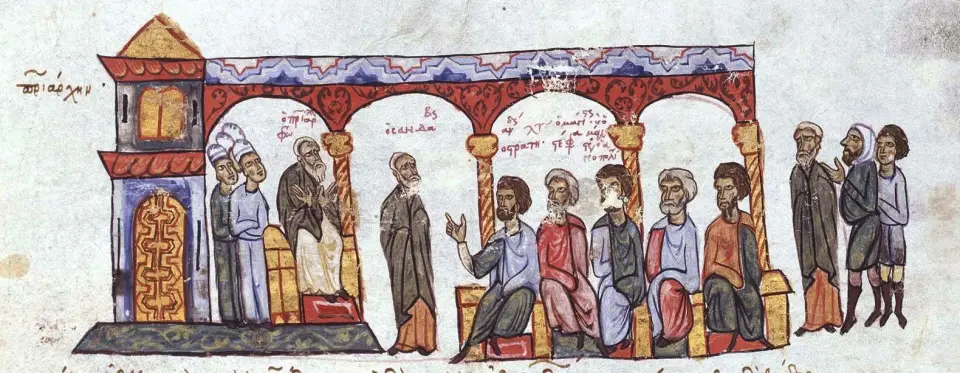
After the deposition of Patriarch Ignatios, the lay intellectual Photios was raised to the see of Constantinople in 858. Pope Nicholas I refused to recognize his election. He overturned his own legates' ruling and demanded Ignatios's restoration. In 867 Photios responded by excommunicating Nicholas I. He declared the whole West heretical for adding the Filioque to the creed.
The dispute concerned not only the legality of Ignatios's deposition but the very principle of primacy. In his treatise "Against the Primacy" Photios argued that Peter had been bishop of Antioch before Rome. True primacy, he held, belonged to Jerusalem. Nicholas I, for his part, upheld Rome's headship over all churches and councils.
After both men's deaths the rivalry continued. There was the council of 869–870, then Photios's return to the see and the council of 879–880. All this showed the growing rift between Rome and Constantinople. It foreshadowed the final break of 1054.
Later, c. 883, Photios set out the Western doctrine of the Spirit's procession from the Son at length in "On the Mystagogy of the Holy Spirit".
Key points
- The dispute over the legality of Photios's election and Ignatios's deposition
- The mutual excommunications of Nicholas I and Photios (867)
- The Filioque as the central doctrinal issue
- The councils of 869–870 and 879–880 foreshadowing the schism of 1054
People
- Photius
- Ignatius of Constantinople
- Nicholas I
- Michael III
- Basil I the Macedonian
Place
Constantinople; Rome
Sources
- J. North – A History of the Church (Russian edition), p. 142–143, 163–164
- Jaroslav Pelikan – The Christian Tradition, vol. 2: The Spirit of Eastern Christendom (600–1700) (Russian edition), p. 92, 267, 270–272, 285–301, 312–328
- Justo L. González – A History of Christian Thought in One Volume (Abingdon, 2014), p. 233
- Justo L. González – The Story of Christianity, vol. I (Russian edition), Ch. 21, sec. 21.4
More on the doctrine
- The Filioque in the East: Photius, On the Mystagogy of the Holy Spirit, and the Break of 1054 (9th–11th centuries)
- The East–West schism as a dispute over the nature of the Church and the primacy of Peter (9th–11th centuries (1054))
Data compiled: 2026-11-09